
A quiet truth about the EE in 2027
The most dangerous EE mistakes rarely feel dramatic.
They feel reasonable in the moment.
You tell yourself you’re being thorough by explaining everything you found. You think you’re being reflective by listing what happened each week. You assume formatting is a final-day problem, like printing a boarding pass.
Then the rubric arrives like weather: calm, indifferent, and exact. Under the newer guide, the line of argument is no longer a vague expectation; it’s a separately assessed strand. And Criterion D, worth 8 marks, is now the single most valuable criterion. That changes what “small” mistakes cost.
This post is a map of the 10 traps that most often derail a 2027 EE, and how to step around them without rewriting your life.
If you want a broader foundation first, start with Mastering IB Extended Essays: How to Research, Write, and Revise and the hub of All IB Extended Essay Posts.
The 60-second EE safety checklist (save this)
Before you draft another paragraph, run this EE checklist:
- Can you state your line of argument in 2 sentences?
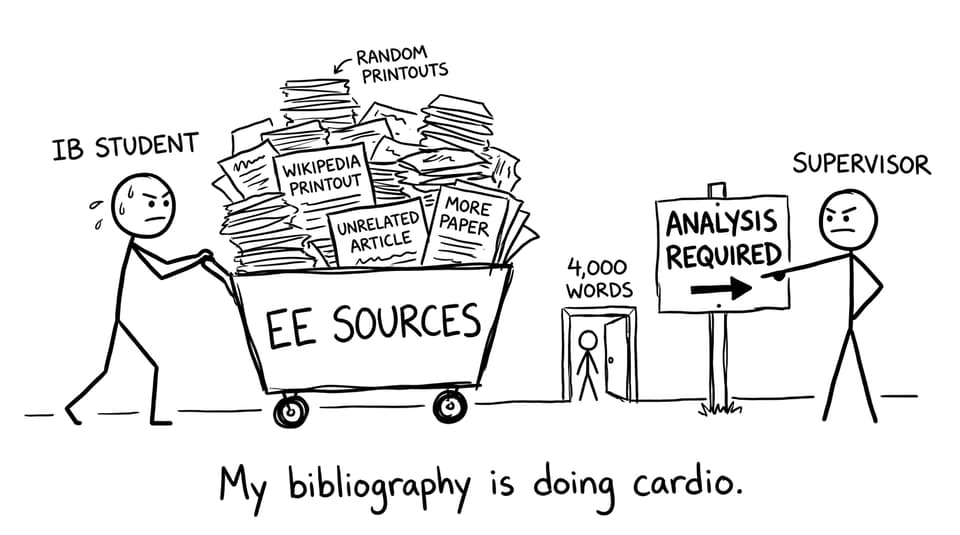
- Is your topic narrow enough to analyze deeply within 4,000 words?
- Are you writing analysis (your thinking) more than description (what happened/what exists)?
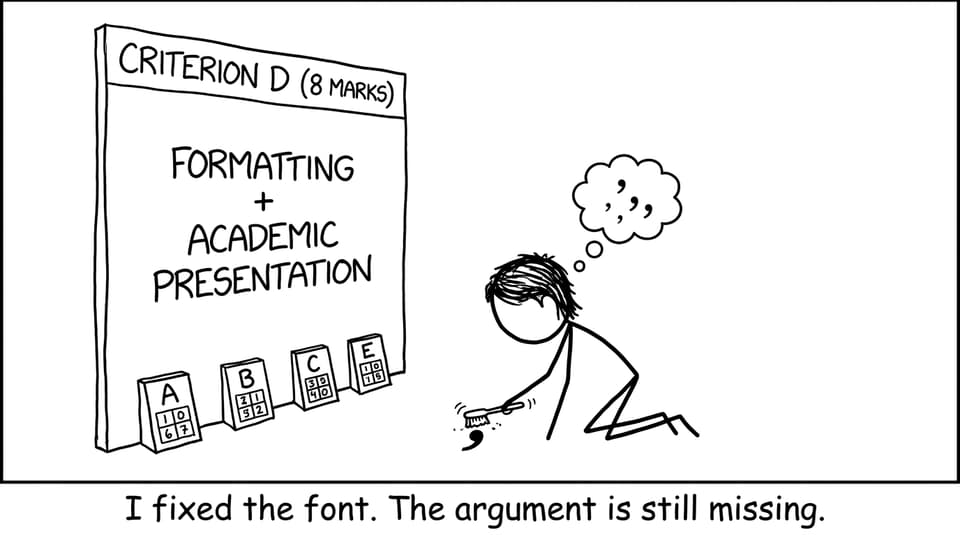
- Are you protecting Criterion D (8 marks) with consistent presentation and academic conventions?
- Are your reflections evaluative, within the word limit, and in the same language as the essay?
- Are you 100% sure you are not double-dipping with internal assessment material?
For criterion clarity, keep this open in another tab: What Are the Assessment Criteria for the IB Extended Essay? Full Breakdown + Scoring Guide.
Top 10 mistakes to avoid in the 2027 EE
Mistake 1: Writing descriptively instead of analytically
A descriptive EE tells the reader what happened. An analytical EE explains why it matters and what it means in relation to your research question.
A simple test:
- Description: “Inflation rose between 2021 and 2023.”
- Analysis: “Inflation rose between 2021 and 2023, which weakened real wages; this helps explain the observed shift in consumer spending in X dataset, supporting the argument that…”
How to avoid it:
- Write “This suggests…” at least once per paragraph, then finish the sentence with a claim linked to your line of argument.
- Use RevisionDojo AI Chat to challenge your paragraphs: ask, “Is this analysis or summary? What inference am I missing?”
- If you’re stuck at the topic stage, use How Do You Know If Your EE Topic Is Good Enough? (Student Checklist).
Mistake 2: Neglecting the line of argument (now assessed separately)
In 2027, treating the line of argument as an “introduction thing” is one of the costliest EE errors.
Your line of argument is the thread that connects:
- your research question,
- your method,
- your selection of evidence,
- your paragraph order,
- and your conclusion.
How to avoid it:
- Create a one-page “argument blueprint”: each body section must answer “How does this move the argument forward?”
- Write topic sentences that are mini-claims, not mini-headings.
- Use How to Craft the Perfect IB Extended Essay Research Question to tighten the question so the argument can actually be sustained.
Mistake 3: Choosing a topic that is too broad for 4,000 words
A broad topic creates a predictable EE failure mode: you spend 2,500 words “setting the scene,” then sprint through analysis with 700 words left.
How to avoid it:
- Force specificity: a defined time window, one case study, one data set, one text pair, one community, one intervention.
- Ask: “What can I reasonably analyze, not just describe, within my access to evidence?”
- Use 10 Powerful Steps to Choose an Extended Essay Topic That Guarantees Success to narrow early, before sunk-cost psychology sets in.
Mistake 4: Underestimating Criterion D (8 marks)
Under the new weighting, Criterion D is not a cosmetic bonus. It’s the largest single score bucket. And it’s also the one students postpone because it feels “administrative.”
Criterion D isn’t just formatting. It’s presentation as academic credibility: structure, citations, consistent conventions, and the feeling that your EE is a real mini-thesis.
How to avoid it:
- Lock one citation style early (and keep it consistent).
- Use headings intentionally: they should reveal the argument’s progression.
- Build a “presentation sweep” into your weekly routine, not your final night.
- Run a rubric check with RevisionDojo’s Grading tools (the IB Coursework Grader is built to give criterion-aligned feedback you can act on quickly).
Mistake 5: Writing reflections as a chronological diary (not evaluative)
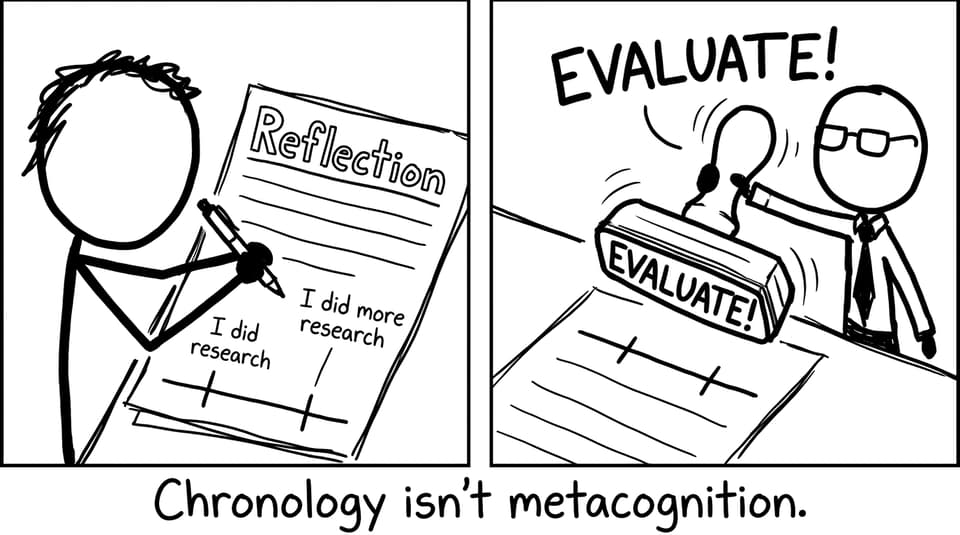
A strong EE reflection is not “what I did.” It’s “what I learned, what changed, and why that decision improved the research.”
Chronology is easy. Evaluation is scored.
How to avoid it:
- Use a 3-part reflection pattern:
- Decision: What did you change?
- Reason: What evidence pushed you there?
- Impact: How did it strengthen your line of argument or method?
- Keep the engagement strand visible: show intellectual movement.
- Read How Reflection Strengthens Your IB Extended Essay and compare your reflection tone to the examples.
Mistake 6: Exceeding the 500-word reflective statement limit
This is painfully simple: if you exceed the limit, examiners stop reading. That means your best insight might not exist to the person marking your EE.
How to avoid it:
- Treat 500 words as a hard wall, not a suggestion.
- Draft at 650-700 words, then cut to the strongest evaluative sentences.
- Use RevisionDojo’s reflection tools inside its Coursework Library mindset: keep evidence, keep decisions, cut filler.
Mistake 7: Submitting the RPF in a different language than the essay
This is an administrative mistake with an academic consequence: submitting the RPF in a different language than your EE can result in an automatic zero for the reflection criterion.
How to avoid it:
- Create a single submission checklist and share it with your supervisor.
- Verify language consistency two weeks before final submission.
- If you want a rubric-aligned reflection-only check, the RPPF Only Grader is a useful last pass.
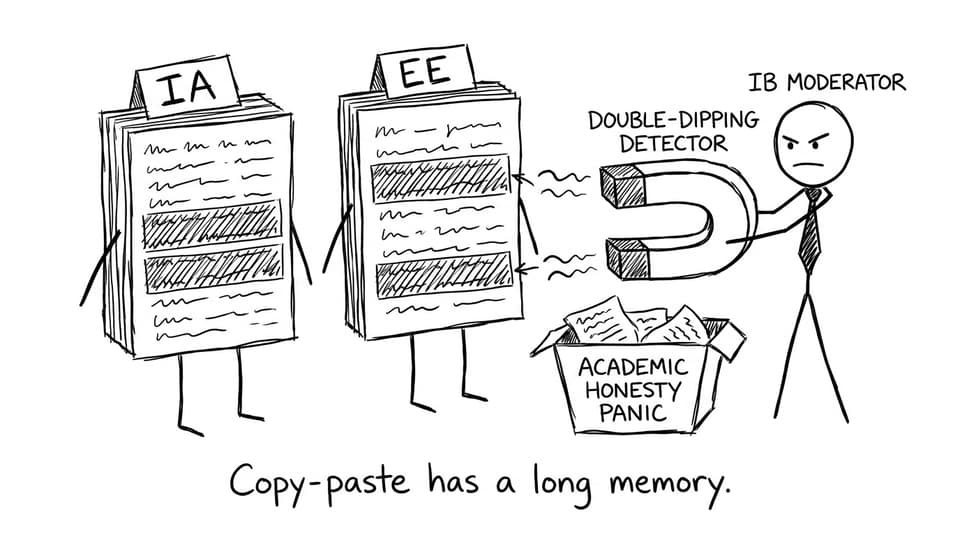
Mistake 8: Double-dipping with IA material
Using the same core content across your internal assessment and EE is one of those mistakes that feels efficient until it becomes risky.
The problem isn’t that you’re interested in the same topic. The problem is reuse of substantial work, data, or analysis in a way that violates academic honesty expectations.
How to avoid it:
- Separate the projects at the level of research question and evidence base, not just wording.
- Keep a simple “origin log” for datasets, paragraphs, and figures.
- If you need coursework strategy, RevisionDojo Tutors can sanity-check whether your idea is too close to your other work before you invest weeks.
Mistake 9: Treating method as a formality (instead of a choice with consequences)
A high-scoring EE makes methodology visible: why this approach, why these sources, what limitations follow.
When method is vague, your analysis becomes fragile. Examiners can’t reward critical thinking if the foundation is unclear.
How to avoid it:
- Write a short “method defense” paragraph: justify the approach and acknowledge what it cannot prove.
- Use RevisionDojo Study Notes to patch subject-specific method expectations quickly, then validate with the relevant subject EE guide at IB Extended Essay Guides.
Mistake 10: Choosing an invalid pathway or subject combination
Some EE failures are not about quality; they are about rules.
Under the new guide, attempting to use ESS in the Interdisciplinary Pathway can create serious compliance issues. Similarly, mismatched administrative choices can produce mark loss or worse.
How to avoid it:
- Confirm your subject and pathway rules early with your coordinator.
- Use the official requirements as your first filter, and curiosity as your second.
- If you’re unsure how the EE differs from other projects, read MYP Personal Project vs Extended Essay: Key Differences for a clean conceptual reset.
A RevisionDojo workflow to prevent these EE mistakes
Most students don’t need more willpower for the EE. They need fewer moving parts.
Here’s a calm workflow you can run inside RevisionDojo:
- Coursework Library: find exemplar-style structures so you stop guessing what “good” looks like.
- AI Chat: pressure-test your line of argument and identify where you’re summarizing.
- Grading tools: run criterion-based checks, especially for Criterion D and engagement/reflection.
- Study Notes: fill method and content gaps fast without spiraling into endless reading.
- Flashcards: turn your key theorists, definitions, and case evidence into daily recall.
- Tutors: one strategic session can save weeks if your topic is too broad or your argument is missing.
And because you’re also an exam student, not just an EE student: keep your baseline revision alive with Questionbank, Mock Exams, and Predicted Papers inside the same platform. RevisionDojo is strongest when everything lives in one loop instead of ten tabs.
Closing: make the EE smaller, sharper, and calmer
The 2027 EE rewards a specific kind of thinking: not more information, but clearer reasoning. Not more pages, but a stronger line of argument. Not last-minute polishing, but early respect for Criterion D (8 marks).
If you want the simplest next step, do this today: open your draft and write your line of argument in two sentences at the top of the document. If you can’t, that’s not failure; it’s the most useful diagnostic you can get.
Then use RevisionDojo to turn that diagnostic into momentum: build structure with the Coursework Library, stress-test ideas with AI Chat, tighten criteria alignment with the Grading tools, and keep your wider IB preparation steady with Study Notes, Flashcards, Questionbank, Mock Exams, and Predicted Papers. Your EE becomes less scary when it becomes a system.