
TOK can feel like a locked room mystery: you walk in with a prescribed title, a blank document, and the unsettling sense that the question is judging you back. The best students aren’t the ones with the fanciest vocabulary. They’re the ones who learn to read what the prompt is really asking, then build an argument that keeps returning to that exact ask, like a compass.
This guide breaks down TOK essay prompts (also called prescribed titles): what they are, what they’re designed to test, and how to use them to plan a clear, examiner-friendly essay.
What TOK essay prompts actually are
TOK essay prompts are the official prescribed titles released by the IB for a given session. You pick one title, then write an argument-driven essay that explores how knowledge is produced, justified, shared, or limited.
A useful way to see TOK prompts is this: they are not asking, “What do you know about the world?” They’re asking, “How does knowing work, and when does it fail?”
Most TOK prompts contain:
-
A command phrase (often “to what extent,” “how,” “in what ways,” “should,” “is it possible”) that signals evaluation
-
A core concept (evidence, interpretation, certainty, explanation, objectivity, values)
-
An implied need for comparison across contexts, usually through Areas of Knowledge (AOKs)
If you want a broader home base for the course, start with IB Theory of Knowledge Resources and then browse more targeted guidance through All TOK Posts.
Quick TOK checklist (before you write anything)
Use this quick TOK checklist every time you open a title:
-
Circle the key terms and define them in your own words
-
Identify what “to what extent” demands (a measured judgment, not a yes/no)
-
Turn the title into one clean knowledge question (KQ)
-
Choose two AOKs that create contrast (different methods, different standards, different risks)
-
Brainstorm one strong real-world example per AOK, plus a limitation or counterexample
-
Draft a thesis that answers the prompt with conditions (“often,” “in high-stakes contexts,” “when methods are transparent”)
For deeper planning frameworks, Structuring for Success in IB TOK Essays pairs well with this checklist.
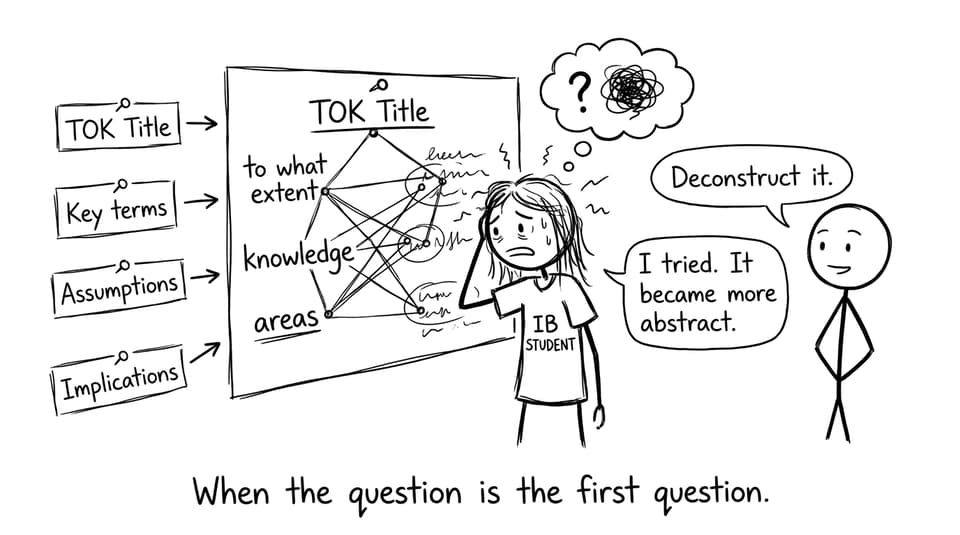
How to deconstruct TOK prompts without overthinking
The trap in TOK is to treat the title like a philosophical riddle you must solve. A better approach is to treat it like a well-designed test of thinking skills.
Spot the “invisible” demands
Even when a TOK title looks simple, it typically demands four moves:
-
Interpretation: what does the title mean in practice?
-
Scope: where does the claim hold, and where does it break?
-
Comparison: how do different AOKs handle the issue?
-
Evaluation: which view is stronger under which conditions?
A fast method is to rewrite the prompt in a more explicit form:
-
Original: “To what extent do you agree that there is a distinction between facts and interpretations in the production of knowledge?”
-
Expanded: “When we claim knowledge, how separable are ‘facts’ from the interpretive choices that produce and communicate them, and does that separation differ by AOK?”
That expanded version basically hands you your paragraph plan.
Convert the title into a knowledge question (KQ)
In TOK, the KQ is your steering wheel. If you keep your KQ visible while drafting, you stop drifting into random examples.
A strong TOK KQ is:
-
Open-ended and debatable
-
About knowledge (not just the topic)
-
Transferable across AOKs
If you need models, use Breaking Down TOK Essay Titles: What Are Knowledge Questions? and Using Knowledge Questions in Your TOK May 2026 Essay.
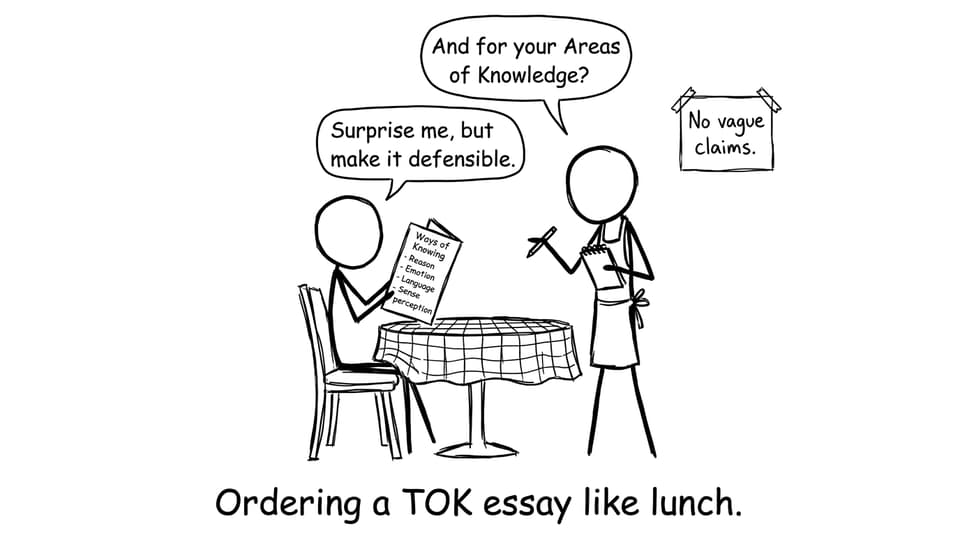
Choosing AOKs and examples that actually help
AOK selection isn’t about showing range. It’s about creating a meaningful comparison.
Pick AOKs that disagree in their “default settings.” For example:
-
Natural sciences often prioritise replicability and measurement
-
History often deals with incomplete records, perspective, and narrative framing
-
The arts often treats interpretation as part of the knowledge itself
Then choose examples that do real work. A good TOK example:
-
Has clear context (who, where, when)
-
Links to a method (experiment, source selection, peer review, translation, curation)
-
Makes a claim testable (“This method reduces bias because…”) and challengeable (“But it also introduces…”)
For a practical method to connect ideas to contexts, read Connecting TOK Essay Ideas to Areas of Knowledge.
A simple structure that keeps TOK focused
TOK rewards clarity. The examiner should never wonder, “Why is this paragraph here?”
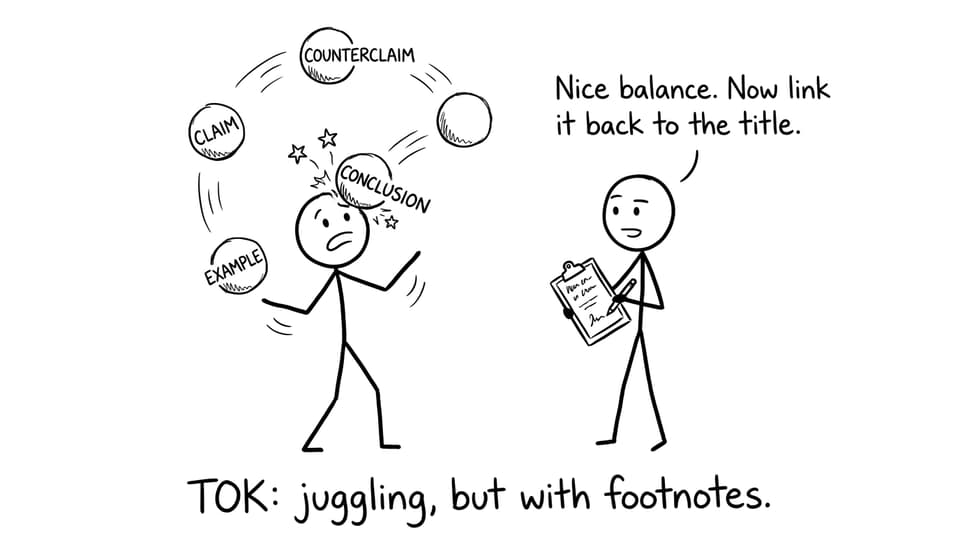
A reliable TOK structure looks like:
-
Introduction: interpret the prompt, define key terms, state your thesis (with nuance), preview AOKs
-
Body AOK 1: claim -> example -> analysis -> counterclaim -> evaluation back to the prompt
-
Body AOK 2: claim -> example -> analysis -> counterclaim -> evaluation back to the prompt
-
Conclusion: answer “to what extent” with conditions; highlight implications
If you want a blueprint with paragraph-level guidance, use Comprehensive Guide to IB TOK Essay Structure and the broader writing workflow in How to Write a Good TOK Essay: A 10-Step Guide.
How RevisionDojo helps you turn a TOK prompt into a finished essay
Most TOK stress comes from not knowing what to do next. RevisionDojo is built to remove that friction.
-
Use Study Notes to refresh AOK methods and typical limitations, then turn those into quick Flashcards for daily recall.
-
Use Jojo AI Chat to pressure-test your KQ and ask, “What assumption am I making here?” without losing an hour.
-
If you already have a draft, upload it to the IB Coursework Grader for rubric-aligned feedback you can act on immediately.
-
When you’re stuck on what good looks like, browse the IB Theory of Knowledge (TOK) Examples in the Coursework Library.
And even if your priority is exam prep overall, the same system holds: Questionbank practice for precision, Mock Exams for pressure, Predicted Papers for direction, Grading tools for feedback loops, and Tutors when you want a human to challenge your thinking.
For extra writing tips, keep Tips for Writing a Clear and Coherent TOK Essay open while drafting.
Closing: use the TOK prompt as your compass
A TOK prescribed title isn’t a hurdle to jump; it’s the map of what the examiner wants to see. When you deconstruct the TOK language, extract a knowledge question, and pick AOKs that genuinely contrast, your essay stops feeling abstract and starts feeling intentional.
If you want that process to feel calmer, build it inside RevisionDojo: plan with guided resources, refine with AI Chat, strengthen memory with Flashcards, and polish drafts with the Coursework Grader and Coursework Library. Your next TOK prompt doesn’t need a miracle; it needs a method.