RevisionDojo logoRevisionDojo logo
FeaturesSubjectsPricingSchools
Back to all posts
  1. Home
  2. /Blog
  3. /TOK Essay Paragraphs: How Many Do You Need?

TOK Essay Paragraphs: How Many Do You Need?

TOKIB
RevisionDojo Team
•Last updated: 19 Jul 2026•7 min read
ShareShare on XShare on WhatsAppShare on LinkedInShare on Facebook
Add as a preferred source on Google
TOK Essay Paragraphs: How Many Do You Need?

Join 650k+ students breezing through the IBReady to breeze through the IB?

Footer

General

  • Download apps
  • For parents
  • For schools
  • Pricing
  • Gift RevisionDojo
  • Tutoring
  • IB syllabus
  • MYP syllabus
  • Blog
  • Student Questions

Features

  • Question Bank
  • Test Builder & Exam Mode
  • Predicted Papers
  • Past Papers
  • Study Notes
  • Interactive Lessons
  • Flashcards
  • Jojo AI Tutor
  • Coursework Studio
  • View all features

Research

  • All research
  • Jojo AI vs leading AI study tools
  • 2026 State of Learning Survey
  • 2025 State of Learning Survey
  • IB Moderation Analysis
  • Jojo AI vs ChatGPT
  • Jojo AI vs Gemini
  • Jojo AI vs Perplexity
  • Jojo AI vs Claude
  • Jojo AI vs Poe

Platform

  • About RevisionDojo
  • RevisionDojo vs Others
  • Content philosophy
  • Trustpilot
  • Join usWe're hiring
  • Student Ambassador
  • Help center
  • Contact us
  • Terms of Service
  • Data & privacy
  • Privacy policy
  • Cookie policy
  • Trust Center

IB Subjects

  • Arabic A
  • Arabic A Lit
  • Arabic ab initio
  • Arabic B
  • Biology
  • Business Management
  • Chemistry
  • Chinese A Lang & Lit
  • Chinese B
  • Computer Science (CS)
  • Computer Science (First Exam 2027)
  • Design Technology (DT)
  • Design Technology (First Exam 2027)
  • Digital Society (DS)
  • Economics
  • English A Lang & Lit
  • English A Lit
  • English B
  • Environmental systems and societies (ESS)
  • French A
  • French A Lit
  • French ab initio
  • French B
  • Geography
  • German A
  • German A Lit
  • German ab initio
  • German B
  • Global Politics
  • History
  • History (First Exam 2028)
  • Mathematics Analysis and Approaches (AA)
  • Mathematics Applications & Interpretation (AI)
  • Philosophy
  • Physics
  • Psychology
  • Psychology (First Exam 2027)
  • Spanish A
  • Spanish A Lit
  • Spanish ab initio
  • Spanish B
  • Sports, exercise and health science (SEHS)
  • Theory of Knowledge (TOK)
  • World Religions

MYP Subjects

  • MYP Biology
  • MYP Chemistry
  • MYP Design
  • MYP English Lang & Lit
  • MYP Extended Mathematics
  • MYP History
  • MYP Individuals & Societies
  • MYP Integrated Sciences
  • MYP Physics
  • MYP Standard Mathematics
  • MYP Biology
  • MYP Chemistry
  • MYP Design
  • MYP English Lang & Lit
  • MYP Extended Mathematics
  • MYP History
  • MYP Individuals & Societies
  • MYP Integrated Sciences
  • MYP Physics
  • MYP Standard Mathematics
RevisionDojo logo

© 2022 - 2026 RevisionDojo (MyDojo Inc)

RevisionDojo was developed independently of the IBO and as such is not endorsed by it in any way.

Download on the App StoreGet it on Google Play
GDPR compliant

A blank page can feel like a dare. You open your TOK document, stare at the prescribed title, and your brain asks the most practical question it can find: How many paragraphs should a TOK essay have?

It’s a fair question. Paragraphs are the visible shape of your thinking. But in TOK, examiners don’t reward you for stacking paragraphs like pancakes. They reward you for coherent analysis, claims that earn their space, counterclaims that complicate the story, and examples that prove you’ve actually looked at the world.
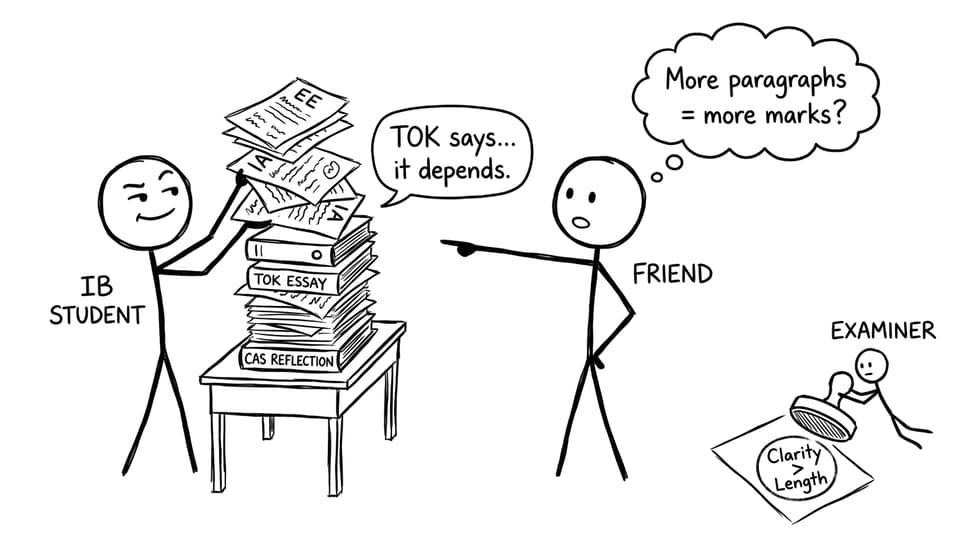
TOK paragraphs comic: clarity vs length

The TOK answer: 6-8 paragraphs is the sweet spot

Most strong TOK essays land naturally at 6-8 paragraphs within the 1,600-word maximum. That usually looks like:

  • 1 paragraph introduction (about 150-200 words)

  • 4-6 paragraphs in the body (the “thinking” part)

  • 1 paragraph conclusion (about 150-200 words)

This matches the structure guidance you’ll see in RevisionDojo’s resources on TOK writing, including the Comprehensive Guide to IB TOK Essay Structure and Structuring for Success in IB TOK Essays.

A quick TOK paragraph checklist (use this before you write)

Before you decide on paragraph count, check whether your plan has enough “moves” to justify them.

Your TOK essay plan should include

  • A clear thesis that answers the prescribed title

  • 2 AOKs (usually) with purposeful contrast

  • 2-3 claims and 2-3 counterclaims (total, not per paragraph)

  • Real-life examples that are specific and debatable

  • Explicit links back to the knowledge question throughout

  • A conclusion that reflects, not repeats

If your outline feels thin, adding paragraphs won’t help. If your outline is rich, the paragraphs will appear naturally.

What each TOK paragraph should do (not just “be there”)

In TOK, paragraphs are like stepping stones: each one should move the argument forward. If a paragraph doesn’t change the reader’s understanding, it probably shouldn’t exist.

Introduction paragraph (1)

A strong TOK introduction does four things quickly:

  • Hooks the reader with a real tension (not a random quote)

  • Defines key terms from the title (briefly)

  • States your thesis stance

  • Previews your approach (AOKs and direction)

If you want a model of how an introduction sets up a whole argument, see RevisionDojo’s teaching draft notes: IB TOK 5.1.2 Model Essay Notes.

Body paragraphs (4-6)

Most high-scoring TOK essays use body paragraphs to create a rhythm: claim, example, evaluation, counterclaim, implication.
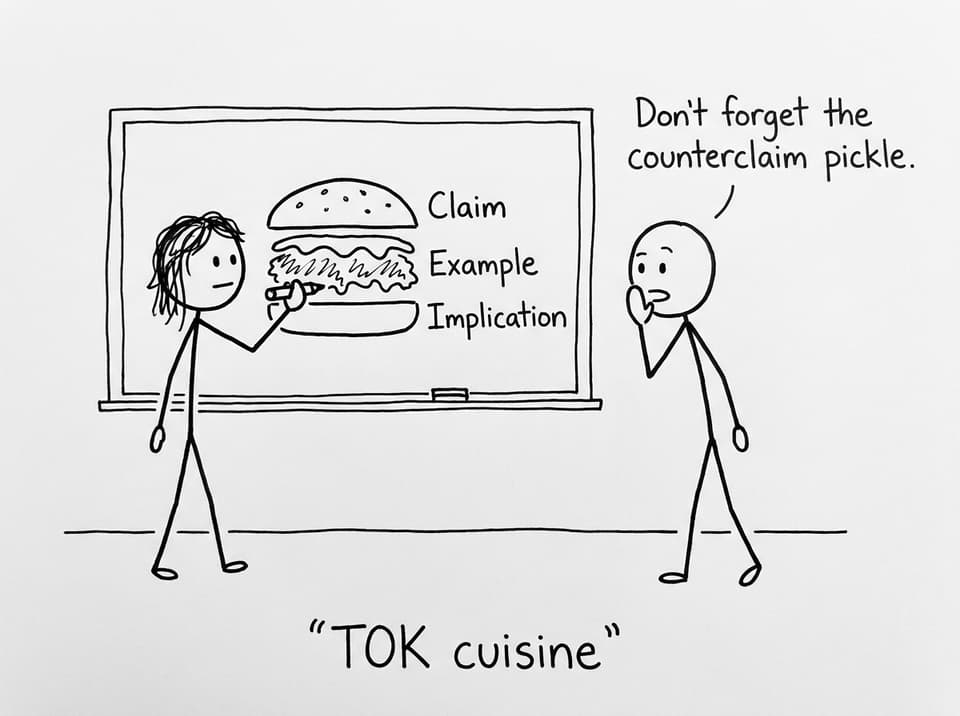
TOK paragraph sandwich comic

A practical pattern that works:

  • Paragraph 1 (AOK 1 claim): Make a clear claim, give a real-life example, and explain what it shows about knowledge.

  • Paragraph 2 (AOK 1 counterclaim): Complicate the claim, offer a contrasting example, and evaluate the trade-off.

  • Paragraph 3 (AOK 2 claim): Repeat the structure in a different AOK to show transfer.

  • Paragraph 4 (AOK 2 counterclaim): Challenge it again and reflect on what changes across AOKs.

  • Paragraph 5 (optional): A synthesis paragraph (implications, perspectives, or conditions where the claim holds).

  • Paragraph 6 (optional): A “precision” paragraph to fix a weak link: definitions, assumptions, or a missing limitation.

If you struggle with flow, don’t guess, borrow a coherence framework from Building Coherent Arguments in TOK. It explains what examiners mean when they want a line of reasoning, not just points.

Conclusion paragraph (1)

A TOK conclusion should feel like the quiet moment after a debate: you don’t re-list points; you state what the tension taught you.

Include:

  • Your final answer to the prescribed title (in sharper language)

  • What your comparison between AOKs reveals

  • A small reflection on implications or limitations

Common TOK paragraph mistakes (and what to do instead)

Mistake: writing “mini essays” inside each paragraph

If every paragraph restates the whole title and redefines everything, coherence collapses. Keep one paragraph to one main move.

Mistake: paragraphing by vibes

A new paragraph should appear because you changed task: claim to counterclaim, example to evaluation, AOK 1 to AOK 2.

Mistake: adding paragraphs to sound “more academic”

In TOK, more paragraphs can mean more unfinished thoughts. Use structure to make thinking visible, not longer.
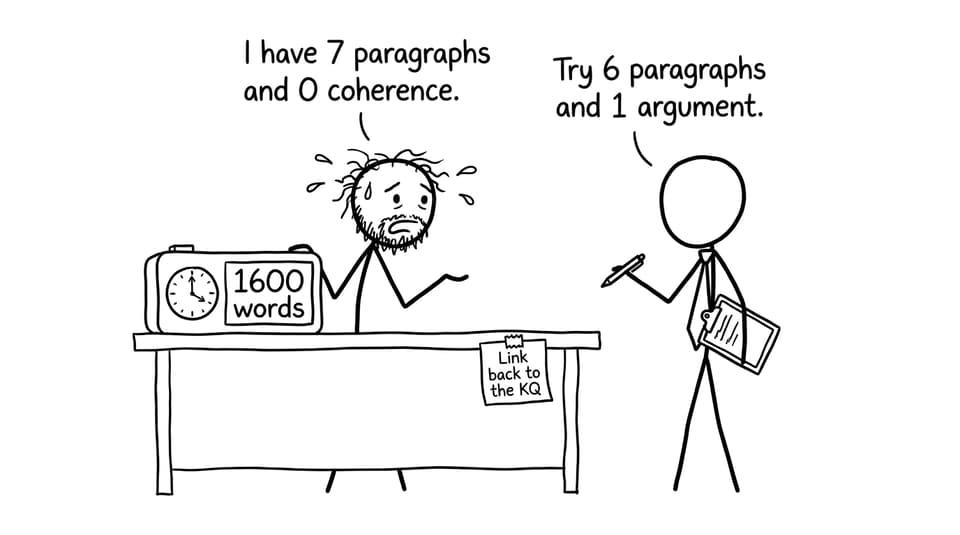
TOK coherence comic: fewer paragraphs, more argument

How RevisionDojo helps you plan TOK paragraphs that actually score

When you’re building a TOK essay, you don’t just need advice, you need tools that reduce decision fatigue.

RevisionDojo supports your TOK planning with:

  • Study Notes that clarify AOK/WOK language

  • Flashcards for key TOK concepts and command terms

  • AI Chat to test whether your claim/counterclaim is actually a tension

  • Grading tools to pressure-test clarity and focus

  • Predicted Papers and Mock Exams to simulate timed conditions

  • A Coursework Library to see examples of strong academic voice

  • Tutors to help you tighten structure when your argument feels “almost there”

For broader guidance across both components, see Mastering the TOK Essay and Exhibition: Requirements, Structure, and Success Tips and How to Tackle the IB TOK Essay and Presentation.

Final takeaway: structure your TOK thinking, then count the paragraphs

If you remember one thing, let it be this: TOK paragraphs are a consequence of clear thinking, not a substitute for it. Aim for 6-8 paragraphs because it fits the 1,600-word maximum and gives you space to develop claims and counterclaims without rushing.

When you’re ready to turn an outline into an essay that flows, use RevisionDojo to practice structure with Study Notes, check your reasoning with AI Chat, and sharpen your final draft with Grading tools. Your TOK essay doesn’t need more paragraphs. It needs more clarity, and clarity is a skill you can train.

How helpful was this article?
Add as a preferred source on Google

Continue studying with RevisionDojo

  • IB Coursework GraderCheck an IA, EE, or TOK draft against IB assessment criteria.
  • IB Coursework ExamplesLearn from high-scoring coursework across IB subjects.
  • IB Grade CalculatorEstimate an IB grade using session-specific boundaries.
  • IB Grade BoundariesExplore historical grade boundaries by subject and session.

Frequently Asked Questions

Related Articles

IB en España · Oct 22, 2026 · 10 min read

¿Es difícil Catalán A del IB? Guía para elegir

Descubre la dificultad de Catalán A del IB, su carga de trabajo, las diferencias entre NM y NS y cómo saber si es una buena elección para ti.

IB en España · Oct 22, 2026 · 10 min read

Errores del examen de Inglés A del IB y cómo evitarlos

Identifica los errores más frecuentes en Inglés A del IB y aprende a evitarlos en la Prueba 1, Prueba 2, oral individual y ensayo de Nivel Superior.

IB en España · Oct 22, 2026 · 10

Lengua ab initio del IB e inteligencia artificial

Aprende a usar IA en Lengua ab initio del IB para practicar, recibir orientación y mejorar sin vulnerar la integridad académica del programa.

IB World Religions · Oct 22, 2026 · 17

IB World Religions Paper 1: Complete Guide

IB World Religions Paper 1 explained: master the 3 + 7 mark format, stimulus analysis, timing, revision, and exam technique with a worked example for SL.

IB World Religions · Oct 22, 2026 · 10

Gender Equality in Sikhism: Teaching and Practice

Gender equality Sikhism analysis through scripture, key concepts, lived practice, and IB World Religions themes for balanced, confident exam preparation.

IB World Religions · Oct 22, 2026 · 11

Kashrut: Jewish Dietary Laws, Meaning and Identity

Kashrut explained for IB World Religions SL: explore Jewish dietary law, sacred texts, diverse interpretations, identity, ethics, and exam links.

min read
min read
min read
min read