
TOK is the only IB subject that can feel like it’s grading your personality.
You walk in expecting content. Instead, you get questions. Big ones. Slippery ones. The kind that seem to change shape the moment you start writing.
But TOK isn’t trying to confuse you. It’s trying to train you. And once you understand what the TOK subject needs from you, the whole thing becomes strangely fair.
This guide is built for IB students preparing for exams who want clarity, not more fog. You’ll get a simple checklist, practical strategies for the exhibition and essay, and a way to use IB Resources without drowning in them.
What TOK actually needs from you (in one sentence)
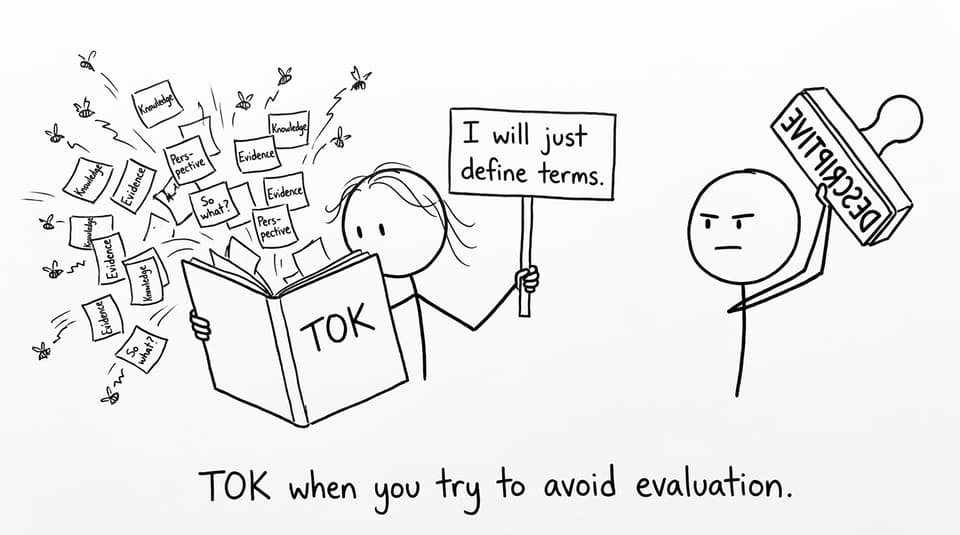
TOK needs you to make a defensible knowledge claim, test it against a different perspective, and evaluate what changes across contexts.
That’s it. Not fancy vocabulary. Not name-dropping philosophers. Not sounding “deep.”
If you want a reliable anchor while you work, keep the core expectations and assessment basics close. RevisionDojo’s IB Theory of Knowledge Resources page is a strong starting point for the structure, weighting, and what the course is aiming to build.
Quick TOK checklist (use this before you submit anything)
Use this as your “pre-flight” list for both the exhibition and the essay:
-
Knowledge question is explicit: You’re not just describing an issue, you’re investigating how knowledge works.
-
Claim + counterclaim are both strong: Not strawmen, not random opposites.
-
Real-world examples are specific: Precise enough that someone could verify them.
-
AOKs are used as lenses, not labels: Methods and standards matter.
-
TOK concepts appear naturally: They clarify your argument rather than decorate it.
-
Evaluation is constant: Strengths, limits, trade-offs, and implications.
-
Conclusion answers with nuance: You don’t “solve” knowledge, you weigh it.
This is where good IB Resources help most: not by giving you more ideas, but by forcing your draft to become clearer.
The hidden skill TOK rewards: making thinking visible
In most IB subjects, you can hide behind correct answers.
In TOK, the “correctness” is the quality of your reasoning. Examiners reward writing that shows:
-
what you’re claiming,
-
why it might be convincing,
-
when it stops being convincing,
-
and what that tells us about knowledge.
If you want a clean map of the skills that consistently score well, read TOK Thinking and Skills: How to Succeed in IB TOK. It frames TOK as a set of moves you practice, not a mood you try to summon.
TOK core content you should actually use (without forcing it)
You’ll hear a lot about TOK “content,” but it’s better to think of it as a toolkit.
Areas of Knowledge: choose fewer, use them deeper
The five main AOKs (History, Human Sciences, Natural Sciences, Arts, Mathematics) are not a checklist to name-drop.
They are different cultures of justification.
When you use an AOK well, you compare things like:
-
What counts as evidence here?
-
How is reliability tested?
-
Who has authority?
-
What are the stakes if we get it wrong?
A practical method: pick two AOKs where the same claim behaves differently. For help building those connections cleanly, see Connecting TOK Essay Ideas to Areas of Knowledge.
TOK concepts: embed them like a lens, not a label
A concept like power, certainty, responsibility, or interpretation should change the angle of your paragraph.
Instead of writing “Power affects knowledge,” write something closer to:
When institutions control what gets published, taught, or funded, they don’t just spread knowledge; they shape what gets counted as knowledge.
The difference is subtle but decisive: one is a definition; the other is analysis.
How TOK is assessed: what examiners look for
TOK assessments reward the same thinking in different formats.
-
The TOK exhibition rewards your ability to connect a prompt to real objects and extract knowledge implications.
-
The TOK essay rewards sustained argument: claims, counterclaims, and evaluation across AOKs.
If you want a tight overview of what each requires, start with Mastering the TOK Essay and Exhibition. Then keep your drafting focused on the rubric behaviors, not on sounding impressive.
How to ace the TOK essay (without writing a philosophy diary)
The TOK essay is where many students overcomplicate things.
They try to cover everything. They add more examples. They chase “depth” by making sentences longer.
A higher-scoring approach is calmer: pick fewer moves and do them properly.
Interpret the prescribed title like an examiner
Before you plan, rewrite the title in your own words and underline:
-
the command term (for example: “to what extent”),
-
the knowledge focus (certainty, evidence, explanation, etc.),
-
and the scope (AOKs, methods, sharing knowledge, and so on).
Then decide what your essay will not do. That boundary is your focus.
For structure support that doesn’t turn into a template, use Structuring for Success in IB TOK Essays and, if you want an even clearer blueprint, Comprehensive Guide to IB TOK Essay Structure.
Build paragraphs around evaluation, not explanation
A reliable body paragraph rhythm looks like:
-
Claim (tied to the title)
-
Real-life example (specific)
-
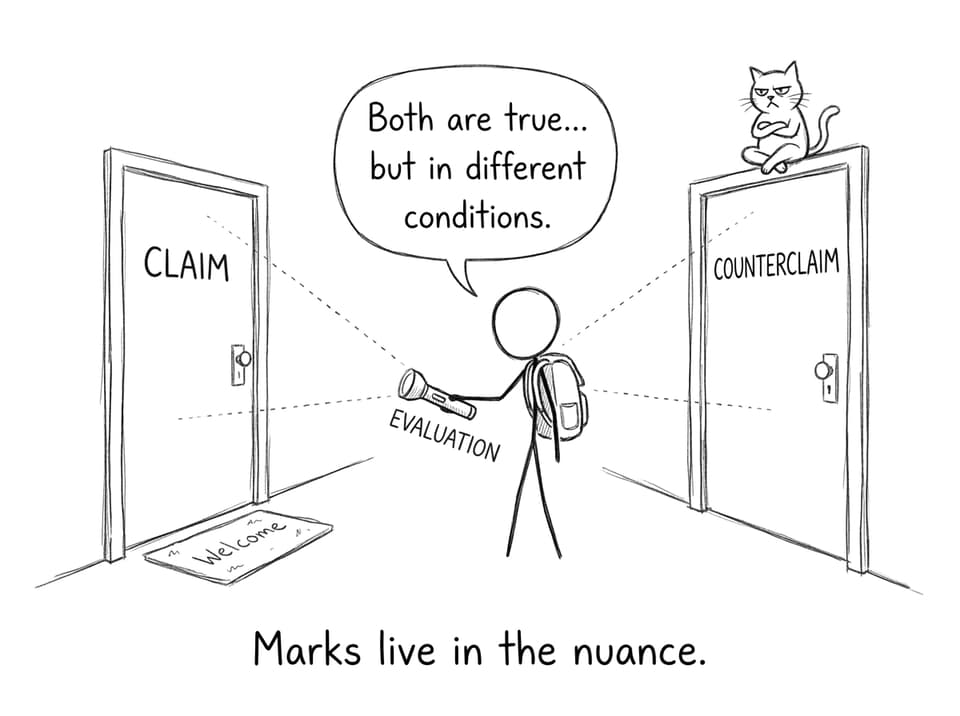
Evaluation (why it works, where it fails)
-
Counterclaim (a genuine limitation)
-
Evaluation again (what conditions change the outcome)
That last step is where marks are.
Upgrade your examples: “Google-able” beats “general”
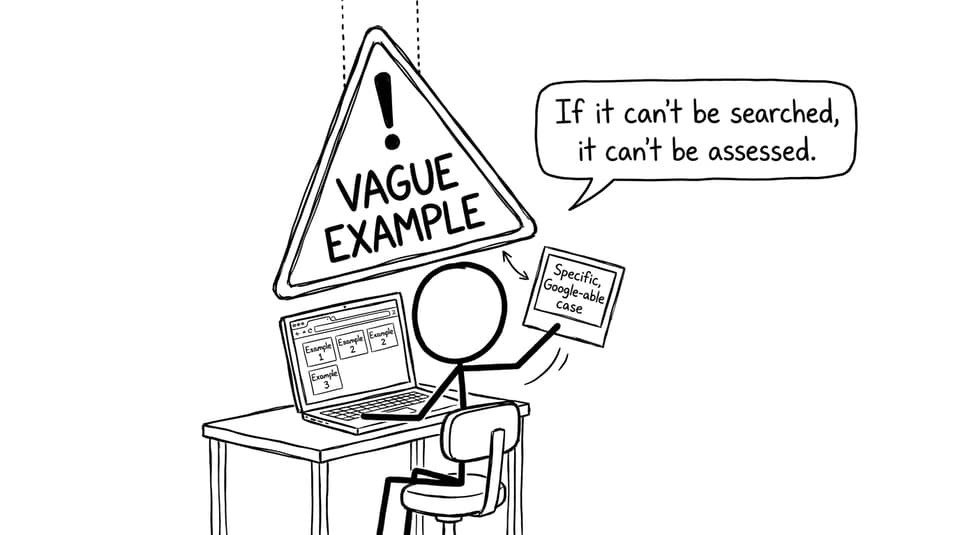
TOK examples fail when they are fuzzy.
“Social media spreads misinformation” is true, but it’s also broad enough to become a speech.
Better: a specific case, a specific mechanism, a specific consequence.
Your goal is not to prove you read a lot. It’s to give your reasoning something solid to push against.
Use AI the right way: momentum, not outsourcing
In exam season, time is your most expensive currency. The temptation is to let tools do the thinking.
Don’t. But do use good IB Resources to keep your drafting cycles fast and honest.
On RevisionDojo, this is where the platform can quietly change your outcomes:
-
AI Chat helps you clarify a claim, find counterclaims, and test whether an example actually links to the title.
-
Grading tools (Coursework Grader) give rubric-aligned feedback so you can iterate quickly.
-
The Coursework Library shows what strong work looks like so you stop guessing.
If you want the big picture of how those tools work together, see The Ultimate IB Study & Grading Tool for TOK, EE, and IA Success.
How to ace the TOK exhibition (by thinking like a curator)
The exhibition is shorter, but it’s not easier. It punishes vagueness quickly.
Your job is to make three objects feel like three angles on the same knowledge tension.
Choose objects that do intellectual work
Strong objects are not “pretty.” They are useful.
They create a problem you can analyze:
-
a conflict between evidence and belief,
-
a mismatch between authority and reliability,
-
a case where interpretation changes meaning,
-
a moment where knowledge is controlled, withheld, or weaponized.
For a practical, start-to-finish workflow, follow How to Excel in Your IB TOK Exhibition, and for broader context read IB TOK Exhibition: Your Complete Guide to Success.
Write commentary that proves relevance, not effort
A high-scoring commentary is tight:
-
What is the object (context in 1-2 sentences)?
-
How does it link to the prompt (explicitly stated)?
-
What does it reveal about knowledge (analysis + implication)?
If you want a sharper feel for what “engaging” means in examiner terms, use How to Create an Engaging TOK Exhibition Commentary.
Link exhibition thinking to essay thinking
If your exhibition is coherent, it can feed your essay.
Not by repeating content, but by reusing the same knowledge tension: what counts as evidence, who gets authority, what responsibility the knower has.
For a clean way to do that without forcing it, see Linking the May 2026 TOK Essay to the Exhibition.
Closing: TOK rewards calm, evidence-based thinking
The students who ace TOK aren’t always the loudest thinkers. They’re the clearest.
They treat TOK like a skill: claim, counterclaim, evaluation. They choose examples that can hold weight. They let AOKs change the argument instead of decorating it.
If you want that process to feel simpler, build it on the right IB Resources. RevisionDojo brings everything into one place: syllabus-aligned guidance, a Coursework Library for strong exemplars, Grading tools for rubric feedback, AI Chat for momentum, plus Study Notes, Flashcards, a Questionbank, Predicted Papers, Mock Exams, and Tutors when you need a human reset.
Start with one action today: take your TOK draft and run the checklist from this article. Then use RevisionDojo to tighten one claim and one counterclaim until the evaluation becomes unavoidable. That’s how TOK stops feeling mysterious, and starts feeling winnable.