


TOK can feel like the only IB subject that grades you for thinking out loud.
One day you’re calmly highlighting a prescribed title. The next, you’re debating whether “facts” even exist, staring at a 1,600-word limit like it’s a personal insult.
If you’re writing the IB TOK essay prescribed titles: November 2026 set, you don’t need more motivation. You need clarity: what each title is really asking, where students lose marks, and how to turn a prompt into a focused argument.
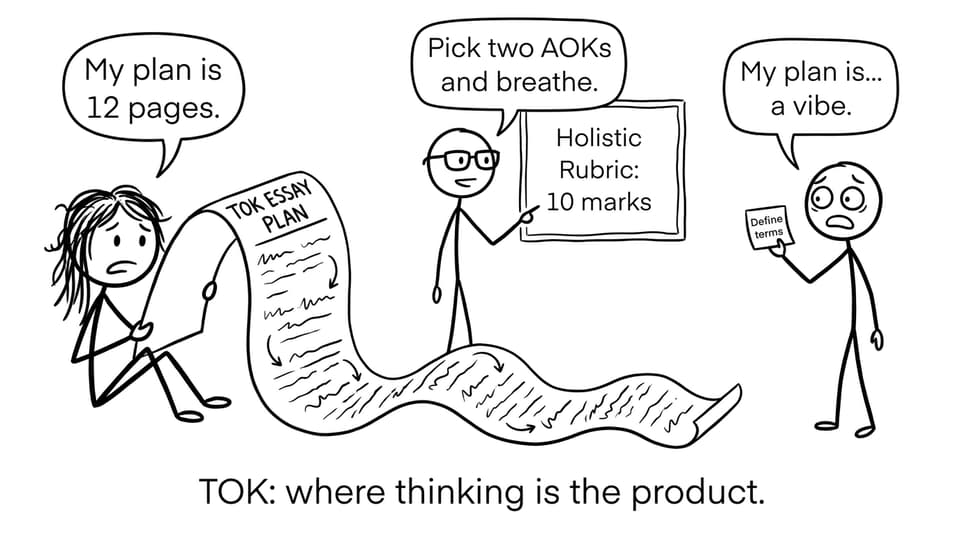
TOK November 2026 essentials (save this checklist)
Before you choose a title, anchor the non-negotiables:
-
Pick 1 of 6 prescribed titles for November 2026.
-
Write up to 1,600 words.
-
Use two Areas of Knowledge (AOKs) (some titles prescribe one or both AOKs).
-
Address the compulsory core theme: Knowledge and the Knower.
-
Aim for depth over breadth: examiners reward sustained analysis.
For the full planning flow, rubric language, and what “holistic marking” really means, keep this open: TOK Essay General Guide (Nov 2026).
What changed in TOK (2022+ syllabus) and why it matters
In the 2022 TOK guide, “Ways of Knowing” stopped being the main organizer. Instead, essays lean on the Knowledge Framework lenses: scope, perspectives, methods and tools, and ethics.
Practically, this means a strong TOK essay doesn’t just say “bias exists” or “emotion matters.” It shows how a knowledge community builds confidence: what counts as evidence, which tools are trusted, and what ethical boundaries shape inquiry.
If you want a syllabus-aligned hub you can return to while drafting, use: IB TOK Essay topic page.
IB TOK Essay Prescribed Titles: November 2026 (quick breakdowns)
Below are the six prompts, with the simplest interpretation that still keeps you on the high-mark path.
Title 1 (History required): “Study the historian”
Prompt: “Study the historian before you study the facts.” To what extent do you agree with this claim? Discuss with reference to history and one other AOK.
What this TOK title is really about: the knowledge producer as part of the knowledge. Who selects facts? Who frames them? And what makes that framing legitimate rather than “just bias”?
Common mistake: treating it like a generic rant about subjectivity. Strong essays go further: historians don’t only distort facts; they also make facts intelligible through concepts, categories, and narratives.
Use RevisionDojo’s targeted support here: Title 1 Breakdown & Cheat Sheet.
Title 2: Failure and knowledge production
Prompt: “To what extent do you agree that failure is an essential part of the production of knowledge?” Discuss with reference to two AOKs.
The hidden challenge is defining “failure” in ways that fit each AOK. In the natural sciences, failure might mean a falsified hypothesis or irreproducible results. In the arts, it might mean rejection, misunderstanding, or an artwork that fails to communicate.
Common mistake: saying “failure is good” without evaluating costs. A higher-level TOK essay asks when failure becomes noise (wasted resources, harmed participants) rather than signal (method refinement).
For a fuller structure approach, pair this with: How to Write a Good TOK Essay (10-step guide).
Title 3 (Human sciences required): Why ideas beat facts
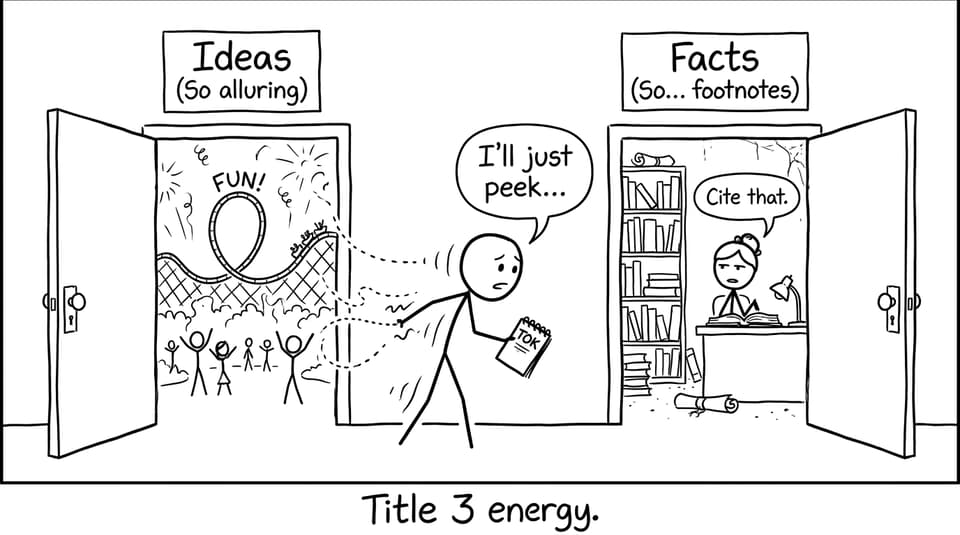
Prompt: “In the production of knowledge, why is it that ideas are so often more alluring than facts?” Discuss with reference to the human sciences and one other AOK.
This one looks like it’s criticizing humans for being irrational. But in TOK terms, “ideas” can be productive: theories organize attention, decide what counts as a relevant fact, and shape research programs.
The scoring move: show both sides. Ideas can motivate inquiry and create explanatory power, but they also invite confirmation bias, ideology, and selective reporting.
If you want to strengthen your AOK pairing so it creates contrast (not parallel paragraphs), use: Connecting TOK Essay Ideas to Areas of Knowledge.
Title 4 (Arts + Natural sciences required): Ethics as equal concern
Prompt: “To what extent do you agree that the artist and the natural scientist should be equally concerned with ethical questions?” Discuss with reference to the arts and the natural sciences.
Because both AOKs are prescribed, your job is comparison: what “ethical concern” does in each field.
A mature TOK angle: in science, ethics often governs research design and harm minimization; in the arts, ethics can govern representation, appropriation, and impact. The phrase “equally concerned” invites you to define “equal” (same level, same type, same priority?) and then test your definition.
For title-specific guidance: Title 4 Breakdown & Cheat Sheet (notes).
Title 5: Sharing knowledge changes how it’s made
Prompt: “Does the need to share knowledge pose challenges in the production of knowledge?” Discuss with reference to two AOKs.
The key phrase is “need to share.” It’s not asking whether communication is hard. It’s asking whether the pressure to be shareable changes what gets accepted as knowledge.
Think about peer review norms, publication bias, standardized methods, proof conventions, and the demand for tidy narratives. In TOK terms, sharing can be both a quality control mechanism and a distortion mechanism.
A strong starting point is RevisionDojo’s focused article: TOK Prompt #5 Nov 2026: Sharing Knowledge, Making It.
Title 6 (Mathematics required): Intuition without evidence
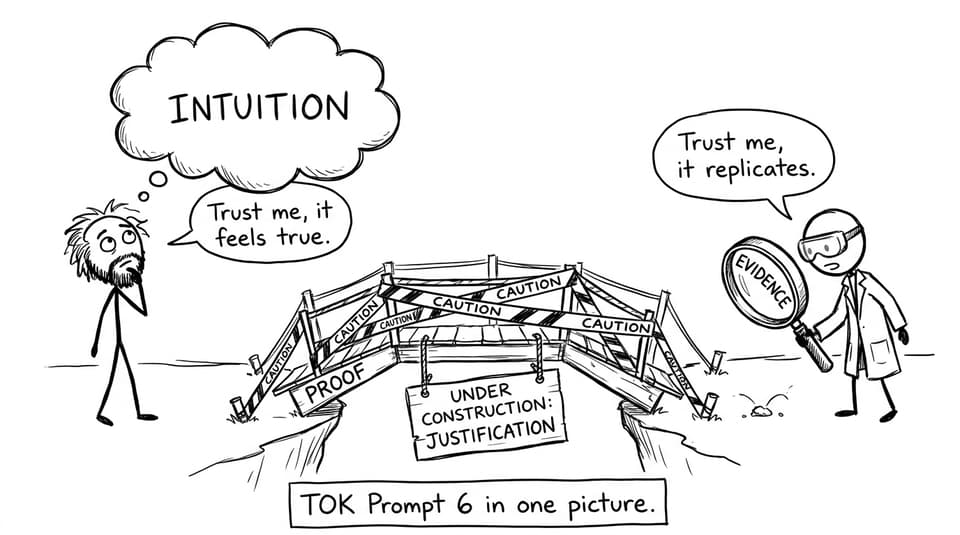
Prompt: “Given that it lacks evidence, how is it that intuition is so valuable in the production of knowledge?” Discuss with reference to mathematics and one other AOK.
This title quietly rewards students who understand sequencing: intuition often comes before justification.
In mathematics, intuition can guide conjectures, suggest patterns, or shape what seems “elegant” before formal proof. Your second AOK should help you test intuition under different standards (for example, the natural sciences, where evidence and replication matter, or the arts, where intuition may be part of the method).
How to choose the right TOK title (a practical method)
If you choose a title because it “sounds easy,” you usually discover the difficulty around paragraph three.
Instead, choose the TOK title where:
-
You can generate 2 strong real-life examples per AOK quickly.
-
Your AOKs create genuine tension (different methods, different standards, different stakes).
-
You can produce at least one meaningful counterclaim that you can evaluate, not just mention.
To sanity-check your structure, keep this open while drafting: Comprehensive Guide to IB TOK Essay Structure.
Final thought: TOK is a writing task, but it’s really a thinking habit
The November 2026 prescribed titles aren’t trying to trap you. They’re trying to see whether you can hold a careful idea in your hands, turn it, test it, and still tell the truth about its limits.
Pick a title where your examples feel alive. Build two AOKs that disagree in productive ways. Then use RevisionDojo to tighten the rest: the TOK Essay General Guide (Nov 2026), the TOK essay structure guide, and the TOK Essay Grader.
TOK rewards students who revise thoughtfully. Let RevisionDojo be the place where that revision becomes simpler, faster, and more confident.