

Art class has a quiet moment most people never talk about.
It happens when you look at someone else’s work and feel two things at once: admiration and panic. Admiration because it’s brilliant. Panic because your own piece suddenly feels smaller.
That’s where IB Visual Arts integrity really begins. Not in a policy document, but in that tiny fork in the road: do you learn from what you love, or do you lean on it so hard that your own voice disappears?
In IB Visual Arts, originality is not a demand to create in isolation. It’s a promise that your final work, your Process Portfolio, and your Comparative Study represent your own thinking, your own decisions, and your own development. Ethical inspiration is how you keep that promise.
A quick integrity checklist for IB Visual Arts
Use this as a weekly self-audit for IB Visual Arts:
-
I can explain how each artwork developed (not just what it looks like).
-
I keep a running list of influences: artists, exhibitions, books, websites, photos.
-
I transform references (composition, meaning, material decisions) rather than tracing them.
-
I have process proof: sketches, tests, failures, progress photos, version history.
-
I have permission for identifiable people in photos (or I obscure identity responsibly).
-
I use digital tools transparently and avoid AI-generated final art.
-
My reflections describe decisions and learning, not just feelings.
If you want the course structure in one place while you plan, keep What is IB Visual Arts? open as your anchor.
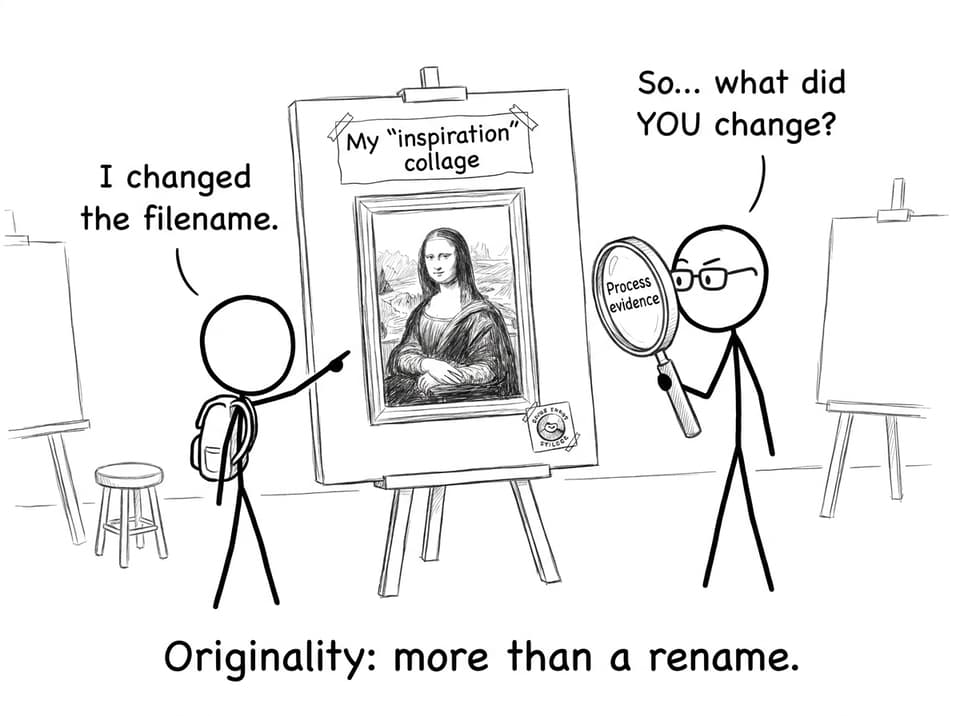
What integrity means in IB Visual Arts (in human terms)
Integrity in IB Visual Arts is the alignment between three things:
-
What you made (the artworks)
-
How you made it (your process and experimentation)
-
How you explain it (reflection, research, and acknowledgment)
The reason this matters is simple: IB Visual Arts grades evidence. Examiners are not mind readers. They can only award marks for what you show and what you can support.
If you’re unsure what the examiner is actually looking for across components, use IB Visual Arts Assessment Criteria Explained Simply as a clarity reset.
Original expression: how to be influenced without becoming a copy
Every artist learns by looking. The issue is not influence. The issue is dependence.
A practical way to protect originality in IB Visual Arts is to treat every reference as a question, not a template.
Try this “reference to result” method
When you add an influence to your page, write three lines beneath it:
-
What I notice: (formal qualities: line, texture, scale, palette, negative space)
-
What I’m borrowing: (one principle or method, not the whole look)
-
What I’m changing: (subject, medium, context, meaning, or composition)
This keeps you in transformation mode. It also creates ready-made reflection text for your Process Portfolio screens.
For more portfolio-specific planning, What to Include in an IB Visual Arts Portfolio is a strong checklist to revisit monthly.
A note on “style mimicry”
In IB Visual Arts, studying a style can be legitimate when it’s clearly framed as experimentation (and documented as such). The risk appears when the final resolved work relies on a recognizable artist’s visual identity without meaningful change or acknowledgment.
If your piece would confuse a viewer into thinking it is “by” the other artist, you’re too close.
Ethical inspiration: images, people, cultures, and materials
Ethics in IB Visual Arts isn’t only about plagiarism. It’s also about how you treat people and contexts while making art.
Using photographs and found images responsibly
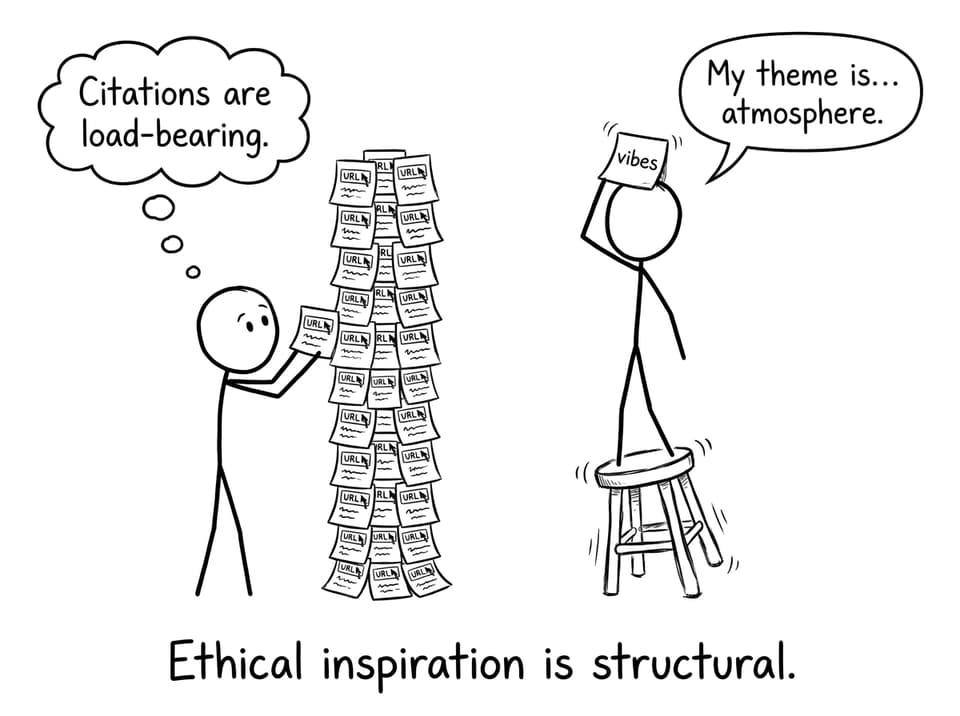
If you use photos you didn’t take, you need to treat them like sources, not free raw material.
-
Prefer your own photography when possible.
-
If a person is identifiable, ask for consent (and note it in your process documentation).
-
If you use public domain or licensed images, keep the source details saved.
-
If you collage or remix, document how and why you transformed the imagery.
This is where a simple “sources log” becomes your best friend: it reduces stress and makes your honesty visible.
Cultural reference vs cultural appropriation
Many IB Visual Arts students explore cultural motifs, symbols, textiles, spiritual imagery, or traditional techniques. Done thoughtfully, this can be powerful.
A safe integrity rule is: research before you represent.
-
Learn what the imagery means and who it belongs to.
-
Avoid stereotypes and aesthetic sampling without context.
-
Write a short note on your positionality: why you are using this reference and what you are trying to communicate.
Ethical inspiration isn’t about being afraid. It’s about being deliberate.
Sustainability and safety
Materials choices can also be ethical choices. Document safe disposal, sustainable alternatives, and why a material supports meaning (not just convenience). Examiners don’t award marks for being eco-friendly, but they do reward thoughtful decision-making and reflection.
Avoiding plagiarism, replication, and duplication in IB Visual Arts
Plagiarism in IB Visual Arts can happen even when the medium isn’t text.
It may look like:
-
Recreating an existing artwork’s composition with minor tweaks
-
Tracing photos or artworks without transformation and acknowledgment
-
Submitting heavily over-assisted work where the idea and execution aren’t yours
-
Reusing earlier assessed work (duplication) as if it is new
If you want a plain-language map of what the IB considers misconduct and how students accidentally fall into it, read IB Misconduct Explained: Avoid Plagiarism and Collusion.
Honest documentation: your Process Portfolio is your alibi (and your growth story)
In IB Visual Arts, students sometimes treat the Process Portfolio like a highlight reel. That’s understandable. But it’s not what scores.
The portfolio is evidence of:
-
experimentation across media and methods
-
decisions made after results (including failures)
-
connections between artist research and studio work
-
reflection that shows learning
If you’re building your screens now, these two resources help you stay examiner-readable:
A helpful mindset: don’t document what happened. Document why it changed you.
Technology and AI: what “responsible” actually looks like
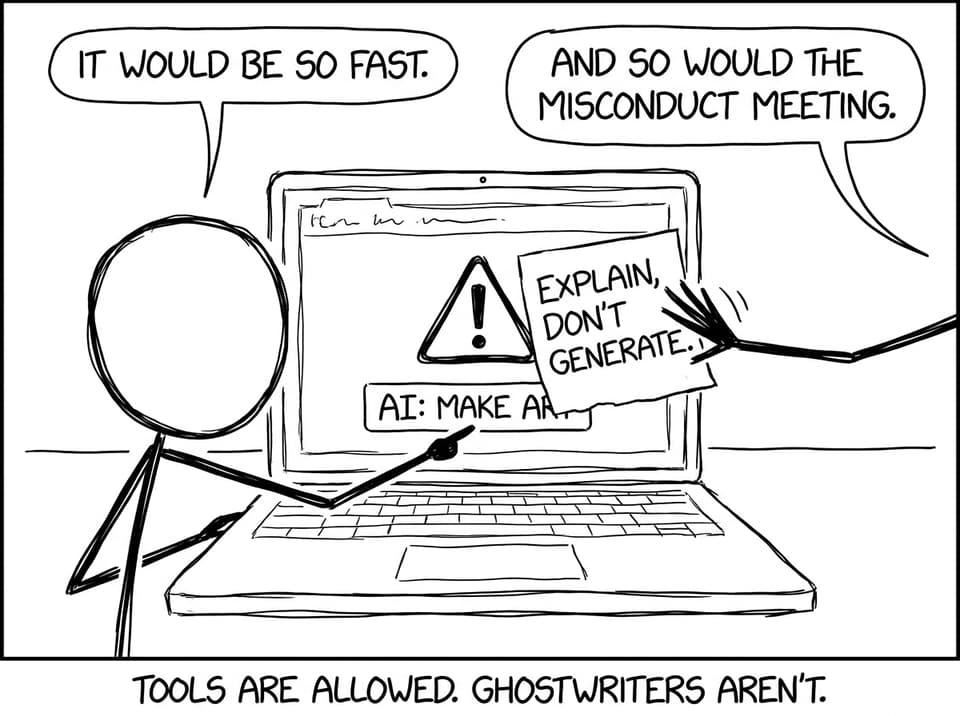
Digital tools are normal in IB Visual Arts. What matters is authorship and transparency.
Good practice usually looks like:
-
using Procreate/Photoshop to develop your own drawings and compositions
-
using digital tools to test color palettes, layout, or layering ideas
-
using AI Chat for explanations, planning, or feedback on your reflection writing (then rewriting in your own voice)
Risky practice is when the tool becomes the maker.
-
AI-generated final images presented as your artwork
-
AI-written analysis presented as your Comparative Study voice
-
“Fixing” reflection text by copying polished paragraphs you didn’t author
For a broader integrity-first way to study across the IB (without drifting into shortcuts), How RevisionDojo Helps You Maintain Academic Integrity While Studying is worth keeping bookmarked.
How RevisionDojo supports IB Visual Arts integrity (and exam readiness)
The stressful truth about IB Visual Arts is that integrity problems rarely come from “bad students.” They come from time pressure, messy documentation, and unclear expectations.
RevisionDojo is built to reduce all three.
-
Use the Coursework Library to benchmark what strong, ethical Visual Arts work looks like: IB Visual Arts Examples.
-
Use AI Chat to ask questions like: “How do I cite an image study?” or “How do I write reflection that shows decision-making?” then rewrite in your own words.
-
Use Grading tools to sanity-check whether your explanations actually match rubric language.
-
Use Study Notes to clarify course requirements quickly: Requirements for IB Visual Arts.
-
Use Mock Exams and Predicted Papers for your written subjects so your Visual Arts workload doesn’t swallow exam prep time.
-
Use Flashcards to keep key artist terms, techniques, and art vocabulary active (fast recall improves your Comparative Study writing).
-
Use the Questionbank for other subjects so you protect studio time without sacrificing exam performance.
-
If you need human strategy, use Tutors for feedback on direction, workload planning, and clarity.
And if you’re still trying to build a weekly rhythm that balances studio work with exam season, How to "Study" IB Visual Arts Effectively gives a sustainable routine.
FAQ: Integrity in IB Visual Arts
What counts as plagiarism in IB Visual Arts?
Plagiarism in IB Visual Arts is not limited to copying text. It includes copying or closely replicating another artist’s composition, imagery, or distinctive style without meaningful transformation and proper acknowledgment. It can also include tracing photographs or artworks and presenting the result as original without citing the source and explaining your process. Another common issue is submitting analysis or reflection that you didn’t truly write, even if it “sounds like you.” The safest rule is this: if someone else’s work is doing the heavy lifting, you must acknowledge it and show what you changed. Integrity is easiest when your portfolio contains visible process evidence that proves authorship.
Can I use AI in IB Visual Arts?
You can use AI responsibly in ways that support learning without replacing authorship. For example, you might use AI Chat to understand a technique, to generate reflection prompts, or to help you plan a week of experimentation. But you should not submit AI-generated artwork as a resolved piece, and you should not submit AI-written Comparative Study analysis or reflection as your own writing. In IB Visual Arts, the assessed value is your decision-making and your voice, not just a polished result. If you used a tool in a meaningful way, be transparent about it according to your school’s guidance. When in doubt, choose the approach you could confidently explain to your teacher with evidence.
How do I prove my work is original if my theme uses common imagery?
Common imagery is not the problem in IB Visual Arts; undocumented development is. You prove originality by showing iterations: sketches, material tests, composition studies, and progress photos that demonstrate how your piece evolved. You also show originality by connecting decisions to intent: what you were trying to communicate, what you tested, what happened, and what you changed next. Keep a sources log even when references feel generic, because it shows you worked ethically and deliberately. Include small comparisons like “I rejected this composition because it matched my reference too closely” and then show what you did instead. Examiners reward visible thinking, and visible thinking is hard to fake.
Closing: Let integrity be the quiet signature on your work
The best IB Visual Arts work doesn’t feel like a performance of originality. It feels like a record of attention: what you noticed, what you questioned, what you tried, and what you learned.
Integrity is what makes that record believable.
If you want to make the integrity side easier while you prepare for exams, build your system with RevisionDojo: use the Coursework Library for benchmarks, AI Chat for clarity (not ghostwriting), Grading tools for rubric alignment, and keep your other subjects steady with the Questionbank, Study Notes, Flashcards, Mock Exams, and Predicted Papers. Your art stays yours, and your preparation stays calm.
In IB Visual Arts, ethical inspiration isn’t a restriction. It’s the discipline that protects your voice.