
Choosing IB subjects can feel like you are forecasting your entire life at 16. One week you are certain you will be a surgeon. The next week, you are sketching late at night and thinking, “I do not want to give this up.” If you are aiming for medicine and still drawn to IB Visual Arts, the real question is not “Is art allowed?” It is: can you choose IB Visual Arts without weakening your medical applications, your grades, or your sanity during exams?
Here’s the calm truth: you often can. But you need to do it deliberately.
What medical schools usually care about (and what they don’t)
If medicine is your destination, your route matters. Most medical programs prioritize science prerequisites and academic consistency. In practice, that means your choices in Groups 4 and 5 usually carry more weight than your Group 6 choice.
For many students, the safest combination includes Biology and Chemistry (often at HL), plus appropriate Mathematics and strong language performance. IB Visual Arts generally isn’t a requirement for medicine, but it also typically isn’t a red flag.
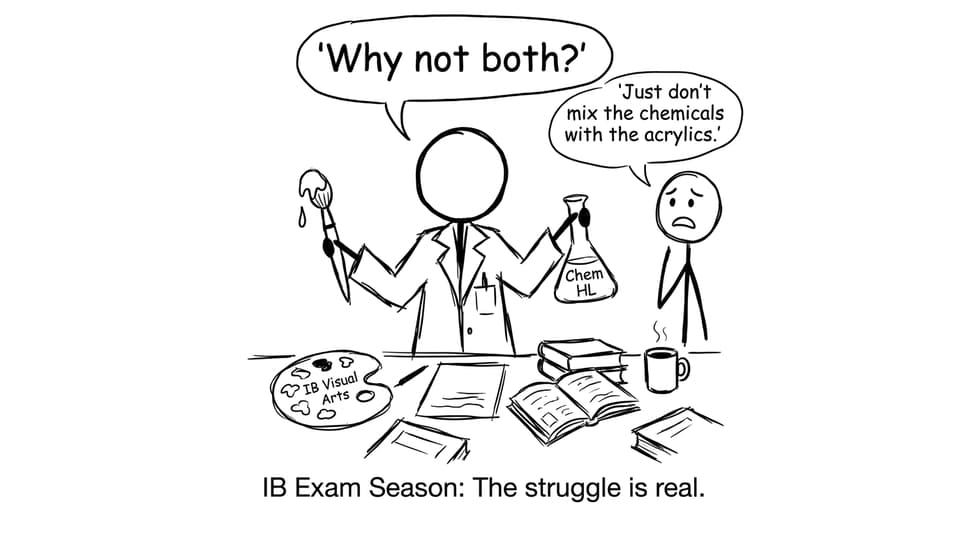
The hidden risk is not “art looks bad.” The risk is workload. IB Visual Arts is coursework-heavy, reflective, and time-consuming, which can squeeze the revision time you need for science exams.
If you want a big-picture refresher on how the arts fit into the IB structure, read What Is a Group 6 Class in IB? and Choosing Your Group 6 Subject: A Comprehensive Guide.
Why IB Visual Arts can actually help future doctors
The best argument for IB Visual Arts is not that it makes you “well-rounded” (though it can). It is that it trains skills medicine quietly demands.
Observation is a medical skill, not just an art skill
Doctors are paid to notice what other people miss: a slight asymmetry, a color change, a pattern of symptoms. IB Visual Arts forces you to slow down and truly observe. That habit carries.
Reflection builds clinical thinking
Visual Arts is not only making. It is documenting process, evaluating decisions, and communicating intent. That reflective loop maps surprisingly well onto clinical reasoning: observe, hypothesize, test, revise.
Stress regulation is part of performance
IB science pressure is real. IB Visual Arts can be your pressure valve, as long as it is scheduled rather than crammed.
If you want to understand what the course actually involves (so you can judge time cost honestly), start with What is IB Visual Arts?.
A quick checklist: should you take IB Visual Arts if you want medicine?
Use this as a fast self-audit:
-
You can take the required sciences (usually Biology + Chemistry) at the levels your target universities expect.
-
You are willing to plan weekly studio time like it is a third science.
-
You can tolerate long projects without last-minute panic.
-
You like writing about your art almost as much as making it.
-
Your timetable does not force you to drop a crucial prerequisite.
If you are unsure how universities tend to weigh Group 6, this overview helps: How Do Universities View IB Group 6 Subjects Compared to Others?.
How to choose levels: HL sciences, SL IB Visual Arts (usually)
For many medicine-focused students, the most sustainable setup is:
-
Biology HL
-
Chemistry HL
-
IB Visual Arts SL
That combination keeps your prerequisites strong while giving you room to protect grades across all six subjects.
HL Visual Arts can still work, but you should choose it because you want the depth and can manage the time, not because it “looks better.” Before deciding, compare expectations in SL vs HL in IB Visual Arts: What’s the Difference? and What Are the Differences Between HL and SL in Group 6 Subjects?.
The part students underestimate: IB Visual Arts assessment and deadlines
IB Visual Arts is built around three components: Comparative Study, Process Portfolio, and Exhibition. Each one has its own “slow burn” timeline. Miss a month, and you feel it later.
To avoid the classic end-of-year spiral, learn the structure and criteria early:
And if you want a practical way to build marks fast, explore examples of what tends to score strongly in Best Marked Art Styles in IB Visual Arts.
Practical time-management that actually works during exam season
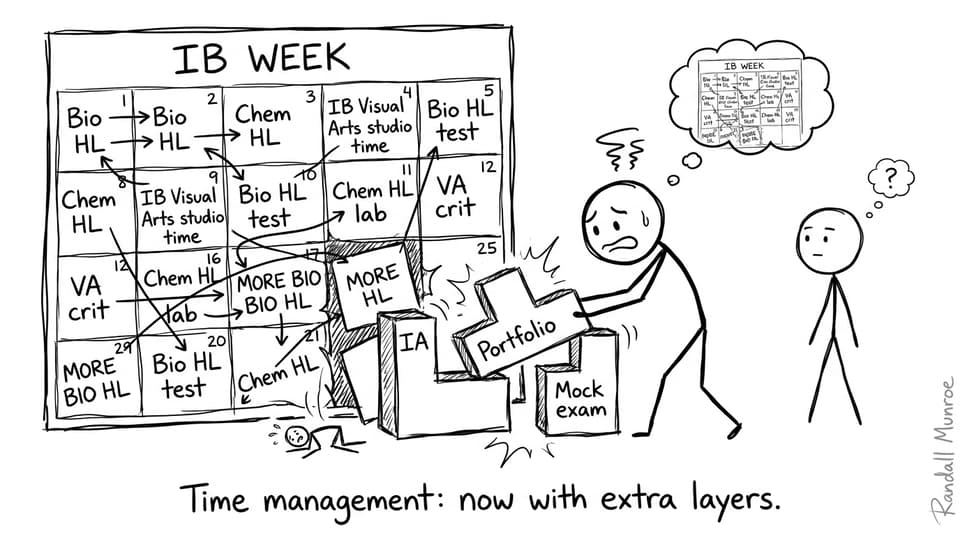
If you take IB Visual Arts alongside HL sciences, your schedule needs guardrails.
Use “minimum viable progress” in art
On heavy science weeks, aim for a small non-negotiable output: one experiment page, one annotated artist reference, one reflection paragraph. Small weekly proof beats heroic weekend sessions.
Link art to science when possible
Try medical illustration studies, microscopy-inspired texture work, or anatomy-informed figure drawing. You are not doing “extra” work. You are creating cohesion and making your Comparative Study reflections richer.
Get feedback in cycles
Arts improve through iteration, not surprise inspiration. Use structured critiques. This guide shows how to do it without vague comments: How to Get Feedback on Your IB Group 6 Work.
Closing: be the kind of applicant who can think in more than one way
Medicine needs precision. It also needs perception, empathy, and the ability to sit with uncertainty until a pattern appears. IB Visual Arts can train that mindset, as long as your subject choices still meet medical prerequisites and your time is managed with respect.
If you want to keep both tracks strong, RevisionDojo is built for it: use Study Notes and Flashcards to lock down science content, the Questionbank and Predicted Papers to train exam performance, AI Chat to clarify weak areas fast, and Grading tools plus Mock Exams to reality-check your progress. And when coursework builds pressure, the Coursework Library and Tutors help you keep momentum without sacrificing your HL priorities.
If art matters to you, you do not have to abandon it to become a doctor. Choose IB Visual Arts with a plan, and let RevisionDojo help you execute it.