

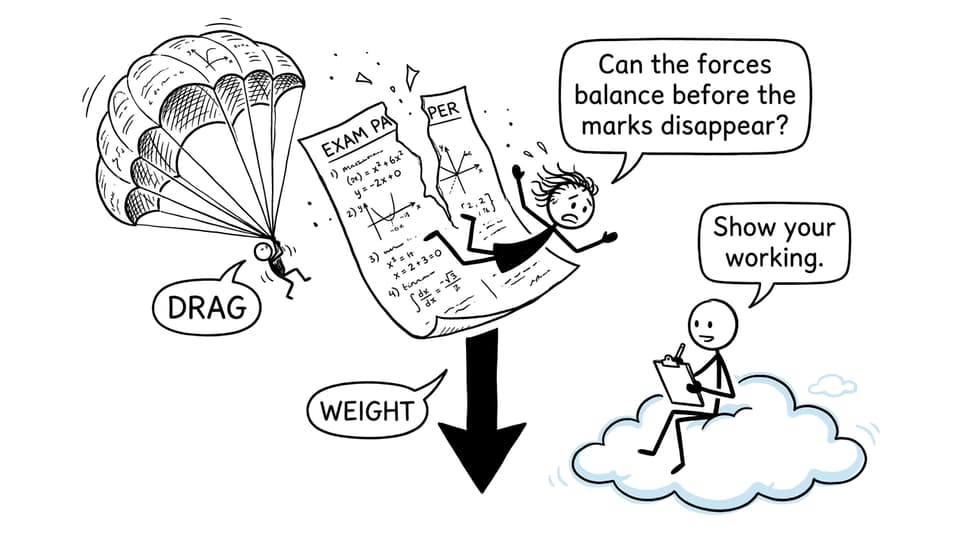
Terminal velocity speed is the constant speed an object reaches when the forces along its direction of motion balance. For a falling object in air, drag equals weight, so the resultant force and acceleration become zero. The object does not stop. It continues moving downward at a steady velocity.
That final sentence is where many exam marks are won or lost. Zero acceleration sounds like rest, but physics is often less intuitive than its vocabulary. Acceleration describes a change in velocity, not velocity itself.
Terminal velocity at a glance
Before going deeper, learn this chain of reasoning:
- The object begins falling and accelerates downward.
- Its speed increases, so fluid resistance increases.
- The increasing drag reduces the downward resultant force.
- The acceleration becomes progressively smaller.
- Eventually, the opposing forces balance.
- Resultant force and acceleration become zero.
- The object continues at constant velocity.
This concept connects kinematics, force diagrams, Newton's laws, graph interpretation, and fluid resistance. It appears in the current IB Physics course for both SL and HL students, particularly through A.1 Kinematics and A.2 Forces and Momentum. RevisionDojo's A.1 Kinematics topic hub and A.2 Forces and Momentum resources provide useful foundations for those connections.
Why terminal velocity speed occurs
Consider an object released from rest in air. Its weight, , acts downward. At the instant of release, its speed is zero, so the drag force is zero or negligible in the simplified model.
The initial resultant force is therefore approximately equal to the object's weight:
Newton's second law gives:
The object initially accelerates at approximately . As it moves faster, however, drag increases and acts opposite to the motion. Taking downward as positive gives:
Therefore:
As increases, acceleration decreases. At terminal speed:
so:
The forces have not disappeared. They are equal and opposite. This is an example of dynamic equilibrium: the object is moving, but its velocity is no longer changing. The connection to Newton's first law is explored further in Newton's First Law explained for IB Physics.
What changes the terminal speed?
The final steady speed depends on the object and the fluid. Relevant factors include:
- the object's mass and weight
- its projected cross-sectional area
- its shape and orientation
- the density of the fluid
- the fluid's viscosity
- the applicable drag model
For many objects moving through air, a quadratic model may be provided:
Here, is the drag coefficient, is fluid density, and is projected area. If buoyancy is neglected, setting drag equal to weight gives:
This relationship shows why increasing mass can raise terminal speed, while increasing area or fluid density lowers it. Do not assume this equation applies automatically. Use it only when the model or necessary information is supplied.
Terminal velocity in a liquid
For a small sphere moving slowly through a viscous fluid under appropriate conditions, the IB Physics guide includes Stokes' law:
where is dynamic viscosity, is the sphere's radius, and is its speed relative to the fluid.
A sphere falling through a liquid may experience three forces:
- weight downward
- viscous drag upward
- buoyancy upward
At terminal speed, the force balance is:
For a sphere of volume , density , and fluid density :
Using and rearranging gives:
This derivation matters because it reveals a frequent misconception: in a liquid, drag does not necessarily equal weight by itself. If buoyancy is significant, drag plus buoyancy balances weight.
Worked IB Physics example
A small sphere of radius and density falls through a liquid of density . The liquid has viscosity . Calculate the terminal speed using Stokes' law. Take .
Identify the model
The question specifies a small sphere, viscosity, and Stokes' law conditions. Include buoyancy because the fluid density is given.
Substitute into the terminal-speed expression
The sphere's terminal speed is therefore approximately:
A strong exam solution shows the force balance before substitution. That makes the method visible and reduces the risk of forgetting buoyancy. For more practice with signs, models, and clearly presented calculations, use the A.1 Kinematics Questionbank.
How terminal velocity appears in exam questions
Terminal-speed questions are not always calculations. Many test whether you can translate motion into forces and graphs.
Velocity-time graphs
For downward motion represented as positive, the gradient begins near and then decreases. The curve gradually becomes horizontal as velocity approaches its terminal value.
Remember:
- gradient of a velocity-time graph = acceleration
- horizontal line = constant velocity
- horizontal line above zero = moving with zero acceleration
If upward is chosen as positive, the falling velocity is negative. The terminal velocity may therefore appear below the time axis. Do not remove a negative sign without interpreting the chosen direction. RevisionDojo's guide to answering IB Physics kinematics questions explains a reliable sign-convention method.
Parachute questions
Before the parachute opens, a skydiver may be moving at one terminal speed. Opening the parachute sharply increases area and drag, creating an upward resultant force. The skydiver slows down, drag decreases with speed, and a new balance is eventually reached at a lower terminal speed.
A precise explanation follows this sequence:
area increases -> drag increases -> upward resultant force -> downward speed decreases -> drag decreases -> forces rebalance at a lower terminal speed
Explanatory questions
For an “explain” command term, do not write only “drag equals weight.” Show the whole causal sequence from rising speed to balanced forces. Definitions can be rehearsed with the A.1 Kinematics flashcards, but complete explanations should also be practised under exam conditions.
Common terminal-velocity exam mistakes
Saying the object has stopped
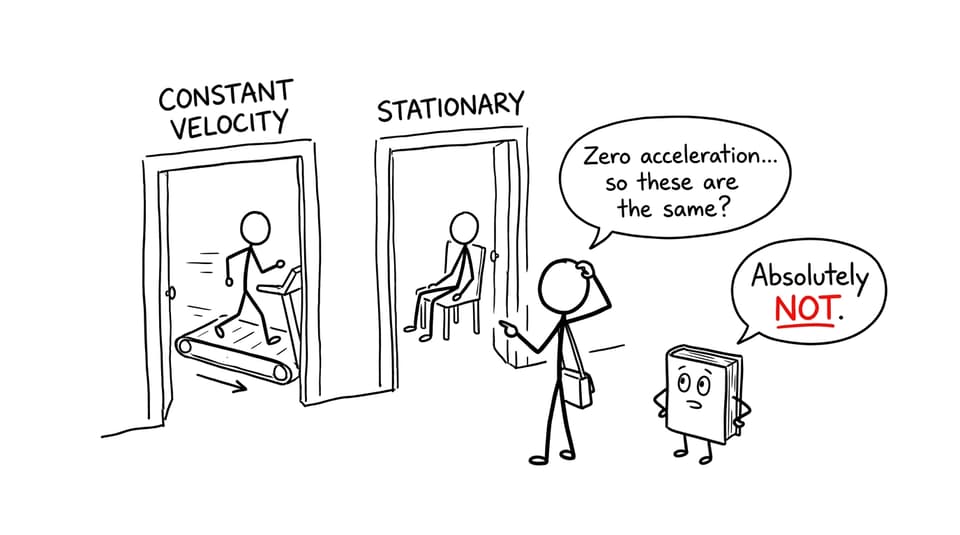
Zero acceleration means velocity is constant. It does not mean velocity is zero. State explicitly that the object continues moving at a steady speed.
Saying there are no forces
The forces are balanced, not absent. Weight and drag still act. In a liquid, buoyancy may act as well.
Assuming acceleration remains equal to g
Once drag becomes significant, the resultant force is smaller than weight. The magnitude of the downward acceleration falls below and approaches zero.
Using constant-acceleration equations carelessly
While drag changes, acceleration generally changes too. Standard SUVAT equations cannot be applied across the whole fall unless the question justifies a constant-acceleration approximation. Review the distinction in the IB Physics kinematics notes.
Forgetting buoyancy
For motion through a liquid, inspect the information provided. A fluid density or displaced volume may signal that buoyancy belongs in the force balance.
Confusing speed and velocity
Terminal speed is the magnitude of terminal velocity. If direction and signs matter, velocity is the more complete vector quantity. If only the magnitude is requested, report a positive speed with units.
Quick-reference revision table
| Situation | Resultant force | Acceleration | Motion |
|---|---|---|---|
| Just released from rest | Approximately weight downward | Approximately downward | Speed increases rapidly |
| Falling with increasing drag | Downward but decreasing | Downward but decreasing | Speed still increases |
| At terminal speed | Zero | Zero | Constant velocity |
| Parachute just opened | Usually upward | Upward | Downward speed decreases |
| New lower terminal speed | Zero | Zero | Constant, slower downward velocity |
Before an exam, reduce the topic to four checks: draw the forces, choose a positive direction, identify the drag model, and state what zero resultant force means. Then test the method rather than merely rereading it.
RevisionDojo makes that loop practical. Use Study Notes and Flashcards to establish the idea, the Questionbank and AI Chat to diagnose uncertainty, and Grading tools to examine how clearly you show your reasoning. Then build timing with IB Physics Predicted Papers and Mock Exams. The Coursework Library and Tutors can support deeper investigation and feedback when physics moves beyond one exam calculation.
Terminal velocity speed is ultimately a lesson in balance. Motion does not require a continuing resultant force. Change does. Once that distinction becomes automatic, the graphs, calculations, and extended explanations begin to feel like different versions of the same idea.