

When the IB gets hard, it usually isn’t because the content is impossible.
It’s because the curriculum feels like six separate worlds that refuse to speak to each other. You revise Biology like it lives on a different planet from History. You write English essays as if Math never existed. Then exam questions show up with an unspoken message: “Bring your whole brain.”
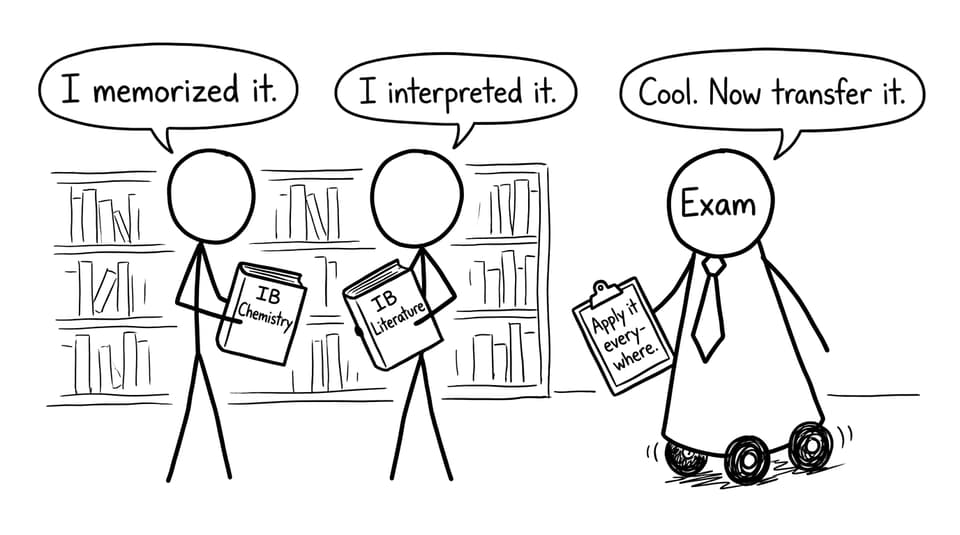
That hidden skill is teaching for transfer (and learning for transfer): the ability to carry an idea from one subject and use it confidently in another. In IB exams, transfer is how a familiar concept becomes a flexible tool. It’s how you stop memorizing and start deploying.
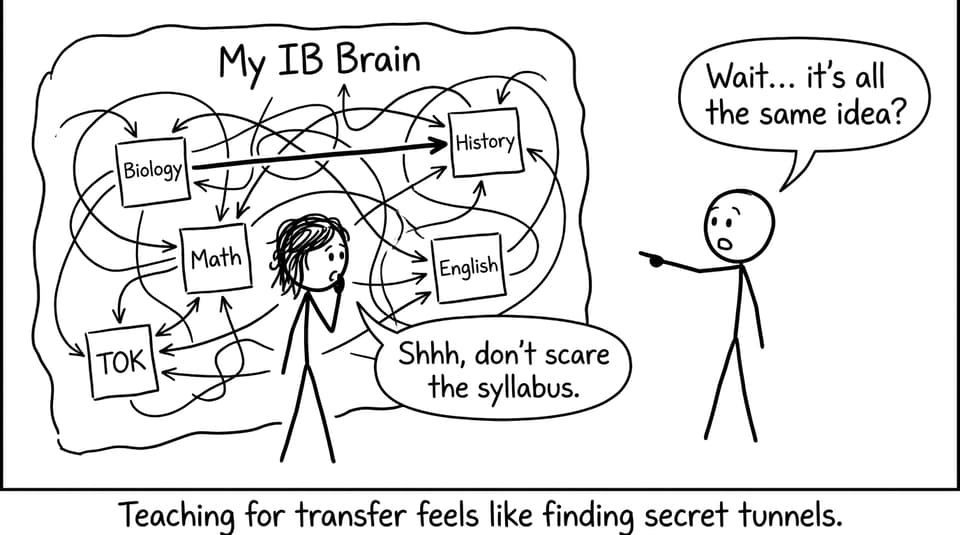
Teaching for transfer: an IB student checklist
Use this short checklist as your weekly reset. If you do these consistently, transfer becomes normal in your IB routine:
-
Pick one “bridge concept” (change, systems, perspective, models, evidence).
-
Find two subjects where it appears this week.
-
Write a two-sentence connection (same concept, different rules).
-
Do targeted practice to prove you can apply it.
-
Store the connection as a flashcard and revisit it.
To make that loop easier, it helps to study in a system that already connects the pieces. RevisionDojo brings Study Notes, Flashcards, Questionbank, AI Chat, Grading tools, Predicted Papers, Mock Exams, a Coursework Library, and Tutors into one workflow.
Why transfer matters for IB exam performance
Transfer sounds like a teacher word until you notice how IB exams actually reward it.
Exams reward students who can:
-
Recognize a pattern quickly (before panic sets in).
-
Choose an appropriate method (not just the one you practiced last).
-
Explain reasoning clearly using the language of the subject (command terms, criteria, structure).
When you build transfer, you stop asking “Have I seen this exact question?” and start asking “What idea is this testing?” That mindset matters across the IB, whether you’re analyzing a text, evaluating an experiment, or just trying to stay calm under time pressure.
If you want a strong general revision backbone while you practice transfer, these guides pair well with this article:
Start with “bridge concepts” (not random overlaps)
Most students attempt transfer by looking for surface similarities: “Both subjects mention ‘energy’.” That can help, but it’s fragile.
Real transfer in IB comes from bridge concepts: ideas that stay stable while the context changes.
Here are a few that show up everywhere:
Change
-
Biology: homeostasis shifting under stress
-
History: turning points, revolutions, reforms
-
Literature: character transformation and narrative arcs
Systems
-
Economics: markets, incentives, feedback loops
-
Biology: ecosystems and regulation
-
Computer Science: inputs, processes, outputs
Perspective
-
TOK: how knowledge depends on lens and method
-
English: narrator, bias, audience
-
Global Politics: stakeholder interests and framing
Your job as an IB student is to name the concept and then notice the rules each subject uses to “judge” it.
A quick way to practice: open a topic in RevisionDojo Study Notes (for clarity), then ask “What is the bridge concept here?” and “Where else have I seen it?” Guides like Digital IB Study Notes You Can Access Anywhere help you set up that habit.
Use TOK as your transfer engine (even if you don’t love TOK)
TOK is basically the IB’s built-in transfer training. It keeps asking the same question in different outfits: How do we know?
Try these TOK-style prompts in any subject:
-
What counts as evidence here?
-
What are the limitations of this method?
-
What is the role of language, assumptions, or models?
For example, “evidence” in a lab report is not the same as “evidence” in a History essay. But seeing that difference is exactly what strengthens transfer.
If you revise with tools that let you ask questions instantly, this becomes easier. RevisionDojo’s AI Chat is useful for quick clarifications like: “Explain how ‘evidence’ is treated differently in Biology vs History in IB terms, with one example each.” The goal isn’t to outsource thinking. It’s to remove friction so you can keep practicing.
Make patterns visible: build a tiny transfer map
Transfer fails most often for one reason: the connection stayed in your head, vague and untested.
So externalize it.
Create a “transfer map” in 5 minutes:
-
Write one bridge concept in the center: systems.
-
Draw three spokes: Biology, Economics, Math.
-
Under each, write:
-
the key vocabulary
-
how it’s assessed
-
a common mistake
-
Then turn the map into active recall:
-
One flashcard: “Define ‘system’ in Economics and give a feedback loop example.”
-
One flashcard: “In Biology, how does negative feedback maintain stability?”
RevisionDojo makes this smooth because your Study Notes can become Flashcards, and your flashcards can point you toward what to practice next.
For a practical setup, these resources help:
Prove transfer with practice (this is where IB marks live)
Transfer isn’t a feeling. It’s performance.
A good test is simple: can you apply the idea under exam constraints, with the right structure and command terms?
Here’s a reliable IB loop for proving transfer:
Clarify
Use IB Subject Note Collections: Comprehensive Study Materials to patch understanding quickly. Don’t rewrite. Just get clean clarity.
Drill
Use the IB Question Bank: How to Use It Effectively approach: topic-filtered sets, immediate marking logic, repeat your weak patterns.
Mix
Once you’re stable, mix topics across subjects in short bursts. This simulates what transfer feels like in real IB exams: switching contexts without losing the underlying idea.
Rehearse
Near exams, add timed realism with Mock Exams and Predicted Papers inside RevisionDojo. If you’re unsure how to use predicted sets responsibly, this guide is useful: IB Predicted vs Specimen Papers: What They Mean.
A student-friendly way to do cross-subject projects (without chaos)
You don’t need a massive interdisciplinary project to build transfer. You need small, repeatable prompts.
Try one per week:
-
Science to English: explain a process (like osmosis) using a metaphor, then critique your metaphor’s limitations.
-
History to TOK: compare how historians and scientists handle uncertainty.
-
Math to Economics: identify what assumptions a model makes, then discuss where it breaks.
The key is that each prompt forces you to translate ideas, not just repeat them. Translation is transfer in motion.
Conclusion: IB transfer is the quiet advantage
The IB can feel like a thousand separate demands until you notice the repeating ideas underneath. Teaching for transfer (and learning for transfer) is how you build that advantage: one bridge concept at a time, made visible through reflection, and proven through practice.
If you want a system that supports transfer without adding complexity, use RevisionDojo as your hub: clarify with Study Notes, lock it in with Flashcards, prove it with the Questionbank, get unstuck with AI Chat, tighten work with Grading tools, and rehearse pressure with Predicted Papers and Mock Exams. Add the Coursework Library and Tutors when you need models and human guidance.
In the IB, the students who win aren’t the ones who memorize the most. They’re the ones who can carry an idea across a boundary and still use it well.