
Mental health in the IB can feel like a quiet background app you forgot you had open.
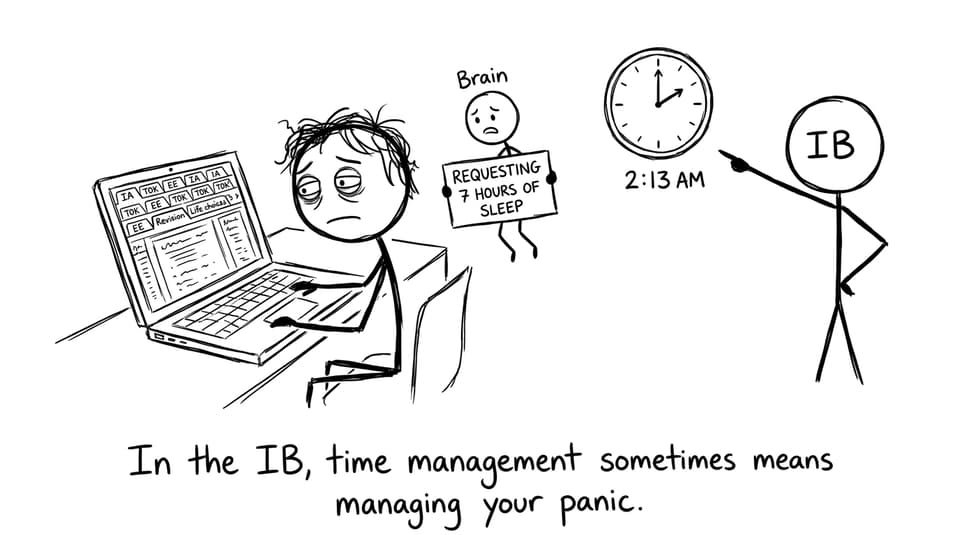
One day you are “just busy.” Then you notice you are tired in a way sleep does not fix. You reread the same paragraph three times. You scroll instead of starting. You tell yourself it is fine because everyone in the IB is stressed, and that is true, but it is also how stress becomes your normal.
Exam season makes this sharper. The workload is real. The standards are high. And the IB has a way of making you feel like every task is urgent, even when some tasks are simply loud.
This guide is here to help you protect your mental health while still preparing well for IB exams. It is not medical advice, and it will not replace professional support. But it will give you a practical system, and a calmer way to move through the next few weeks.
A simple IB mental health checklist (save this)
Use this as your “I am overwhelmed, what now?” reset for IB exam prep:
-
Name the stress: what exactly is heavy right now (a paper, a topic, a deadline)?
-
Shrink today: choose one task you can finish in 45-90 minutes.
-
Use active study: questions and recall, not endless rereading.
-
Protect sleep: do not trade tomorrow’s brain for tonight’s panic.
-
Talk to a human: friend, teacher, counsellor, parent, or tutor.
-
Run a loop: notes -> practice -> feedback -> repeat.
For a strong structure you can borrow, see How to Study for IB Exams: Step-by-Step Guide.
Why the IB hits mental health so hard
The IB is challenging in a very specific way. It is not just “a lot of content.” It is constant context switching: one hour you are solving problems, the next you are writing, the next you are doing coursework. Your brain never fully settles.
Stress also grows when your work has unclear edges. A topic has an end. But “revise Chemistry” does not. “Improve my Paper 2 essays” does not. The IB creates many tasks that feel infinite, and infinite tasks are anxiety fuel.
That is why mental health in the IB often improves when your study becomes more measurable. Not easier. Just clearer.
Recognising IB stress and anxiety early (before it snowballs)
In the IB, stress rarely announces itself with a dramatic moment. It usually shows up as small shifts:
-
Sleep changes: you cannot fall asleep, or you wake up tired.
-
Irritability: tiny things feel personal.
-
Avoidance: you open your laptop and somehow end up reorganising folders.
-
Brain fog: you study longer but remember less.
-
Body signals: headaches, stomach discomfort, tight jaw or shoulders.
The important move is not to judge these signs. Treat them like data. If your body is telling you the current plan is unsustainable, then you do not need more motivation. You need a different plan.
If you are stuck in the “I study all day but nothing sticks” loop, this is worth reading: IB: I Study All Day but Remember Nothing.
Build a calmer IB routine: small loops, not heroic marathons
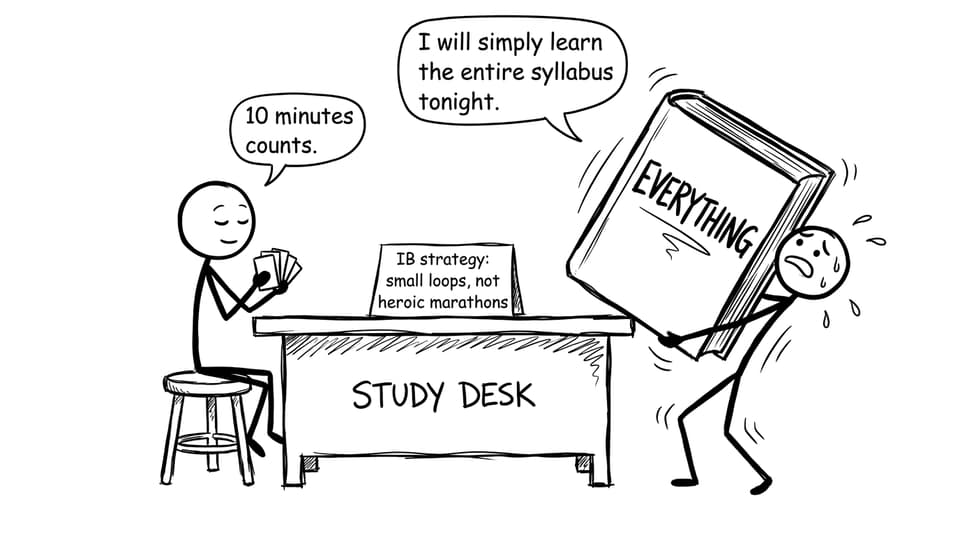
Most IB burnout comes from the same story: “I will fix everything this weekend.” The weekend becomes a marathon. Monday arrives. You are behind again. The cycle repeats.
A healthier strategy is a loop you can repeat even on tired days. RevisionDojo is built around this exact idea: learn quickly, practise a lot, get feedback fast.
A simple IB loop looks like this:
-
10-15 min: patch understanding with Study Notes
-
25-40 min: practise in the Questionbank
-
10 min: review mistakes and ask one precise question using AI Chat
-
7-12 min: lock the key facts with Flashcards
You are not trying to “finish the syllabus.” You are trying to convert effort into marks without converting your nervous system into a mess.
Use the IB “one-paper focus” rule
When mental health drops, decision-making gets noisy. So reduce choices.
Instead of “revise Biology HL,” choose “Paper 2 data-based questions” or “Topic: genetics short answers.” This is also how high scorers study: paper first, then topic, then question type.
For more on structured exam training, see How 45-Point IB Students Prepare for Exams and The Ultimate Guide to Revision for IB Students.
Sleep is not optional in the IB (it is part of your grade)
It is tempting to treat sleep like a negotiable resource during IB exams. But sleep is where memory consolidates and emotional regulation resets.
A practical rule: do not pull late nights for tasks that do not directly translate to marks. If a study method is mostly “feels productive” but does not improve performance (like rewriting notes beautifully), it is not worth trading sleep.
If you want to keep revision efficient, use 10 Proven Study Techniques for IB Students and keep the boring basics: consistent recall, targeted practice, and short review.
Mindfulness that works for IB students (no mysticism required)
Mindfulness in the IB is not about becoming a different person. It is about giving your brain a gear shift.
Try one of these before a study block or paper practice:
-
Two-minute breathing reset: inhale 4, hold 2, exhale 6, repeat.
-
Grounding: name 5 things you see, 4 you feel, 3 you hear, 2 you smell, 1 you taste.
-
Journaling for clarity: write “What is the one thing I am afraid will happen?” and answer honestly.
This matters because anxiety is often your brain trying to keep a vague threat visible. When you name it, it becomes specific. When it is specific, you can plan.
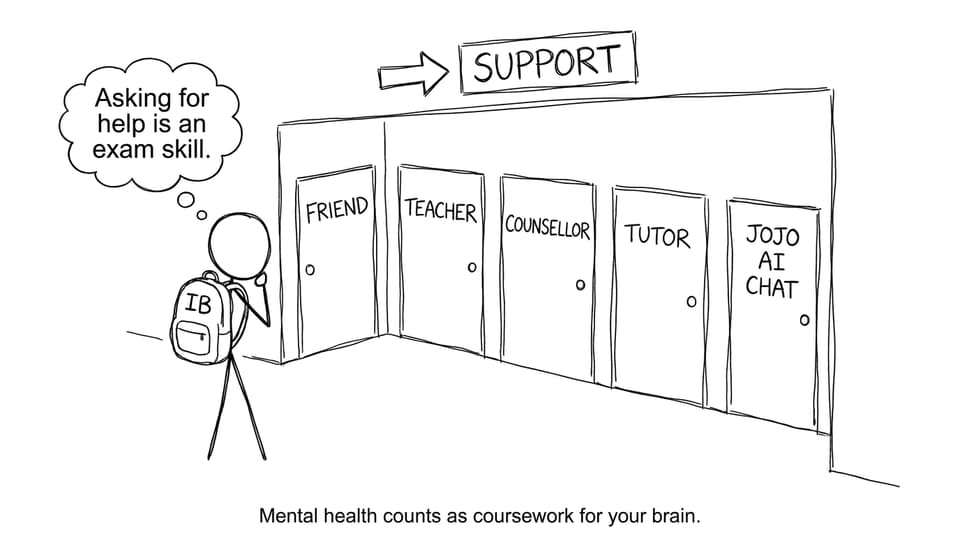
Stay connected: support is an IB exam strategy
Isolation makes IB stress louder. Connection makes it smaller.
That can mean:
-
A friend who studies beside you (even silently)
-
A teacher you ask for one clarifying explanation
-
A school counsellor who helps you build coping routines
-
A tutor who fixes the root problem faster than you can alone
On RevisionDojo, students often use AI Chat for quick unblocking, then step up to Tutors for deeper diagnosis when a topic keeps draining confidence. And if coursework stress is part of the load, the IB Coursework Grader and Coursework Library reduce the background uncertainty that fuels anxiety.
A healthier way to use RevisionDojo during IB exam season
When mental health is fragile, your study system should reduce friction.
A simple plan:
-
Use IB Question Bank | How to Use It Effectively to practise by topic and difficulty.
-
Keep daily recall light with IB Flashcards with Spaced Repetition (SRS).
-
Use RevisionDojo for IB as your home base so you are not hunting resources at 1 a.m.
-
For confidence under time pressure, add a weekly timed session using Mock Exams and Predicted Papers (inside RevisionDojo), then review mistakes like a scientist.
If you want a routine that avoids burnout while still building timing, read How to Study for IB Mocks (Without Burning Out).
Closing: you can do the IB without losing yourself
The IB will try to convince you that stress is the price of ambition. But the real goal is not to survive on adrenaline. It is to build a routine that makes you steady.
If you want one place where your IB revision feels more organised and less chaotic, use RevisionDojo as your home base: Study Notes for clarity, Flashcards for daily recall, Questionbank for marks, AI Chat and Grading tools for feedback, Mock Exams and Predicted Papers for realism, plus Coursework Library support and Tutors when you need a human plan.
Your mental health is not a side quest. In the IB, it is part of how you earn the grade you are working for.