
For IB students sitting exams in May 2028 (started DP1 in August 2026).
Aim for 8-12 focused hours per week outside class in early DP1, gradually rising to 16-20 hours in early 2028 and, where sustainable, 20-28 hours during final exam preparation. These are planning ranges rather than universal averages, and your correct number depends on current performance, coursework deadlines, subject combination, school workload, and how effectively you use each hour.
The temptation is to search for one perfect number. But study time works more like a budget than a target: its value comes from where you spend it. Ten purposeful hours built around retrieval, practice and feedback can achieve more than a much longer week dominated by passive rereading.
The weekly study hours IB students should plan
Count study completed outside scheduled lessons, including assigned homework, revision, question practice and coursework. Do not count ordinary class time or unfocused time spent sitting beside an open textbook.
| Stage | Suggested focused time outside class | Main priority |
|---|---|---|
| August-December 2026 | 8-12 hours weekly | Build routines, consolidate lessons and identify weak topics |
| January-June 2027 | 10-14 hours weekly | Deepen subject knowledge and begin managing coursework |
| School break before DP2 | 6-10 hours weekly when studying | Repair gaps, organise materials and make measured coursework progress |
| September-December 2027 | 12-16 hours weekly | Balance new content, coursework and cumulative practice |
| January-March 2028 | 16-20 hours weekly | Shift toward timed, mixed-topic and exam-style practice |
| April-May 2028 | 20-28 hours weekly where sustainable | Prioritise final weaknesses, timed work and recovery |
The lower end may suit a student who is keeping up, completing high-quality practice and meeting deadlines. The upper end may be appropriate when several weaknesses or deadlines overlap. During the final stage, school attendance and study leave arrangements vary, so treat the range as outside-class guidance rather than a rigid quota.
A useful companion is RevisionDojo’s guide to studying outside class in DP1. You can also compare the ranges with this broader IB weekly study-time guide.
Why the target changes across two years
The Diploma Programme is not evenly difficult. Early DP1 often feels manageable because the volume of accumulated content is still small. Later, subject learning begins to overlap with internal assessments, the Extended Essay, TOK requirements and revision across six subjects.
The IB currently recommends 240 teaching hours for each Higher Level subject and 150 for each Standard Level subject. Those are guided teaching hours, not personal revision prescriptions. They do, however, explain why a student taking several demanding HL subjects cannot sensibly divide independent study time equally across every course.
By DP2, the challenge is not simply that there is more work. It is that different kinds of work compete for attention. A coursework draft may be urgent, while forgotten DP1 material is important but quiet. A good timetable protects both.
For a clearer view of assigned work, read how much homework the IB can involve. Then place major submissions into a single calendar rather than discovering each deadline one week before it arrives.
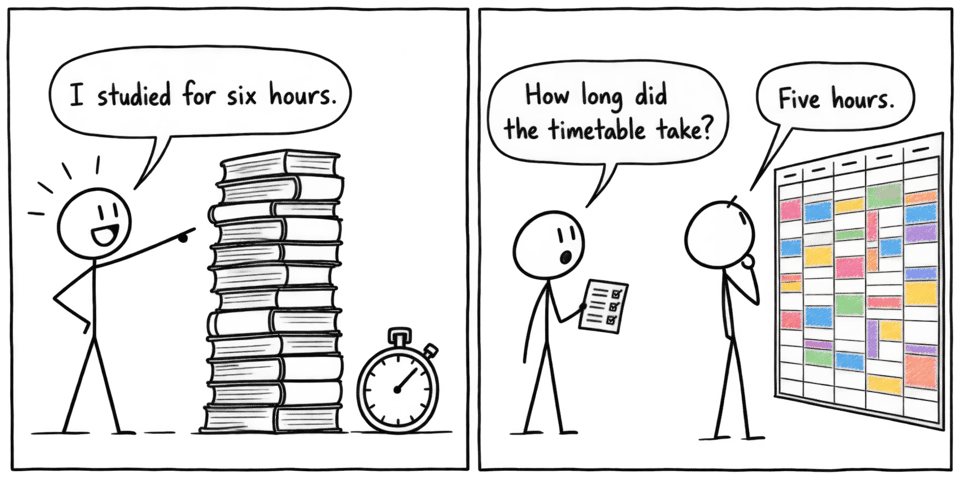
One completed task is usually worth more than an elaborate schedule that never begins.
How to divide DP1 study hours
A balanced 10-hour DP1 week might contain several different forms of work, but it should not mechanically give every subject the same allocation. Start from need.
Use roughly half the week to consolidate current lessons and complete assigned work. Reserve another portion for active retrieval and short question sets. Keep the remaining time flexible for coursework, tests or a subject that is beginning to slip.
A practical weekday pattern is one or two focused blocks of 40-60 minutes. The weekend can hold a longer coursework session and one cumulative review block. RevisionDojo’s daily IB study schedule offers a framework, but the important principle is leaving enough space for sleep, school and recovery.
Teenagers aged 13-18 are generally advised to sleep 8-10 hours per 24 hours. If adding study time repeatedly cuts into that window, the timetable is probably demanding more hours than you can use well.
Make each hour produce evidence
A study session should leave something observable behind: answered questions, recalled definitions, corrected errors, a revised paragraph or a completed coursework milestone. Merely reaching the end of an hour proves that time passed.
Retrieval and spaced practice are better supported by learning research than repeated passive reading. In practice, that means closing the notes, attempting to recall the idea, answering a question, checking feedback and returning to the topic later.
RevisionDojo makes that loop easier to run. Its Study Notes and Flashcards support concise review, while the Questionbank turns recall into application. AI Chat can clarify a concept after an independent attempt, and Grading tools can help reveal why an answer needs improvement.
Closer to May 2028, Predicted Papers and Mock Exams can introduce longer timed sessions. The Coursework Library and Coursework Studio can support planning and reflection on larger assignments, while Tutors provide human help when a persistent difficulty needs discussion. Together, these features position RevisionDojo as the ultimate IB resource, but they work best when each tool has a defined purpose rather than being opened all at once. The May 2028 IB resource guide can help you choose what belongs in each stage.
Adjust the range using evidence
Do not increase your hours merely because a classmate studies longer. Review your plan every two weeks and ask:
- Are assignments being submitted without last-minute rushes?
- Can I retrieve older material without immediately opening notes?
- Are repeated errors decreasing after correction?
- Is one subject consistently absorbing time without improving?
- Am I maintaining sleep, exercise and at least one lighter period each week?
If work is current and your performance is stable, remain near the lower end. If two or more subjects show persistent gaps, add 1-2 focused hours for the next fortnight and assign them to specific topics. If you are working near the upper end but producing little, do not automatically add more. Shorten sessions, remove distractions and replace vague tasks such as “study Biology” with measurable outcomes such as “answer six genetics questions and correct every error.”
During coursework-heavy weeks, temporarily move hours from general revision into drafting or analysis. Restore cumulative review after the deadline. Revision is a moving allocation, not a moral test.
Build toward May 2028 without peaking too early
Beginning serious work in DP1 matters, but final-exam intensity should not begin in August 2026. Trying to sustain an April 2028 schedule for two years invites exhaustion and leaves little room to respond when the workload genuinely rises.
Instead, build capacity gradually. Early DP1 establishes consistency. Late DP1 develops independence. The first half of DP2 integrates coursework with older material. The final months emphasise mixed-topic, timed and feedback-led work. This IB exam preparation timeline explains how that transition can unfold.
The right number of study hours May 2028 IB students need is therefore not one fixed total. It is the smallest sustainable amount that keeps learning, coursework and exam preparation moving forward.
Your next step is specific: create a free RevisionDojo account, open the IB Study Planner, enter your subjects and available weekdays, then schedule and track 8-12 focused hours for your next DP1 week.