

The best study group strategies for MYP Individuals and Societies combine retrieval, conceptual discussion, evidence analysis, structured writing, and an independent exit task. A productive group does not divide the notes and let one person teach. It makes every student recall, explain, challenge, and revise.
Gather two to four classmates, choose one narrow topic, and schedule a 60-minute meeting. Use the MYP Individuals and Societies resource hub for Study Notes, Flashcards, and Questionbank prompts, while keeping the session connected to your current unit. An hour of general conversation disappears quickly. An hour in which everyone defends a claim with evidence leaves something durable behind.
Your quick study group checklist
Before meeting, agree to these rules:
- Keep the group to two to four students when possible.
- Select one topic and one MYP criterion or skill.
- Bring one question, source, case study, or previous mistake each.
- Attempt tasks individually before discussing them.
- Support claims with specific evidence.
- Rotate roles so nobody becomes the permanent teacher.
- Finish with an individual exit response.
A useful target might be: “By the end, everyone can explain two effects of urbanisation, compare two perspectives, and write a supported judgement.” That is more useful than saying, “We are revising geography.” The RevisionDojo urbanisation resources can provide focused starting material.
Why this subject needs a different group method
Individuals and Societies is not simply a contest to remember facts. Students engage with factual, conceptual, and debatable questions while developing knowledge, investigation, communication, and critical-thinking skills.
Accurate knowledge matters, but you must also connect evidence to concepts such as change, systems, global interactions, and time, place and space. Assessments may ask you to evaluate sources, compare perspectives, communicate for an audience, or form a justified conclusion.
A good group therefore resembles a small inquiry team rather than a shared reading session. For more context, explore MYP Individuals and Societies interdisciplinary learning.
Use this 60-minute study group method
Before meeting: choose one clear output
Choose one topic, one skill, and one product. For example:
Topic: population change. Skill: evaluating evidence. Output: one paragraph answering whether rapid population growth always reduces quality of life.
Ask each member to bring one relevant example and one question. If background knowledge is uneven, share one short section from the Study Notes instead of assigning an entire unit. The goal is common ground, not excessive preparation.
Minutes 0-8: assign roles and retrieve
Use four rotating roles:
- Facilitator: follows the schedule and invites contributions.
- Evidence checker: tests whether evidence supports each claim.
- Skeptic: introduces another interpretation or limitation.
- Recorder: captures misconceptions and next steps.
With fewer students, combine roles. Then close every resource and write remembered definitions, examples, causes, consequences, perspectives, and concepts. Check MYP Individuals and Societies cheatsheets or Flashcards afterward. Looking first creates familiarity; retrieving first reveals what you genuinely know.
Minutes 8-23: map concepts and evidence
Put the topic in the centre of a page. Add branches for causes, consequences, stakeholders, evidence, perspectives, and concepts. Every student contributes one connection and explains it aloud.
Do not accept a bare statement such as “migration causes urban growth.” Ask what kind of migration, in which context, through what mechanism, and with what evidence. Mark uncertain examples for verification instead of treating confidence as accuracy. The population growth study notes can help repair gaps after the attempt.
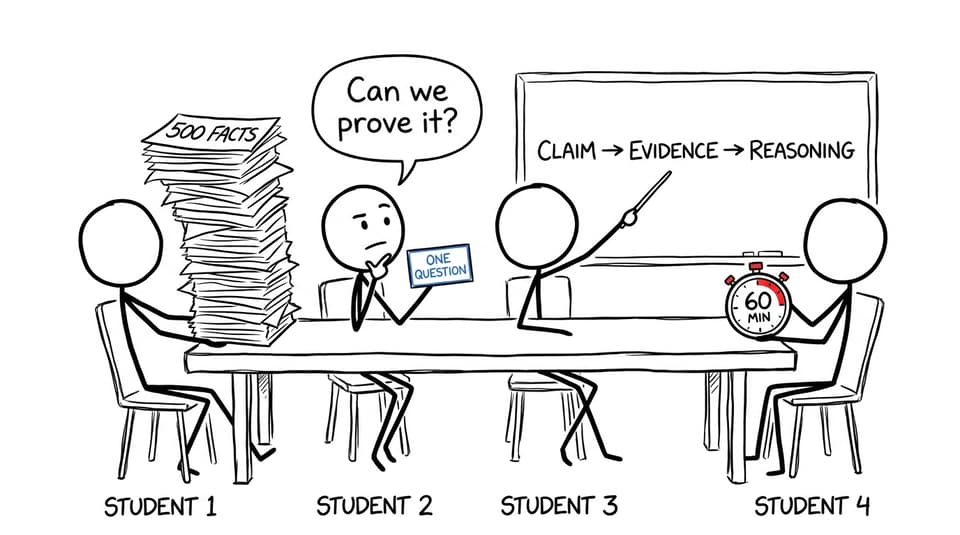
Minutes 23-43: use claim, evidence, and reasoning
Choose one debatable question. Each student silently writes:
- A clear claim.
- One specific piece of evidence.
- An explanation connecting the evidence to the claim.
- A counterargument or limitation.
- A reasoned judgement.
Students read their reasoning aloud. The evidence checker asks whether the example genuinely supports the claim. The skeptic identifies a missing perspective or assumption. The group can discuss improvements, but each student must rewrite their own answer.
For source-based work, consider origin, purpose, value, and limitations without reducing evaluation to a memorised formula. The scientific worldviews notes demonstrate research questions, evidence collection, corroboration, and source limitations.
Minutes 43-55: practise one criterion
Choose the activity matching your assessment target.
| MYP criterion | Productive group activity |
|---|---|
| A: Knowing and understanding | Retrieve terminology, explain concepts, and apply knowledge to an unfamiliar example. |
| B: Investigating | Improve a research question, select methods, or assess source relevance. |
| C: Communicating | Reorganise a response for its audience and check structure, terminology, and referencing. |
| D: Thinking critically | Compare perspectives, analyse evidence, challenge assumptions, and form a judgement. |
Identify visible evidence of improvement. “Make it better” is too vague. “Add a relevant example and explain how it changes the judgement” gives the writer an action. Use the MYP Individuals and Societies criteria guide to turn criterion language into practical feedback.
Minutes 55-60: prove independence
End the conversation. Everyone answers a fresh question alone, without notes or help. Compare the response with the relevant criterion, teacher guidance, or RevisionDojo Grading tools.
Each person records what they can now do independently, which mistake remains, and the next small action. Discussion may reveal understanding, but independent performance shows whether that understanding belongs to you.
Improve the quality of group discussion
Begin with a factual question, move to a conceptual question, and finish with a debatable one. For example: What is urbanisation? How can it change social systems? To what extent should governments restrict urban growth? This inquiry ladder prevents debate from floating free of knowledge.
For every issue, identify at least two affected groups or interpretations. During a conflict unit, students might compare governments, civilians, international organisations, or groups with competing historical memories. The group conflict topic resources can support this work. The aim is not to treat every argument as equally strong, but to recognise perspective before weighing evidence.
RevisionDojo AI Chat can add pressure by generating a counterargument, questioning an assumption, or identifying a source limitation. Ask for a challenge rather than a finished response. Then close the answer, reconstruct the reasoning, and write independently.
Avoid common study group mistakes
Turning the meeting into a lecture: Make everyone retrieve and write before anyone explains.
Choosing an enormous topic: Replace “development” with a target such as comparing two development indicators.
Accepting unsupported opinions: Make “What evidence supports that?” the default question.
Letting confident students dominate: Use timed turns and rotating roles. Confidence is not accuracy.
Correcting without rewriting: After discussion, each student should produce an improved answer independently.
Studying only comfortable material: Use an error log to choose the next session. Revision should respond to evidence, not mood.
Turn one meeting into a weekly system
A dependable rhythm is simple: prepare individually, meet for one focused hour, retry weak tasks the following day, and complete mixed practice at the weekend. As assessments approach, Predicted Papers and Mock Exams can build timing and decision-making. The Coursework Library offers models of organisation and communication, while Tutors can diagnose problems that peer discussion has not resolved.
RevisionDojo works as the ultimate IB resource because these stages remain connected. Clarify a concept with Study Notes, retrieve it through Flashcards, apply it in the Questionbank, challenge the reasoning with AI Chat, and check the result with Grading tools. The MYP revision guide can place your weekly meeting inside a sustainable routine.
The best study group is not the one that talks longest. It is the one that turns conversation into stronger independent thinking. Begin with one question, make every claim earn its evidence, and finish by proving what each person can do alone.