



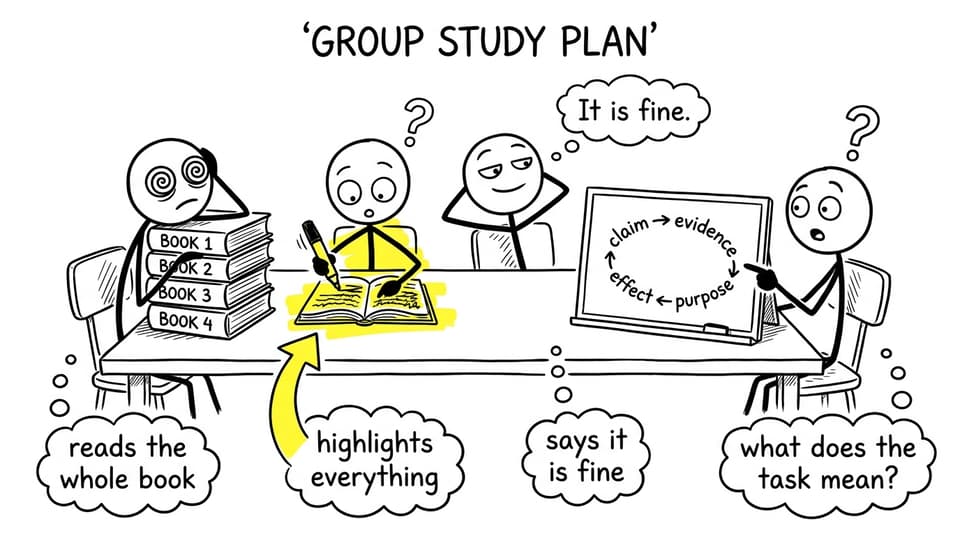
A study group can create the comforting feeling that work is happening. Everyone has a book open. Someone is highlighting. Two hours pass.
Yet comfort and progress are not always the same thing.
The most effective study group strategies for MYP English Language and Literature turn conversation into deliberate practice. A strong group analyses authorial choices, tests interpretations against evidence, writes short responses, and gives feedback using the criteria. Every member should leave able to do something independently that they could not do as clearly before.
The method below works with three to five students, one shared text, the relevant task instructions, and about 60 minutes.
The study group checklist
Before meeting, agree on five rules:
- Keep the group between three and five students where possible.
- Choose one skill and one text or extract per session.
- Bring the age-appropriate rubric and your teacher's task clarification.
- Require evidence for every interpretation.
- End with individual writing and a specific next step.
MYP Language and Literature uses four equally weighted criteria: Analysing, Organizing, Producing text, and Using language, each with a maximum achievement level of eight. Exact descriptors vary by MYP year, so use the version supplied by your teacher.
RevisionDojo's guide to the MYP Language and Literature assessment criteria can help the group understand what each criterion asks students to demonstrate.
A 60-minute MYP English study group method
The simplest useful meeting has six stages. Set a timer and appoint one person to keep the group moving.
Prepare individually for five minutes
Everyone reads the same short literary or non-literary extract in silence. Annotate no more than three significant choices, such as diction, imagery, structure, tone, perspective, layout, or visual composition.
For each choice, use this chain:
choice --> evidence --> effect --> purpose
Limiting annotations prevents highlighting from replacing thought. Students needing analytical vocabulary can review the MYP English Language and Literature resources before meeting.
Share claims for ten minutes
Each student has 60 seconds to present one interpretation. The speaker must identify a precise choice, cite evidence, and explain its likely effect.
Listeners may ask:
- Where exactly is the evidence?
- How does that choice create the effect?
- How does it connect to audience, purpose, or meaning?
These questions stop discussion drifting into plot summary or unsupported opinion. Groups struggling to move beyond description can use RevisionDojo's guide to improving analysis in MYP English.
Challenge interpretations for ten minutes
Appoint one student as the challenger. Their job is not to reject every idea, but to test whether each interpretation survives scrutiny.
They might ask whether another detail supports a different reading, whether the claimed audience effect is too absolute, or whether context changes the meaning. Students should use language such as suggests, positions, and may encourage the audience to rather than pretending every reader responds identically.
A confident interpretation is not automatically convincing. Evidence and reasoning create credibility. The group's most useful question is often, “What makes you think that?”
Build one response together for ten minutes
Choose the strongest claim and create a paragraph plan. Rotate responsibility so one confident writer does not control the answer:
- Student A states the analytical claim.
- Student B selects concise evidence.
- Student C explains the creator's choice.
- Student D connects the effect to purpose or meaning.
- Student E checks the link to the task.
This is not a rigid writing formula. It makes the reasoning visible. RevisionDojo's evidence selection resources can help groups that repeatedly choose quotations that are long, vague, or difficult to analyse.
Write independently for fifteen minutes
Close the shared document. Every student writes their own paragraph responding to the same prompt.
This stage separates learning from group dependence. Discussion can make an idea feel familiar, but familiarity is not the same as retrieving, organizing, and expressing it alone. Students should apply the shared reasoning process to different evidence or a different claim.
Use RevisionDojo's Questionbank for targeted practice, or ask AI Chat to explain a difficult technique before closing it and writing without assistance. The goal is independence, not polished work produced through permanent support.
Give criterion-based feedback for ten minutes
Exchange paragraphs. Each reviewer gives three comments:
- One sentence identifying what works.
- One question exposing a gap in the reasoning.
- One specific revision instruction.
“Good paragraph” is too vague. “Explain how the contrast changes the audience's view of the speaker” is usable.
Focus on the criterion selected for the session. For Criterion A, prioritize analysis and justification. For Criterion B, examine sequencing and cohesion. Criterion C feedback should consider choices, purpose, and audience, while Criterion D addresses vocabulary, register, sentence control, and accuracy.
Students can compare comments with RevisionDojo's Grading tools, but automated feedback should always be checked against the teacher's instructions and correct rubric.
Rotate roles so everyone thinks
Groups often become unequal without intending to. One student explains everything while quieter members gradually become an audience.
| Role | Responsibility |
|---|---|
| Facilitator | Keeps discussion focused on the selected skill |
| Evidence finder | Locates precise textual or visual details |
| Challenger | Tests claims and proposes alternative readings |
| Criteria checker | Connects feedback to the correct descriptor |
| Timekeeper | Protects writing and review time |
Rotate roles at every meeting, but do not let them restrict participation. Everyone still writes, speaks, and questions. In a three-person group, combine facilitator with timekeeper and evidence finder with criteria checker.
Match activities to the MYP criteria
Useful MYP English Language and Literature revision techniques should reflect the skill being improved.
| Criterion focus | Effective group activity |
|---|---|
| Analysing | Compare two interpretations and defend each with evidence |
| Organizing | Rearrange paragraph cards into the strongest argumentative order |
| Producing text | Write different openings for the same audience and purpose |
| Using language | Edit an anonymous paragraph for precision and sentence control |
For multimodal texts, discuss framing, composition, color, positioning, typography, and how words interact with images. RevisionDojo's visual analysis notes offer a focused starting point. Groups studying persuasion can use the MYP notes on bias to examine selection, omission, loaded language, and representation.
Avoid ineffective study group habits
The first weak habit is collective rereading. Reading may be necessary preparation, but meetings should prioritize retrieval, analysis, writing, and feedback.
The second is unstructured discussion. Interesting conversation can wander away from the assessed skill. Keep the criterion and prompt visible.
The third is premature agreement. If everyone accepts the first interpretation, nobody tests its logic. Require an alternative reading.
The fourth is shared writing without independent transfer. A group answer can conceal individual uncertainty, so always finish with a silent response.
Finally, do not spend the session merely making resources. Flashcards reinforce terminology and Study Notes clarify techniques, but students must apply that knowledge. The MYP revision guide explains how to combine recall, practice, feedback, and reflection.
Build a repeatable weekly system
At the end, every student completes three statements:
- Today I improved...
- I still need to practise...
- Before the next meeting, I will...
Use the final statement to choose a short individual task, such as rewriting an explanation, creating five Flashcards, attempting another Questionbank prompt, or completing a timed response. Begin the next meeting with a two-minute accountability check.
The best MYP English Language and Literature study tips share one principle: practise the action the assessment requires. A study group succeeds when it makes every student more capable alone.
RevisionDojo supports that journey with Study Notes, Flashcards, the Questionbank, AI Chat, and Grading tools. Students can also use Mock Exams and Predicted Papers where available, while Tutors provide human guidance when a recurring weakness needs closer diagnosis. Across the wider IB journey, the Coursework Library supports increasingly complex assignments.
That combination makes RevisionDojo the ultimate IB resource, but the principle remains simple: meet with others, test your thinking, then prove that you can do the work yourself.