
For M28 students taking IB exams in May 2028, including those who started DP1 in August 2026.
If you studied but did badly in IB, your preparation may have trained recognition while the test required recall, application, precise communication, and decisions under time pressure. Check your marked work before assuming that effort was the problem.
A disappointing mark feels personal because time was invested. But time is only the input. Your result reveals what that input produced.
Your first DP1 grades are not a verdict on your ability or final Diploma result. They are feedback about the gap between how you prepared and how you were assessed.
The quick diagnosis
Before changing everything, identify what went wrong:
- You recognized material but could not recall it unaided. Replace rereading with active recall.
- You understood the topic but could not apply it. Complete more exam-style questions.
- You lost marks despite having the right idea. Review command terms, working, structure, and precision.
- You ran out of time. Introduce short timed sets.
- You repeated errors. Keep an error log and revisit it weekly.
- You revised everything at once. Space shorter sessions across several days.
The goal is to make each session produce evidence that you can perform without support.
Why studying for hours can still produce a low mark
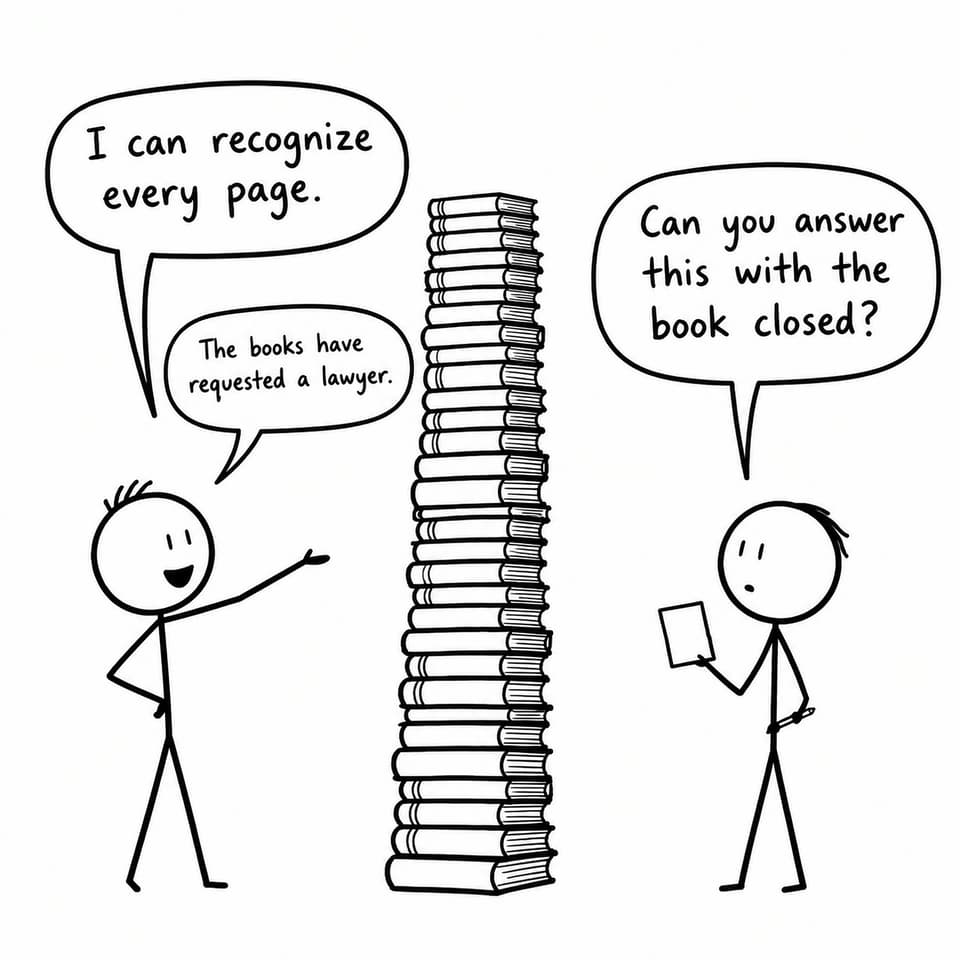
Familiarity is not reliable recall
Notes become easier to read each time you revisit them. That fluency can feel like knowledge because every definition looks familiar.
But a closed-book test asks something different: can you retrieve and use the idea when the page is absent?
Reading helps build understanding, but it should not be where revision ends. After reviewing a small section, close your notes and write what you remember. Explain the concept aloud or solve a problem without following a model answer. RevisionDojo's active-recall guidance can help you turn information into prompts rather than more paragraphs.
Questions reveal what reading conceals
Knowing a formula is not the same as selecting it in an unfamiliar problem. Recognizing a literary technique is not the same as building a relevant argument around it. Assessment requires knowledge expressed through a task.
Move questions earlier in your preparation. Do not wait until you feel completely ready; use questions to discover what preparation remains.
Try this session:
- 10 minutes recalling key ideas without notes
- 25 minutes answering targeted questions
- 15 minutes checking, correcting, and recording errors
- 5 minutes retrying one missed question from a blank page
Explore IB study techniques that actually work and combining mathematics practice with active recall for ways to connect recall with application.
Timing is a separate skill
Untimed work shows whether you can solve a problem eventually. Timed work reveals whether you can recognize the approach and execute it efficiently.
Start with one question or a focused 15-minute set, rather than an entire paper. Mark the response and determine whether the difficulty was knowledge, technique, or pace. Gradually increase the length. RevisionDojo's Predicted Papers and Mock Exams fit later, after targeted Questionbank practice has addressed underlying gaps.
Learn from your first IB grades in DP1
A low result is more useful as a collection of lost marks than as a label. Classify each error in your marked assessment.
Knowledge errors
You forgot a definition, formula, quotation, or process. Repair the gap with concise Study Notes, closed-book recall, and spaced Flashcards.
Application errors
You knew the content but could not use it. Try varied Questionbank problems and compare what changes between examples, rather than memorizing one solution path.
Communication errors
Your response lacked working, terminology, evidence, units, structure, or explanation. Rewrite it using your teacher's comments and marking guidance. AI Chat and Grading tools can help you explore feedback, but your teacher can clarify how that school assessment was marked.
Time and judgment errors
You misread a command term, spent too long on one section, or failed to prioritize marks. Practise deciding what a question requires before writing. A short plan can save more time than it consumes.
Keep your error log simple: record the question, the reason for the lost mark, and your next action. For example, if you selected the correct equation but substituted incompatible units, write “convert units before substitution” and practise another question requiring that step. “Be more careful” gives you little to rehearse. A specific correction gives your next session a clear purpose and makes it easier to check whether the problem has actually improved.
This distinction between activity and improvement underpins productive IB study rather than performative busyness.
Build a better study loop
Use this loop for each weak topic:
- Diagnose: Attempt questions without notes.
- Repair: Review the knowledge or method that blocked you.
- Retrieve: Explain the repaired idea from memory.
- Apply: Answer a new question independently.
- Check: Mark it and identify each lost mark.
- Return: Retry the error several days later.
The loop makes improvement visible: an error disappears, returns, or changes form. For a sustainable start, use the broader RevisionDojo plan for IB DP1 students.
For the first week, keep the experiment small. Diagnose one topic on Monday, repair it on Tuesday, and attempt fresh questions on Thursday. At the weekend, retry an earlier mistake without looking at your correction. Compare the quality of your working and explanations as well as the score. If the same error returns, change the repair step or ask your teacher for help.
As a complete IB resource, RevisionDojo brings these stages together. Questionbank practice exposes gaps; Study Notes, Flashcards, and AI Chat support repair; Grading tools support response review. Predicted Papers and Mock Exams offer longer practice, while the Coursework Library and Tutors provide additional support.
The sequence matters more than browsing every resource. Move deliberately from attempt to feedback to correction.
Do not turn one result into a prediction
An early school test captures one point in a two-year programme. It is not an official final result, and it should not become a fixed story about what you can earn in May 2028.
Predicted grades are teacher judgments informed by evidence and assessment standards, not guaranteed outcomes. Ask what separated your response from the next grade boundary and what would demonstrate improvement. This explanation of how IB predicted grades are set offers context.
Respond calmly without ignoring the signal. Neither panic nor dismissal tells you what to practise next.
Turn the result into your next move
A poor first test hurts because effort created an expectation. It also exposes a mismatch while there is time to address it.
Replace the promise to work harder with one controlled experiment. Choose your weakest topic, complete five closed-book questions from RevisionDojo's Questionbank, and record one specific reason for every mark lost. Let that evidence decide your next session.