


If you have ever finished a three-hour “study session” and still felt strangely unsafe about your next IB exam, you already know the feeling behind Busy vs Productive for IB: Study That Actually Scores.
It usually starts innocently: you open your laptop to do “some revision.” You tidy the desk, make a plan, rewrite a summary, color-code headings, line up resources like you are building a control tower. The work looks impressive from the outside. But then you sit in a timed paper-style question and realize your brain has no traction.
That moment is not about intelligence. It is about training.
The IB does not hand out marks for effort, hours, or aesthetics. It rewards performance under constraints: a question you did not choose, in a time limit you cannot negotiate, with markscheme logic that is often stricter than your own sense of “close enough.”
This is the heart of Busy vs Productive for IB: Study That Actually Scores: busy work protects your confidence by avoiding proof. Productive work creates proof, then uses it.
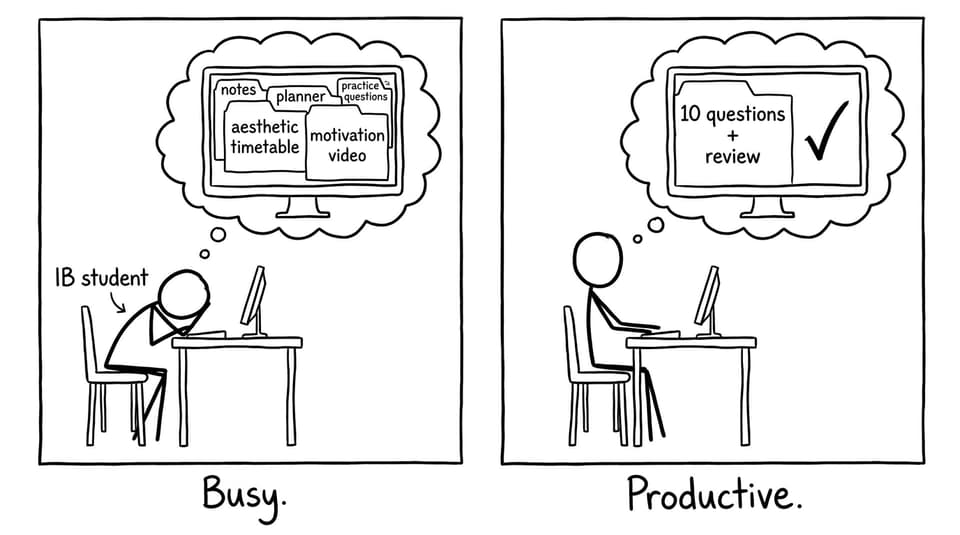
The quick self-check: am I busy or productive in IB today?
When you are tired, stressed, or behind, your brain will quietly push you toward the safest version of studying. Use this checklist as your reset button.
If your session includes two or more, you are usually on the productive side of Busy vs Productive for IB: Study That Actually Scores:
-
Active recall: you retrieve from memory without looking first.
-
Exam-style questions: you do work that resembles what the IB marks.
-
Timing practice: you practice pace, not just content.
-
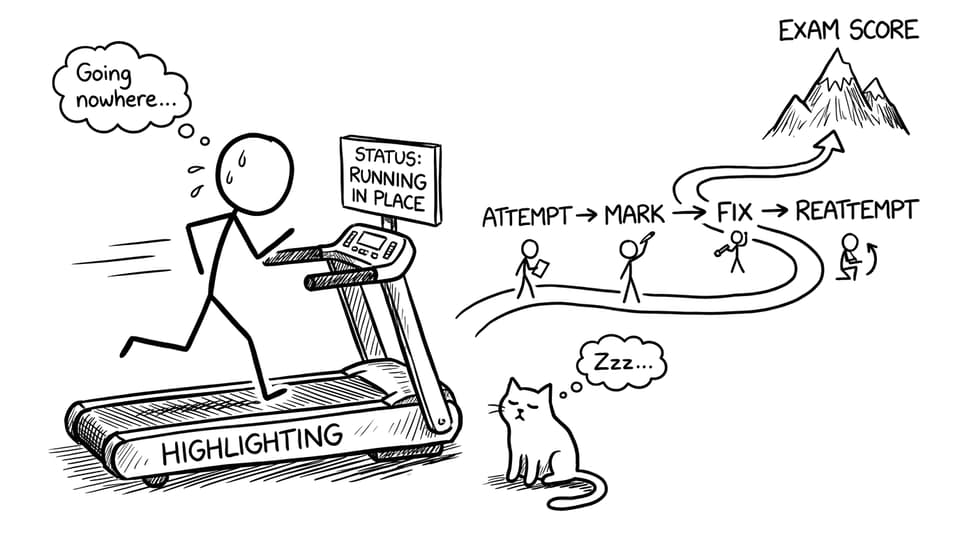
A feedback loop: you check, correct, and reattempt.
-
A clear output: a score, a marked response, or a tagged weakness list.
If your session ends with “I was working, but I cannot show what improved,” you were probably busy.
Why busy studying feels so convincing (especially in IB)
Busy studying is rarely laziness. In the IB, it is usually anxiety wearing a productivity costume.
Busy work tends to be:
-
low-risk (you cannot really fail at highlighting)
-
soothing (clean notes feel like control)
-
endless (you can always “improve” the resource)
Common “busy” patterns in IB exam season:
-
rewriting notes because it feels responsible
-
making flashcards for hours but not reviewing them
-
watching explanations for topics you already basically understand
-
switching subjects repeatedly to reduce guilt
-
spending 30 minutes deciding what to do next
The trap is that busy studying produces motion, not feedback. And without feedback, you cannot prioritize. Without prioritization, you keep working hard in the wrong direction.
If you want a calm, structured IB system that reduces this drift, start with RevisionDojo’s IB hub: All your IB revision needs, in one place.
What productive studying looks like in IB (marks, not motion)
Productive study usually looks simpler. Sometimes almost boring. But it produces something you can measure.
Productive work in Busy vs Productive for IB: Study That Actually Scores tends to include:
-
attempting questions you might get wrong
-
checking markscheme logic (why marks were awarded, not just the final answer)
-
spotting repeating mistakes and turning them into rules
-
reattempting the same question type 48-72 hours later
-
timing a section so your pacing becomes familiar
It can feel uncomfortable in the moment because it exposes gaps. But it becomes calming over days because your weaknesses turn into a finite list.
The hidden cost: decision fatigue (the real reason you feel behind)
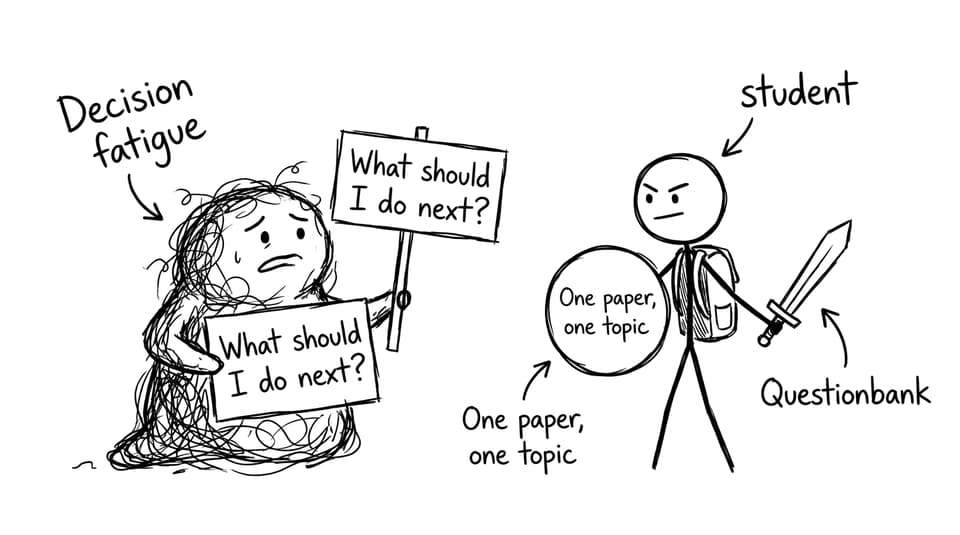
In IB revision, one of the biggest energy leaks is not “hard content.” It is constantly answering: What should I do next?
Every time you:
-
search for a new resource
-
rebuild a plan mid-session
-
bounce between tabs
-
debate which topic is “highest yield”
…you burn focus that should have gone into recall, application, and review.
This is why an all-in-one workflow matters. When your notes, practice questions, feedback, and retesting are connected, you spend less time steering and more time driving.
If you want a broader structure for exam prep, keep this guide bookmarked: How to Study for IB Exams: Step-by-Step Guide.
The “one paper, one topic” rule (a simple antidote to busy)
Vague goals create busy work.
“Revise Chemistry” is too big. Your brain reacts by choosing something that resembles studying but avoids failure.
Instead, plan in paper-shaped units:
-
one subject
-
one paper
-
one topic
-
one question type
-
one constraint (timed or untimed)
This is the smallest unit of work that produces honest feedback.
When you build sessions this way, Busy vs Productive for IB: Study That Actually Scores stops being a mindset debate and becomes a design choice.
The IB productivity loop: Learn -> Recall -> Apply -> Review -> Repeat
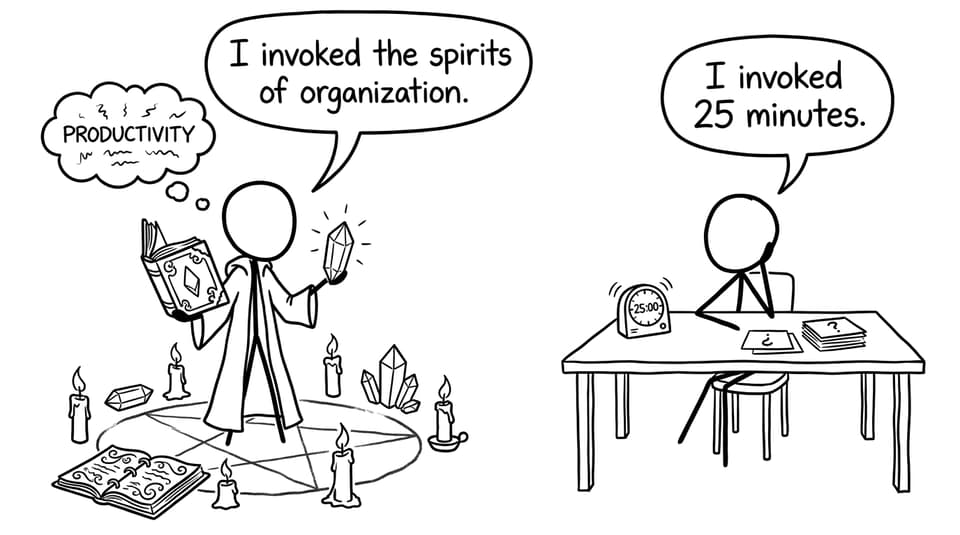
If IB productivity had a secret, it would be this: productivity is a loop, not a mood.
You do not wait to feel motivated. You run the loop until motivation shows up as a side effect.
Learn fast (clarity, not perfection)
Notes are a map, not a mattress.
Use Study Notes to understand the minimum you need, then leave quickly. If you spend the whole session rewriting, you are paying time for the feeling of safety.
RevisionDojo’s Study Notes are designed to be syllabus-aligned and exam-oriented, which helps you avoid the endless “make it pretty” spiral.
If you want a deeper explanation of how the platform connects the loop, read: RevisionDojo App: The Smarter Way to Prep for IB Exams.
Recall daily (prove you can retrieve)
Do short, daily recall even on chaotic school days. This is the compounding habit.
This is where Flashcards and spaced repetition matter. Not because flashcards are magical, but because they force retrieval.
A strong companion read for this stage is: IB Flashcard System: Active Recall for Better Memory.
If you want the bigger method behind it, this article pairs well with Busy vs Productive for IB: Study That Actually Scores: Active Recall for IB: The Only Method You Need.
Apply with exam-style questions (practice how the IB marks)
This is the moment productive students separate from busy students: they do questions that look like the exam.
Use targeted practice so you are not guessing what to do next. RevisionDojo’s Questionbank is built for this: topic filters, difficulty control, and analytics that turn your mistakes into a plan.
Start here: Comprehensive IB Question Bank: Thousands of Practice Questions.
When you are stuck deciding what to drill, use: IB Question Search Engine: Find Questions by Keyword.
Review like an analyst (mistakes become data)
Busy students avoid review because it feels personal. Productive students review because it is efficient.
Keep a short error log:
-
what I did
-
why it lost marks
-
the rule that fixes it
-
the next question type to practice
RevisionDojo’s AI Chat helps here: you can ask one precise question about the mistake and keep momentum, instead of turning confusion into an hour-long internet spiral.
Repeat with slightly more pressure (timing and realism)
Once you have accuracy, increase realism: mix topics, raise difficulty, or add time pressure.
This is where Mock Exams and Predicted Papers matter, because the IB is also stamina and pacing. Not just knowing.
If you want a simple entry point into timed practice, start with: IB Paper 1 Mock Exams: Master Multiple Choice Questions.
A busy-proof weekly plan (realistic, repeatable, score-focused)
This plan is designed around Busy vs Productive for IB: Study That Actually Scores. It assumes you are still in school, still tired, still human.
Daily (30-75 minutes)
-
10 minutes: Flashcards (active recall only)
-
25-45 minutes: Questionbank set (one topic, one paper)
-
5-15 minutes: review mistakes + tag weak areas
The daily win condition is simple: you end with proof.
Twice per week (45-90 minutes)
-
Study Notes for one subtopic (fast)
-
Immediately convert into questions (Questionbank)
-
Ask AI Chat one “blocking” question you keep avoiding
This stops “learning” from becoming a place you hide.
Once per week (60-150 minutes)
-
one timed section or mini mock
-
review longer than you sat the timer
The review is where improvement is manufactured. The timed attempt is just the test.
If consistency is your bottleneck, read: How to Stop Procrastinating in IB (Without Burning Out) and How to Build Habits That Stick During IB.
Where RevisionDojo fits (when you want “productive” to become automatic)
Most IB students do not need more resources. They need fewer gaps between steps.
RevisionDojo is built to keep the whole loop in one place:
-
Questionbank for exam-style practice and targeted drilling
-
Study Notes for syllabus-aligned clarity
-
Flashcards for daily recall and spaced repetition
-
AI Chat to get unstuck without derailing the session
-
Grading tools to turn written work into actionable feedback
-
Predicted Papers and Mock Exams to train timing and pressure
-
Coursework Library to reduce uncertainty by showing strong exemplars
-
Tutors when you need a human to triage priorities fast
The goal is not to study more. It is to make your next action obvious.
If your schedule is intense right now, this perspective helps: IB Exams Without Pausing Your Life.
Closing: train the skill that the IB actually marks
The difference in Busy vs Productive for IB: Study That Actually Scores is not effort. It is direction.
Busy IB revision tries to feel prepared. Productive IB revision tries to become prepared by generating feedback, then using it.
So start small and make it honest: one paper, one topic, one Questionbank set, then review. Let your mistakes tell you what to do next. Build daily recall with Flashcards. Use AI Chat to unblock confusion without losing the session. Add Mock Exams and Predicted Papers when you are ready to practice under pressure.
When you are ready to turn your IB study time into marks, not just hours, build your loop inside RevisionDojo: All your IB revision needs, in one place.