

If you are wondering about active recall and how does it help in MYP, the short answer is simple: active recall means trying to retrieve information from memory before checking your notes. It helps MYP students remember knowledge for longer, identify weak areas, and practise explaining or applying ideas rather than merely recognizing them on a page.
That distinction matters. Rereading can make a topic feel familiar, but an assessment asks you to produce an answer without seeing it first. Active recall creates small, low-pressure versions of that moment during revision.
It is not a complete study system by itself. MYP assesses subject knowledge alongside inquiry, communication, critical thinking, and application. The strongest routine combines retrieval with feedback, criteria-based questions, and practice in unfamiliar contexts.
Your active recall checklist
A useful MYP recall session follows six steps:
- Choose one small concept or skill.
- Close every source before answering.
- Retrieve the idea in writing, aloud, or through a question.
- Compare your answer with reliable notes.
- Correct errors and explain why they occurred.
- Return to the same idea after a delay.
The RevisionDojo MYP resource hub supports this loop with subject-specific Study Notes, Flashcards, Questionbank practice, and worked explanations.
What active recall means
Active recall is the deliberate attempt to bring knowledge out of memory. You might answer a flashcard, draw a process on blank paper, define a command term, solve a problem without an example, or explain a concept aloud.
The important feature is not the format. It is the attempt.
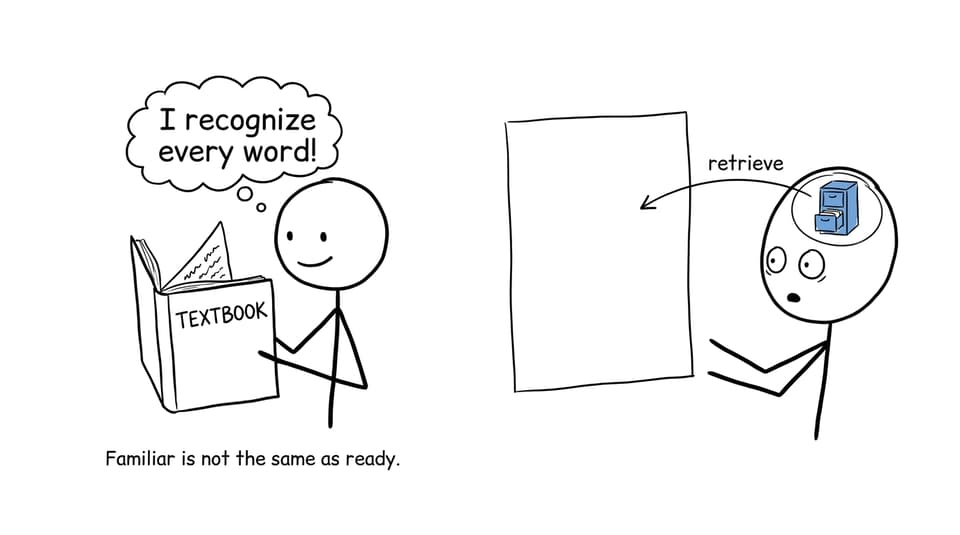
Looking at a definition and thinking, “Yes, I know that,” is recognition. Closing the book and accurately writing the definition is retrieval. Recognition feels easier because the page supplies clues. Retrieval feels harder because you must reconstruct the idea yourself.
That difficulty is useful when it remains manageable. Research on retrieval practice has found that recalling learned material can strengthen later retention and reveal missing knowledge, especially when students check their answers and receive feedback.
How active recall helps in MYP
It exposes the familiarity gap
Imagine reading a page about cell respiration three times. Every phrase looks familiar. Then someone asks you to explain the role of oxygen without the page, and the answer disappears.
The reading was not necessarily useless. It simply did not test whether the information was retrievable. A blank-page explanation would have exposed the gap earlier, while there was still time to fix it.
This is why active recall is one of the most useful MYP revision techniques. It turns a vague feeling of confidence into visible evidence. You either retrieve the idea accurately, retrieve part of it, or discover that it needs more work.
It supports concept-based learning
MYP learning is not limited to collecting isolated facts. Students are expected to understand concepts and connect ideas to real situations. Recall questions should reflect that expectation.
A weak prompt asks, “What is diffusion?” A stronger sequence asks:
- What is diffusion?
- Which factors affect its rate?
- How would the process change in a new situation?
- What evidence would support your explanation?
The first question retrieves knowledge. The others make that knowledge flexible. In MYP Sciences, RevisionDojo’s guide to revising MYP Sciences combines concept explanations with data analysis and unfamiliar contexts.
It improves command-term responses
Knowing a topic and answering the question set are different skills. A student may understand an event but lose marks by describing it when the task asks them to evaluate it.
Include command terms in your prompts:
- Describe: What happened or what pattern is visible?
- Explain: Why did it happen?
- Compare: What are the relevant similarities and differences?
- Evaluate: What judgment can be supported by evidence?
You are retrieving both subject knowledge and the structure needed to communicate it. The broader MYP revision guide explains how criteria, command terms, reflection, and timed practice fit together.
It creates better feedback
Notes cannot show you what you would have forgotten. A recall attempt can.
After answering, check for missing vocabulary, unsupported claims, calculation errors, or steps in the wrong order. RevisionDojo’s Grading tools and Questionbank feedback can help identify weaknesses, while AI Chat can clarify a misconception before you try again.
The correction is only half the process. Close the explanation and retrieve the corrected version. Otherwise, you may understand the feedback without being able to use it independently.
A method you can start today
You do not need a new timetable or hundreds of flashcards. You need one topic, a blank page, and about 30 minutes.
Choose one micro-topic
Avoid targets such as “revise biology.” Choose something narrow, such as cell respiration, linear equations, persuasive techniques, or causes of migration. Students studying biology could begin with the MYP Biology resources and select one section.
Write five useful questions
Create a mixture of prompts:
- one definition question
- one explanation question
- one comparison or connection question
- one application question
- one question using an MYP command term
RevisionDojo Study Notes can help identify essential ideas. If your questions are unclear, ask AI Chat to turn the topic into concise recall prompts. Check that every prompt matches material you have learned.
Retrieve, check, and correct
Set a timer for eight minutes. Answer from memory on paper or aloud. For mathematical or scientific content, reproduce the complete method, including units and working. For language or humanities subjects, state a claim and retrieve the evidence or reasoning that supports it. The MYP Individuals and Societies resources help combine content review with structured questions.
Open your notes and compare each response. Add omitted details in another color, but do not copy entire paragraphs. Label each answer Secure, Developing, or Not secure. Spend most of your time on developing and insecure material.
Read each correction once, close it, and answer again in your own words. If you still cannot retrieve the idea, reduce the question into smaller steps. RevisionDojo Flashcards support short repetitions, while the Questionbank tests whether knowledge survives inside a fuller task.
Schedule short returns
Revisit the questions tomorrow, several days later, and approximately one week later. These are practical starting points, not universal rules. Difficult material may need earlier review, while secure material can wait longer.
Begin each return without notes. Mix old questions with newer ones so you must identify the relevant method rather than repeat a predictable sequence.
Common mistakes
The first mistake is creating cards that contain paragraphs. A flashcard should prompt retrieval, not become a miniature textbook.
The second is recalling an answer incorrectly without checking it. Practice needs accurate feedback. Use trustworthy class material or RevisionDojo Study Notes, then correct and retest the response.
The third is memorizing definitions while ignoring application. MYP tasks require explanation, analysis, evaluation, creation, or problem-solving. Move from Flashcards into Questionbank tasks and timed Mock Exams when appropriate.
The final mistake is turning every evening into a marathon. Short, repeated sessions are easier to sustain and give you more opportunities to retrieve material after a delay. For additional guidance, see RevisionDojo’s active recall study routine.
Build active recall into MYP revision
Active recall works best as the memory layer within a broader system. Use Study Notes to understand an idea, Flashcards to retrieve it, the Questionbank to apply it, and Grading tools to improve the response. Use AI Chat when a misconception blocks progress, but finish by answering independently.
Longer MYP tasks need different support. The Coursework Library can help students understand the shape of strong academic work without replacing their authorship, while Tutors can provide targeted guidance when independent attempts are not resolving a problem. Predicted Papers and Mock Exams are useful where available for realistic timing and mixed-task practice.
RevisionDojo brings those stages together. Effective revision is a quiet loop: retrieve, check, correct, apply, and return. Start with five questions today, and your next MYP assessment will draw on knowledge you have already practised finding.