


You do not have to love history to become good at it. Staying engaged in MYP History is usually less about forcing enthusiasm and more about changing the task: replace passive reading with short investigations, concrete questions, and visible progress.
Waiting to feel interested gives motivation control over your work. Starting with one manageable question gives you control. The goal is not to pretend every treaty, revolution, or political system is fascinating. It is to make the next 20 minutes worthwhile.
A quick engagement checklist
When MYP History feels dull, try this sequence:
- Turn the topic into one question you genuinely want answered.
- Connect the event to power, fairness, identity, technology, or life today.
- Work for 20 focused minutes instead of planning a long session.
- Examine one source, image, speech, or object instead of rereading a chapter.
- Produce something: a timeline, argument, voice note, quiz, or source evaluation.
- Finish by recording one thing you understand better.
The RevisionDojo MYP History resource hub supports this process with Study Notes, Flashcards, definitions, practice questions, lessons, and feedback.
Change what you think History is
History can feel lifeless when it is presented as a warehouse of names and dates. But dates are not the subject. They are coordinates.
The real subject is human choice under pressure. Why did people support an unfair system? Why did one protest succeed while another failed? Who benefited from industrial change? Why do two accounts describe the same event differently?
MYP Individuals and Societies emphasizes inquiry, interpretation, real-world examples, and original source material. History frequently returns to change, systems, perspective, causality, conflict, and significance. The guide to MYP History topics and concepts explains how these ideas organize the course.
A better mindset is: I am not collecting facts; I am investigating why people acted as they did. Facts still matter, but now they have a purpose.
Find one personal doorway into each unit
You may not choose the unit, but you can choose how you approach it. During a unit on industrialization, for example, you might investigate inventions, working conditions, inequality, environmental effects, or changing family life. The content remains historical, but the doorway becomes personal.
Begin each unit with one lens:
- Power: Who could make decisions, and who could not?
- Fairness: Who gained, and who suffered?
- Identity: How did class, nationality, religion, or gender shape experience?
- Change: What changed, and what remained the same?
- Perspective: Why might people remember the event differently?
- Today: Where can its consequences still be seen?
Write your chosen question above your notes. Each new fact can then become possible evidence rather than another isolated detail.
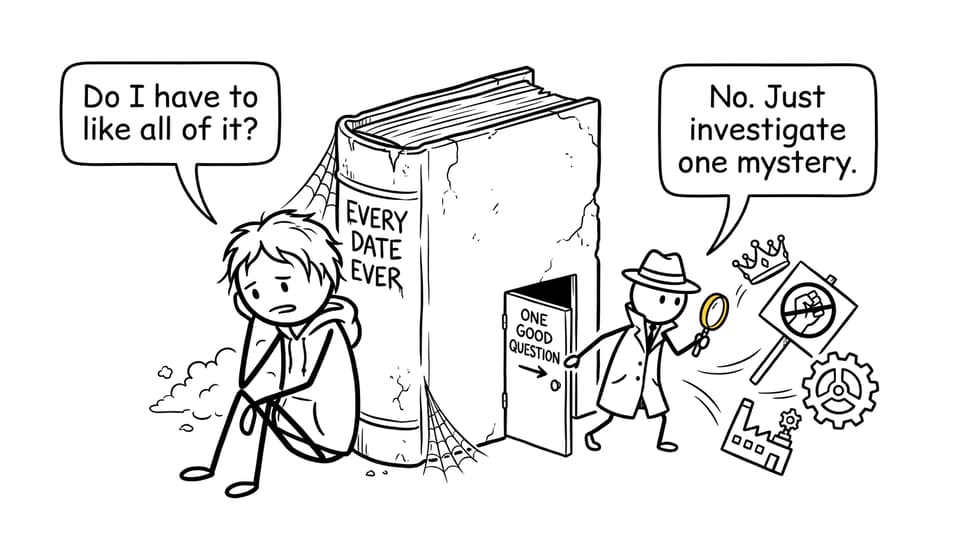
Replace passive reading with detective work
Boredom often grows when your only instruction is “read and remember.” Give yourself a problem to solve instead.
Choose a photograph, law, diary entry, speech, poster, map, or statistic. Ask who created it, which audience it addressed, what its creator wanted, what it reveals, and what it cannot prove alone. This turns a document into evidence with strengths and limits.
RevisionDojo’s guide to analyzing historical sources in MYP History provides a fuller method using origin, purpose, audience, context, value, and limitations. Keep the activity small. One carefully examined poster can demand more thought than ten passively read pages. That thought is engagement, even when it does not feel like excitement.
Use a low-friction study routine
Motivation is unreliable because it often arrives after progress, not before it. A routine reduces the negotiation required to begin.
Try this 25-minute session:
| Time | Task |
|---|---|
| 3 minutes | Write one question about the topic from memory. |
| 7 minutes | Use Study Notes to find essential context. |
| 5 minutes | Retrieve key terms with Flashcards. |
| 7 minutes | Answer one focused question without notes. |
| 3 minutes | Check the response and write one improvement rule. |
Make that rule specific. “Do better” changes nothing. “After naming a cause, explain how it produced the outcome” gives your next attempt direction.
The broader MYP revision guide shows how to combine concepts, criteria, practice, and reflection. If starting remains difficult, these MYP motivation strategies can help you reduce the task until beginning feels manageable.
Make your progress visible
Disliked subjects often feel endless because improvement is hard to see. Divide a page into three categories: I can recall, I can explain, and I can evaluate.
You may initially remember that an event happened without explaining its causes. Later, you might explain two causes but struggle to judge which was most significant. That movement is progress.
RevisionDojo makes the learning loop easier to see. Use the Questionbank to isolate a skill, Study Notes to repair missing context, and Flashcards for retrieval. Ask AI Chat for a simpler explanation when necessary, then close it and restate the idea independently. Use Grading tools to diagnose weaknesses instead of merely labeling an answer good or bad.
The essential loop is attempt, inspect, adjust, and retry. The guide to common MYP Geography and History response errors can turn vague feedback into a practical next action.
Aim for competence before enjoyment
Enjoyment sometimes follows competence. When every source seems confusing and every response feels uncertain, avoidance is understandable. Once you can identify a claim, select evidence, and explain significance, the subject becomes less threatening.
Do not make loving History your target. Aim to explain one cause clearly, compare two perspectives, evaluate one source, answer the command term, or work for 20 minutes without switching tabs.
If assessment language feels mysterious, read RevisionDojo’s explanation of MYP Criterion D and critical thinking. Mock Exams can later develop stamina, while Tutors can help when a problem survives repeated independent attempts. RevisionDojo also offers Predicted Papers and a Coursework Library, but you do not need every tool at once. The best resource is the one that solves today’s obstacle.
Your next step
Open your current topic and write one question beginning with why, how, or to what extent. Spend seven minutes finding evidence, then write three sentences: one claim, one example, and one explanation.
A small completed investigation is more valuable than an ambitious session you never begin. Staying engaged does not mean pretending to enjoy every lesson. It means creating enough curiosity, structure, and momentum to remain present. RevisionDojo provides the route from explanation to retrieval, practice, feedback, and support. Your part is smaller: begin with one good question.