


September can feel full of possibility. By November, the same school year can look like a road with no visible end. Summer is distant, deadlines are multiplying, and the excitement of a new term has faded.
If you are wondering how to stay motivated when it's months until summer, do not try to manufacture enthusiasm every morning. Build a routine that works when enthusiasm is absent. Focus on the next visible milestone, keep daily work repeatable, and protect the rest that makes consistency possible.
Motivation helps. A dependable system helps more.
Your fall-term motivation checklist
Use this reset when the IB year begins to feel endless:
- Choose one academic priority for the next two weeks.
- Define a minimum session for difficult days.
- Turn vague goals into measurable actions.
- Track completed work, not hours spent worrying.
- Separate coursework from subject revision.
- Schedule one genuinely free period each week.
- Ask for help before confusion becomes avoidance.
- Review your plan every Sunday.
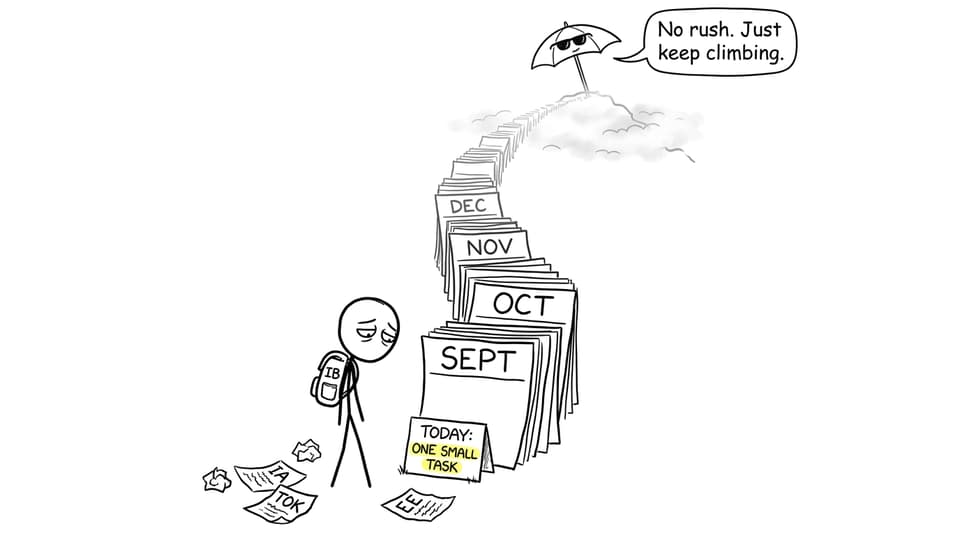
Stop measuring the year by its finish line
Summer is a poor motivational target in October. It is too far away to shape what you do after school today.
Instead of thinking, “I need to survive until summer,” divide the fall term into short chapters. A chapter might end with an IA checkpoint, class assessment, completed unit, or two-week revision cycle.
At the beginning of each chapter, ask:
- What must be completed?
- What skill should improve?
- What can wait?
This turns an enormous school year into manageable decisions. It also prevents every IB responsibility from feeling equally urgent. For help building that structure, try this low-stress daily IB study schedule.
Build a minimum routine for difficult days
A routine designed only for your best days will fail on ordinary ones. The fall term includes crowded weeks, difficult lessons, and afternoons when concentration arrives late.
Create a minimum routine that still counts as progress:
- 10 minutes of Flashcards
- 15 minutes of targeted Questionbank practice
- 5 minutes reviewing mistakes
- 2 minutes choosing tomorrow's first task
This is not your maximum. It is your floor.
A small commitment lowers the emotional cost of beginning. Some days you will stop after the minimum. On others, the first few minutes will create enough momentum to continue. Both outcomes matter because the routine survives.
That distinction sits at the heart of IB discipline versus motivation: motivation changes, but a simple starting ritual remains available.
Make progress visible
IB students often complete meaningful work without feeling they have moved forward. Research, planning, and correcting mistakes can be hard to see. Your memory records what remains unfinished instead.
Keep a small evidence log. Record outputs such as:
- 12 Biology questions completed
- one English introduction rewritten
- three Mathematics errors corrected
- five EE sources evaluated
- one TOK claim clarified
“Studied Chemistry” says little. “Completed eight equilibrium questions and corrected two misconceptions” provides proof.
RevisionDojo makes this loop easier to sustain. Use Study Notes to clarify a narrow topic, Flashcards to retrieve it, and the Questionbank to test application. If a misconception stalls the session, AI Chat can help isolate the problem. The goal is not to collect tools. It is to finish with visible evidence.
Separate coursework from daily revision
During September-to-November, subject learning competes with IAs, the EE, TOK, CAS, and school deadlines. When everything lives on one list, every task feels equally heavy.
Divide weekly work into three lanes:
| Lane | Examples | Useful rhythm |
|---|---|---|
| Subject learning | Notes, recall, topic questions | Short sessions across the week |
| Coursework | IA analysis, EE research, TOK drafting | Fewer, longer focused blocks |
| Performance | Timed responses, mark review, technique | One controlled session each week |
RevisionDojo's Coursework Library can show what strong academic work looks like, while Grading tools can identify areas for improvement. Later, Mock Exams and Predicted Papers can support sustained timed practice. During fall, however, smaller sections are usually easier to repeat.
The IB revision strategy guide explains how to connect planning, practice, correction, and retesting.
Plan around your real energy
A timetable can look impressive and remain unrealistic. The common mistake is planning for the person you wish you were at 8 p.m., rather than the person who arrives there after a full school day.
Place demanding work where your concentration is usually strongest. Use lower-energy periods for Flashcards, organizing sources, reviewing feedback, or correcting familiar questions. Keep one evening lighter after a demanding day.
Sleep and recovery are not rewards for finishing everything. They help make continued effort possible. Sacrificing sleep to rescue one evening can make the following day harder, creating a cycle that resembles laziness but is often exhaustion.
If persistent tiredness, detachment, anxiety, or difficulty concentrating affects daily life, speak with a parent, teacher, school counselor, doctor, or another trusted adult. A study plan should not conceal a health problem. These ideas for avoiding burnout during the IB Diploma can also help make the workload sustainable.
Turn unclear goals into next actions
Sometimes you are not unmotivated. You simply do not know what to do next.
Replace “work on my IA” with “rewrite the method paragraph using my teacher's comments.” Replace “revise Mathematics” with “complete ten functions questions and categorize each error.” Precise actions make beginning easier.
If the gap remains unclear, ask a teacher, use RevisionDojo's AI Chat, or work with its Tutors. The broader IB resources hub brings the Questionbank, Study Notes, Flashcards, feedback, and other support together.
Keep the promise small enough to repeat
A successful fall term is built from modest evidence: one corrected misconception, one finished paragraph, one honest rest period, and one return after a difficult day. You can find more practical ideas in these ways to stay motivated during the IB Diploma.
RevisionDojo is the ultimate IB resource because it supports the full learning cycle, from understanding and recall to application, feedback, coursework, and timed performance. The most important step remains wonderfully ordinary: choose the next useful task, make it small, and begin.