
The question "Should my child do IB?" often carries several quieter questions inside it. Will they cope? Will they still have a life? Will universities value the qualification? And will saying yes open doors or simply create two difficult years?
Here is the clear answer: the IB Diploma can be an excellent choice for a motivated, reasonably organised student who enjoys learning across several subjects and is willing to improve their study habits. Your child does not need to be effortlessly brilliant. They do, however, need the right subject combination, realistic expectations, support from their school, and a daily system that prevents small tasks from becoming large emergencies.
The decision should be based less on prestige and more on fit. The IB is demanding, but demanding and unsuitable are not the same thing.
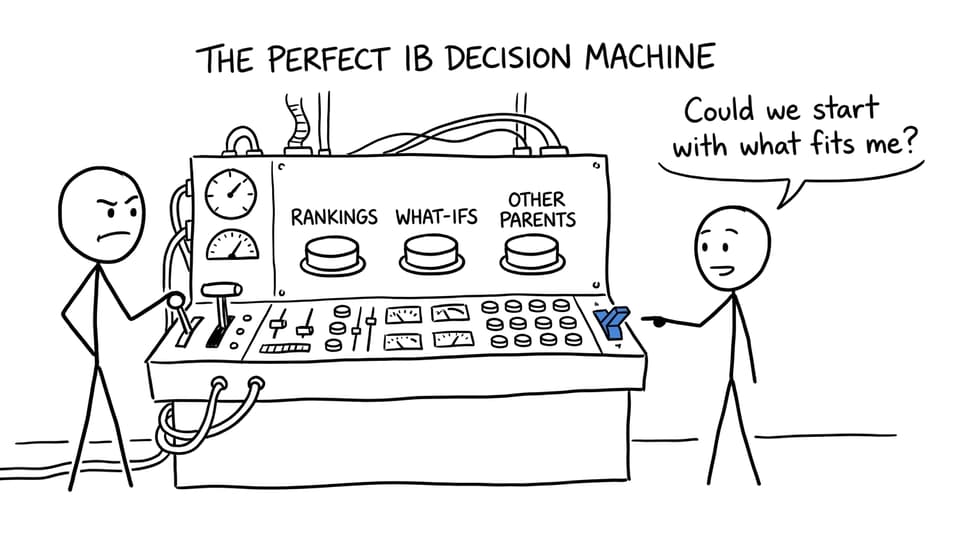
The short decision checklist
The IB Diploma is likely worth serious consideration if your child:
- enjoys several academic areas rather than wanting to specialise immediately
- can work independently, or is willing to learn how
- responds constructively to feedback
- has three plausible Higher Level subjects that match their strengths or university plans
- is prepared to manage coursework, revision, and activities concurrently
- attends a school with strong IB teaching, coordination, and pastoral support
- wants an internationally recognised university-entry qualification
Pause and investigate alternatives if your child strongly dislikes academic breadth, has no sustainable subject combination, is already experiencing significant unmanaged stress, or would be better served by a more specialised or career-focused route.
This is not a verdict on intelligence. It is a question of educational fit.
What is the IB Diploma?
The International Baccalaureate Diploma Programme is a two-year programme for students aged 16 to 19. Students normally study six subjects, with at least three and no more than four taken at Higher Level. The remaining subjects are taken at Standard Level.
Higher Level courses have 240 recommended teaching hours, compared with 150 for Standard Level. Both levels contribute to the final score, but HL subjects involve greater scope and depth. RevisionDojo's explanation of HL and SL in the IB offers a useful comparison before subject decisions are finalised.
Alongside six subjects, students complete the Diploma core:
- Theory of Knowledge, which examines how knowledge is produced and evaluated
- The Extended Essay, an independent research paper of up to 4,000 words
- Creativity, Activity, Service, a programme of experiences and a collaborative project
Each academic subject is graded from 1 to 7. Up to three additional points can come from Theory of Knowledge and the Extended Essay, creating a maximum score of 45. The minimum overall threshold for the Diploma is 24, but students must also satisfy additional conditions, including completing CAS and meeting requirements across their HL and SL subjects.
For a fuller foundation, read how the IB Diploma works for students and parents.
Who tends to thrive in the IB Diploma?
The strongest IB candidate is not always the student with the highest marks at 15. Often, it is the student who can tolerate being temporarily confused, ask for help, and return to a difficult task without treating struggle as proof that they do not belong.
Students who like breadth
An aspiring engineer may still study literature and a second language. A future historian will still take mathematics and science. This breadth is part of the Diploma's purpose, but it can frustrate students who want to abandon certain academic areas completely.
Ask your child whether breadth feels stimulating or merely restrictive. Their answer matters.
Students who can become organised
IB students handle subject assessments, the Extended Essay, Theory of Knowledge, CAS, school tests, and final examinations. No single task necessarily causes the pressure. The challenge comes from overlap.
Organisation is therefore more important than perfection. A student who records deadlines, starts coursework early, and studies in regular blocks may be better positioned than a naturally quick learner who relies on last-minute effort. The good news is that organisation can be taught. A balanced IB study schedule can make the workload visible before it becomes intimidating.
Students with a reason for their HL choices
Higher Level subjects should sit at the intersection of three considerations:
- What does the student enjoy?
- Where have they demonstrated ability?
- What do possible university courses require?
University requirements differ by institution, country, and degree. Families should check official course pages rather than relying on general assumptions. RevisionDojo's guide to choosing IB Higher Level subjects wisely can help structure the conversation.
The real workload: challenging, but manageable
The IB's reputation for difficulty is not imaginary. Six subjects and three core components create a sustained workload. Yet the more useful question is not whether the IB is hard. Most worthwhile qualifications are. The useful question is whether your child can build a routine that makes the work predictable.
| Pressure point | A practical response |
|---|---|
| Several deadlines converge | Maintain one calendar for subjects, TOK, the Extended Essay, and CAS |
| Revision keeps being postponed | Schedule short question-based sessions from the first term |
| A weak topic becomes intimidating | Ask for help early, then practise that exact skill |
| Coursework expands endlessly | Break it into research, outline, draft, feedback, and revision stages |
| Every evening feels academic | Protect sleep, movement, meals, and genuine time away from study |
The difference between manageable pressure and chronic panic is often lead time. Fifty minutes spent early can prevent five frantic hours later.
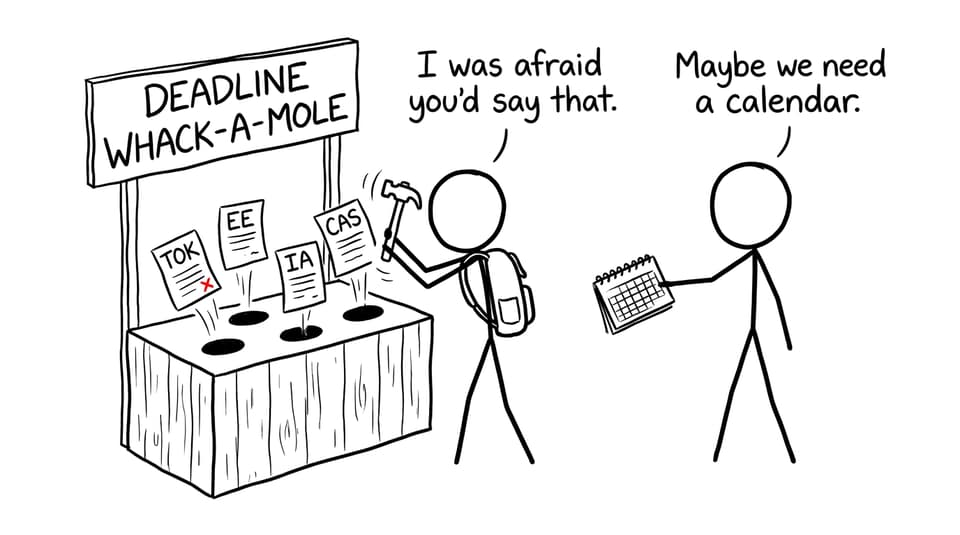
Parents can support this without becoming project managers. Ask, "What is coming up in the next two weeks?" rather than, "Have you finished everything?" The first question encourages planning. The second is so broad that it often produces defensiveness.
RevisionDojo's guide to time management techniques for IB students provides methods students can adapt rather than a rigid timetable they will abandon.
The advantages parents should weigh
Strong preparation for independent study
The Extended Essay asks students to define and investigate a focused research question. Theory of Knowledge requires them to examine claims and assumptions. Subject assessments demand more than memorising isolated facts. Together, these elements can develop research, argument, reflection, and time-management skills that are relevant to university study.
That does not mean every graduate arrives at university perfectly prepared. It means the programme repeatedly gives students opportunities to practise independent academic work before they leave school.
International university recognition
The Diploma is widely recognised by universities around the world. However, recognition does not mean identical admissions treatment everywhere. Universities may set an overall points requirement, demand particular HL subjects and grades, use local equivalency procedures, or grant credit under their own policies.
Families should create a small spreadsheet of possible degrees and record each institution's current requirements. This is especially important for courses such as engineering, medicine, economics, and natural sciences, where subject prerequisites can be specific. The question is not simply whether a university accepts the IB, but whether your child's proposed subjects satisfy the course conditions.
A broad education with room for depth
The IB asks students to remain broad while going deeper in selected subjects. For the right teenager, this is a valuable compromise between keeping future options open and developing genuine specialisation.
If your child remains undecided about university, review IB subject options for students who are unsure about their degree.
When the IB may not be the right choice
A respected programme can still be the wrong programme for a particular student.
Consider another pathway if your child wants early specialisation and finds compulsory breadth deeply demotivating. The same applies if their preferred IB school cannot offer the necessary subjects, has restrictive timetable combinations, or lacks stable support for the Extended Essay and coursework.
Wellbeing also deserves honest attention. Ordinary nervousness about a challenging programme is not necessarily a reason to avoid it. Significant existing anxiety, exhaustion, or health difficulties require a more individual discussion with the child, school, and relevant professionals. The goal is not to prove that your child can endure the hardest available route. It is to choose a route on which they can learn and remain well.
Before enrolling, ask the school:
- Which subjects and HL combinations are actually available?
- How are major coursework deadlines coordinated?
- What academic and pastoral support exists?
- How experienced are teachers with the current IB curriculum?
- When can students change a subject or level?
- How does the school support university planning?
RevisionDojo's pre-IB questions every student should ask can help families prepare for that meeting.
How parents can help without taking over
The most valuable parental role is to create stability around the work, not to perform the work.
Hold a brief weekly check-in about deadlines and pressure points. Provide a suitable place to study where possible. Encourage early conversations with teachers. Treat disappointing marks as information about knowledge, technique, or timing rather than a judgement about character.
Most importantly, keep the relationship larger than the Diploma. A teenager should know that a score matters without believing it determines their worth.
If subject choices become tense, use questions instead of declarations. Ask what your child likes about a subject, what evidence they have about its difficulty, and whether it is required for a likely university route. RevisionDojo's guide to talking with your child about IB subjects and careers offers a calm framework.
Build the support system before it is needed
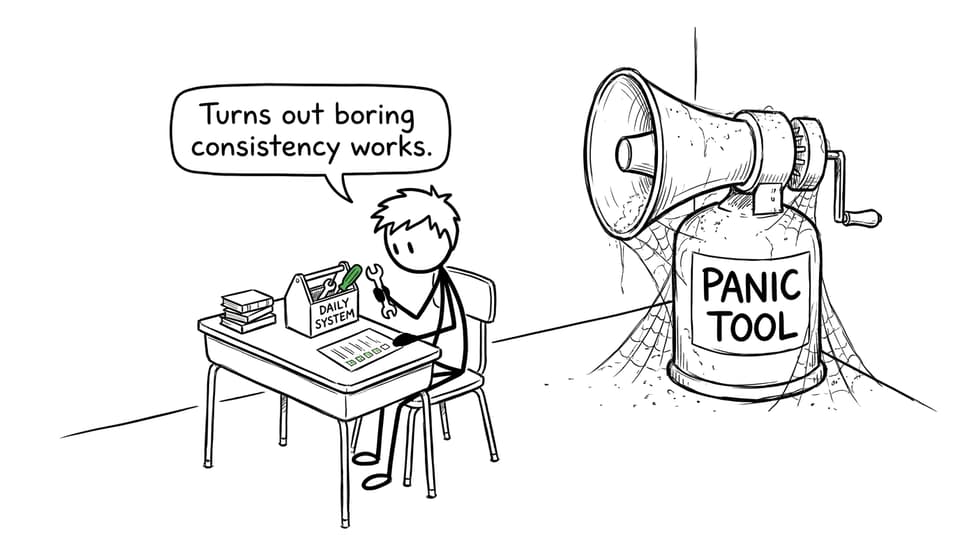
Many families look for academic support only when grades fall or deadlines collide. By then, every decision feels urgent. A better approach is to establish a modest daily system from the beginning.
RevisionDojo is designed as that system. Students can clarify content with Study Notes and AI Chat, retain it with Flashcards, and apply it through the Questionbank. Grading tools and the Coursework Library support more informed drafting, while Predicted Papers and Mock Exams help students develop timing and exam stamina. When more personal guidance is needed, Tutors add human explanation and accountability.
The point is not to use every feature every day. It is to shorten the distance between confusion, practice, feedback, and improvement. Families can explore RevisionDojo's IB study support for parents to understand how that routine can work from the first term rather than becoming a crisis response.
A final way to make the decision
Do not ask whether the IB is the best qualification in the abstract. Ask whether it is the best available environment for this child, at this school, with these subjects and this support system.
Talk with your child, review realistic HL combinations, check current university requirements, and question the school's IB coordinator. Then decide together. If the fit is right, the IB is demanding but very doable. With RevisionDojo supporting learning, practice, feedback, and exam preparation from day one, your child can approach those two years with a plan rather than a promise to somehow work harder later.