
Saltatory conduction is the rapid propagation of an action potential along a myelinated axon. Myelin electrically insulates the internodal membrane, while ion pumps and channels are concentrated at gaps called nodes of Ranvier. Local currents spread beneath the myelin and trigger a new action potential at each successive node, increasing conduction speed.
The word saltatory comes from the idea of jumping. That image is useful, but it can also create the misconception most likely to cost you marks: neither ions nor one intact action potential physically leap through space. The electrical effect appears to jump because the action potential is regenerated at separated nodes.
What IB Biology students need to know
Saltatory conduction appears in C2.2 Neural signalling and is identified as HL content in the current course. You should be able to:
- define the process precisely;
- identify myelin and nodes of Ranvier on a diagram;
- explain how local currents depolarize the next node;
- state that ion pumps and channels are clustered at the nodes;
- compare conduction in myelinated and unmyelinated fibres;
- apply the mechanism to unfamiliar data or damaged myelin.
Start with RevisionDojo's C2.2 Neural Signalling study resources, then use the dedicated C2.2.11 saltatory conduction materials to keep your revision aligned with the syllabus statement.
How saltatory conduction works
A myelinated axon contains alternating regions:
- Internodes: longer sections covered by the myelin sheath.
- Nodes of Ranvier: short gaps where the axon membrane is exposed.
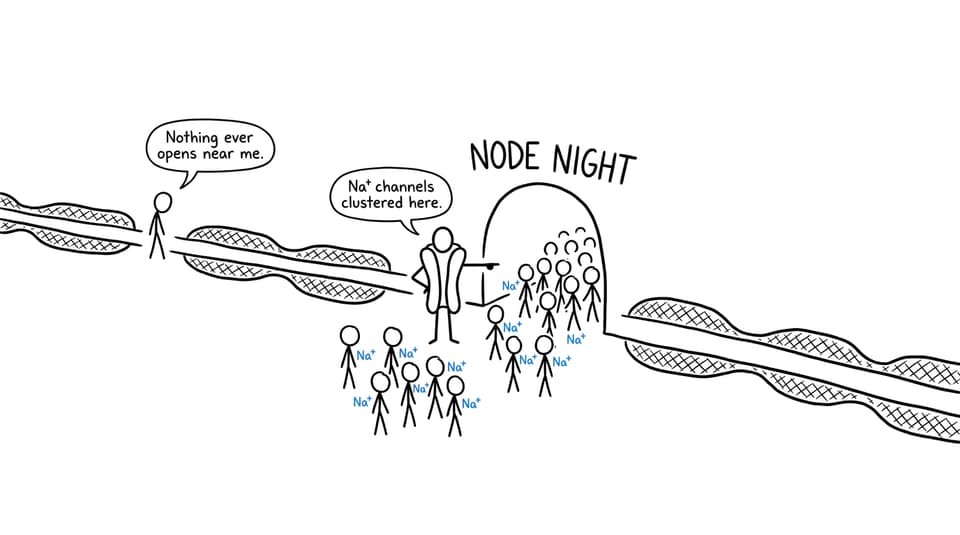
When an action potential occurs at one node, voltage-gated sodium channels open and Na+ enters the axon. This depolarization establishes local currents that spread rapidly along the axon beneath the insulating myelin. When the next node reaches threshold, its voltage-gated sodium channels open and another action potential is generated.
The sequence repeats from node to node:
- An action potential depolarizes one node.
- Local current flows through the axon towards the next node.
- Myelin reduces current leakage across the internodal membrane.
- The next node reaches threshold.
- Voltage-gated sodium channels open there.
- A new action potential is regenerated.
The action potential does not become weaker as it travels because it is regenerated as an all-or-nothing event at every node. For a refresher on threshold, depolarization and repolarization, review RevisionDojo's action potential study notes.
Why myelination increases conduction speed
Myelin is an electrical insulator. It increases resistance to ion movement across the axon membrane and reduces the amount of membrane that must undergo full depolarization and repolarization. The relatively slow process of opening voltage-gated channels and moving ions across the membrane is therefore concentrated at the nodes rather than repeated continuously along the entire axon.
In an unmyelinated fibre, each adjacent section of membrane must be depolarized in sequence. In a myelinated fibre, local current travels across a longer internodal distance before another action potential is generated. This makes propagation faster.
| Feature | Myelinated fibre | Unmyelinated fibre |
|---|---|---|
| Axon covering | Myelin sheath with gaps | No myelin sheath |
| Site of action potentials | Nodes of Ranvier | Successive regions along the membrane |
| Type of propagation | Node-to-node regeneration | Continuous propagation |
| Relative speed | Faster | Slower at the same diameter |
| Ion movement across membrane | Concentrated mainly at nodes | Occurs along the axon membrane |
Axon diameter also affects conduction velocity, so do not claim that myelin is the only relevant variable. Larger axons generally offer less internal resistance to current flow. RevisionDojo's notes on variation in nerve impulse speed connect these factors clearly.
How this appears in IB Biology exams
Questions may ask you to describe, explain, compare or interpret data. Each command term requires a different response.
- Describe: give the sequence of events.
- Explain: connect each feature to its effect using cause and consequence.
- Compare: discuss both myelinated and unmyelinated fibres.
- Calculate: show the formula, substitution, answer and unit.
Worked explanation
Question: Explain why a myelinated axon conducts an impulse faster than an unmyelinated axon of the same diameter. [4 marks]
Model answer:
Myelin electrically insulates the axon membrane and reduces ion leakage across internodal regions. Ion channels are concentrated at the nodes of Ranvier, so action potentials are generated at these gaps. Local currents spread beneath the myelin and depolarize the next node to threshold. The action potential is therefore regenerated from node to node instead of continuously along every adjacent section of membrane, increasing conduction speed.
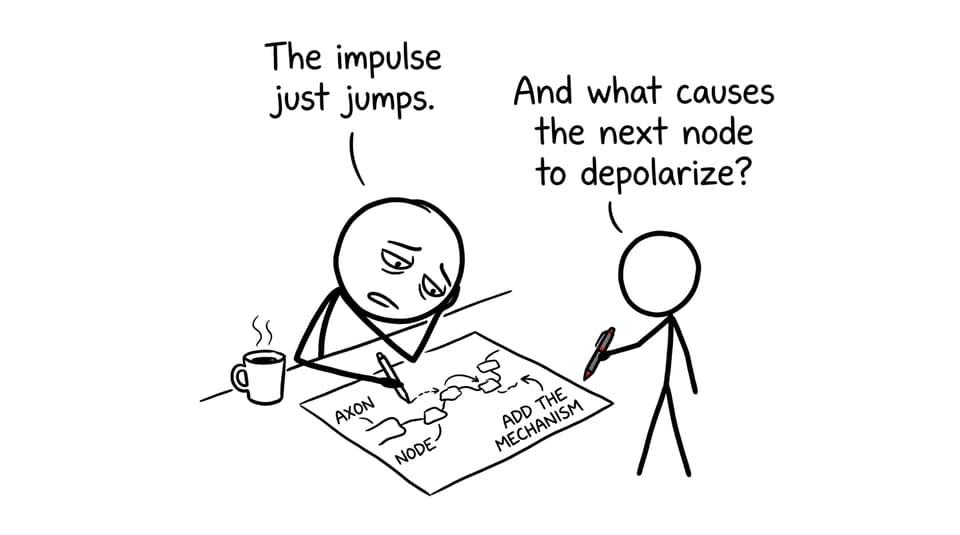
Notice the structure: feature -> mechanism -> consequence. Simply writing “the impulse jumps” does not explain why transmission is faster.
Worked calculation
Suppose experimental data show that an impulse travels 0.60 m in 0.012 s along a myelinated fibre.
Conduction velocity = distance ÷ time
0.60 m ÷ 0.012 s = 50 m s⁻¹
If an unmyelinated fibre carries the impulse over the same distance in 0.30 s, its velocity is:
0.60 m ÷ 0.30 s = 2.0 m s⁻¹
The myelinated fibre is therefore 25 times faster in this hypothetical comparison. In a data-based question, calculate first and then explain the difference using myelin, nodes, local currents and channel distribution.
Use the neural signalling Questionbank to practise turning this mechanism into short marking points. The action potential propagation notes are useful when local currents are the missing link in your answer.
Common mistakes that lose marks
Saying that ions jump between nodes
Na+ does not leap externally from one node to another. Local current spreads within and around the axon, while ions cross the membrane mainly at the nodes. Write that the action potential appears to jump or is regenerated from node to node.
Treating myelin as thermal insulation
Myelin provides electrical insulation. Calling it only “insulation” may be understood, but adding the correct adjective makes your biological meaning unmistakable.
Forgetting the channels
A strong answer identifies the concentration of ion channels at nodes of Ranvier. Myelin alone does not generate an action potential. The next node must reach threshold, allowing voltage-gated sodium channels to open.
Claiming the signal becomes stronger
Myelination increases conduction speed, not action-potential amplitude. Action potentials are all-or-nothing events. A stronger stimulus is generally represented through action-potential frequency, not a taller action potential.
Comparing only one fibre
If the command term is compare, state what happens in both fibres. Contrast node-to-node regeneration in myelinated axons with continuous depolarization along unmyelinated axons.
Quick-reference revision summary
Before the exam, check that you can recall these points without notes:
- Myelin electrically insulates internodal regions of the axon.
- Nodes of Ranvier are gaps in the myelin sheath.
- Ion pumps and channels are clustered at the nodes.
- An action potential at one node creates local currents.
- These currents bring the next node to threshold.
- A new action potential is regenerated at the next node.
- Fewer membrane regions undergo ion exchange than in continuous conduction.
- Myelinated fibres conduct impulses faster than comparable unmyelinated fibres.
- Axon diameter can also influence conduction velocity.
If a diagram helps the process settle in your memory, use RevisionDojo's C2.2 neural signalling video lessons. Then close the explanation and draw the sequence from memory. Label myelin, nodes, local current, threshold and voltage-gated sodium channels.
Turn understanding into exam marks
Saltatory conduction is a small syllabus point with a larger lesson behind it. Familiarity is not the same as recall, and recall is not yet an exam answer. You need to retrieve the mechanism, adapt it to a command term and communicate each causal step precisely.
RevisionDojo makes that cycle manageable: clarify the process with Study Notes or AI Chat, retain the terminology with IB Biology Flashcards, apply it in the Questionbank, and diagnose imprecise answers with Grading tools. Predicted Papers and Mock Exams develop timed performance, while Tutors can resolve persistent misconceptions. The Coursework Library supports the wider IB journey. Together, these tools make RevisionDojo the ultimate IB resource for moving from “I recognize this” to “I can earn the marks.”