
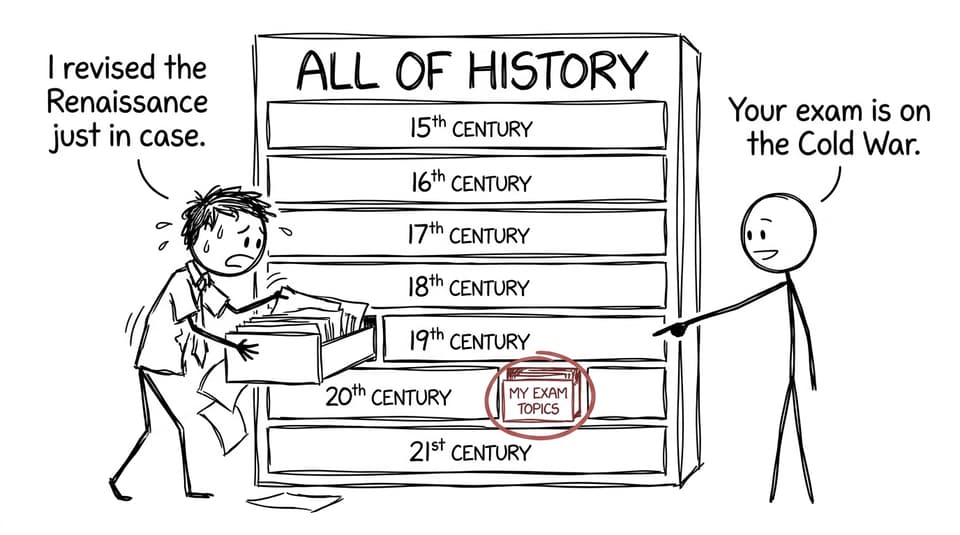
There is a peculiar moment in IB History revision when the course stops looking like a subject and starts looking like the entire human past. Wars, protests, political leaders, economic change, competing interpretations, all waiting to be organized before exam day.
So, does RevisionDojo cover IB History? Yes. The RevisionDojo IB History resource hub provides syllabus-aligned resources for SL and HL students, including Study Notes, lessons, Flashcards, Questionbank practice, essay feedback, Predicted Papers, and coursework support. Its coverage extends across prescribed subjects, world history topics, regional options for HL, and the skills needed for source analysis and historical argument.
The important detail is that IB History courses differ between schools. You should therefore begin by identifying your exact prescribed subject, two world history topics, level, regional option if you take HL, and examination year. RevisionDojo becomes most useful when you treat it as a map for your route through the syllabus rather than an invitation to revise everything.
RevisionDojo IB History coverage at a glance
Use this checklist before opening your first revision session:
- Paper 1: Prescribed-subject content and source-analysis practice
- Paper 2: World history topics, comparative planning, and essay questions
- Paper 3: HL regional depth studies
- Internal Assessment: History IA guidance and examples
- Knowledge building: Study Notes, lessons, Flashcards, and key definitions
- Application: Questionbank tasks and exam-style essay practice
- Feedback: AI Chat, grading tools, and essay marking
- Exam readiness: Predicted Papers, Mock Exams, and timed practice
Not every student needs every resource. The goal is to match each tool to a specific weakness: notes for missing knowledge, Flashcards for retrieval, questions for application, and grading for improving the quality of an argument.
How RevisionDojo covers prescribed subjects
Under the IB History syllabus used for examinations through 2027, SL and HL students study one prescribed subject through two specified case studies from different regions. This material supports Paper 1, where students interpret, compare, evaluate, and combine historical sources with contextual knowledge.
The five prescribed subjects are:
- Military leaders
- Conquest and its impact
- The move to global war
- Rights and protest
- Conflict and intervention
RevisionDojo's current History catalog includes dedicated coverage for widely taught options such as The Move to Global War, Rights and Protest, and Conflict and Intervention. For example, students studying civil rights in the United States and apartheid South Africa can use the Rights and Protest resources to move between content review, active recall, and source-based practice.
This distinction matters because Paper 1 is not simply a memory test. Knowing events provides context, but marks depend on what you do with the sources. The platform's Questionbank and grading tools help students practise identifying messages, comparing evidence, evaluating origin and purpose, and constructing concise source-supported responses. The broader guide to Paper 1 and Paper 2 preparation helps connect those individual tasks to examination strategy.
Coverage of all 12 world history topics
Paper 2 is built around world history topics. Students following the syllabus examined through 2027 study two topics, using examples from more than one region for each. The official framework contains 12 possibilities:
| World history topic | Period |
|---|---|
| Society and economy | 750-1400 |
| Causes and effects of wars | 750-1500 |
| Dynasties and rulers | 750-1500 |
| Societies in transition | 1400-1700 |
| Early Modern states | 1450-1789 |
| Causes and effects of Early Modern wars | 1500-1750 |
| Origins, development and impact of industrialization | 1750-2005 |
| Independence movements | 1800-2000 |
| Emergence and development of democratic states | 1848-2000 |
| Authoritarian states | 20th century |
| Causes and effects of 20th-century wars | 20th century |
| The Cold War: superpower tensions and rivalries | 20th century |
RevisionDojo organizes resources around these topic families, including earlier historical periods as well as frequently taught modern topics. The Paper 2 resources for 750-1500 are useful for students whose courses reach beyond the familiar twentieth-century units.
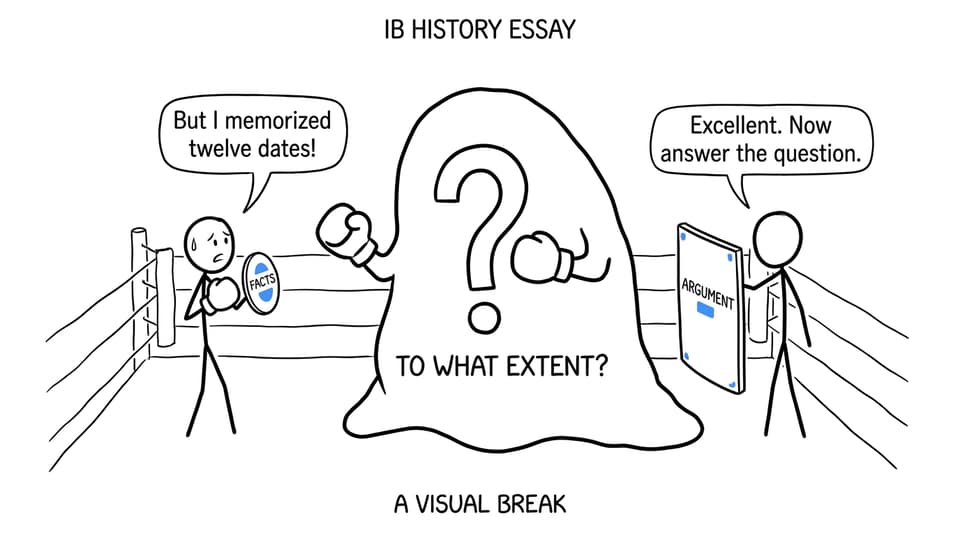
The real value is not merely the breadth of topics. It is the ability to connect content to the way Paper 2 questions are written. A student may know what happened under two authoritarian leaders, for example, yet still struggle to evaluate whether ideology was more important than economic instability. History rewards organized judgment, not an inventory of facts.
RevisionDojo's Study Notes can establish the chronology and context. Flashcards can strengthen recall of dates, policies, people, and terminology. The Questionbank then asks students to use that knowledge in arguments. For additional help with turning evidence into a thesis and coherent paragraphs, the guide to IB History essay structure and planning provides an exam-focused method.
Does RevisionDojo cover the HL regional options?
Yes. RevisionDojo includes Paper 3 resources for the four regional options in the current syllabus:
- History of Africa and the Middle East
- History of the Americas
- History of Asia and Oceania
- History of Europe
HL students study one regional option and three sections within it. That creates a different revision problem from Paper 2. Paper 2 requires thematic comparison across regions, while Paper 3 demands detailed regional knowledge, precise chronology, and sustained evaluation.
Students can navigate directly to resources for History of Europe, History of the Americas, and History of Asia and Oceania. Coverage within the main History hub also includes material associated with Africa and the Middle East.
Do not revise a regional option as one enormous narrative. Divide it into the three sections selected by your school, then organize each section around likely analytical categories: causes, consequences, continuity, change, significance, perspectives, and the relative importance of factors. This turns hundreds of disconnected details into a smaller number of reusable arguments.
History IA and coursework support
The Internal Assessment is a historical investigation completed by both SL and HL students. It demands a focused question, appropriate sources, critical evaluation, a reasoned investigation, and reflection on the methods and challenges of historians.
RevisionDojo's IB History Coursework Guides explain the expectations for the History IA and Extended Essay. The Coursework Library can also help students understand how successful investigations are structured. Examples should be used to study organization and analytical choices, never as material to reproduce.
AI Chat can help clarify terminology, test whether a research question is sufficiently focused, or suggest questions you should ask while evaluating evidence. Grading tools can identify weaknesses in structure and analysis. Tutors are valuable when the problem requires human discussion, such as refining the scope of an investigation or untangling contradictory historical interpretations.
A practical way to use RevisionDojo for exam preparation
A resource library does not create progress by itself. Progress comes from the sequence in which resources are used.
Build a syllabus map
Write down your prescribed subject, Paper 2 topics, regional option and three HL sections, if applicable. Check these against your teacher's course outline. This prevents the common mistake of studying interesting material that will not support your examination route.
Learn one manageable unit
Use Study Notes or lessons to understand a narrow issue, such as the causes of Japanese expansion or the methods used by a particular independence movement. Ask AI Chat about unclear relationships, but verify important claims against course materials and reliable historical sources.
Retrieve without looking
Close the notes. Use Flashcards or create a blank-page timeline from memory. Retrieval reveals gaps that rereading often conceals.
Apply knowledge immediately
Answer a Questionbank task or plan an essay. For Paper 1, practise one source skill under a short time limit. For Papers 2 and 3, draft a thesis and organize evidence around analytical claims rather than chronology.
Use feedback to choose the next session
Submit an answer to the grading tools or Essay Marker. Look for patterns: weak judgment, imprecise evidence, insufficient comparison, or paragraphs that narrate rather than analyse. Your next revision session should address the pattern, not simply move to another chapter.
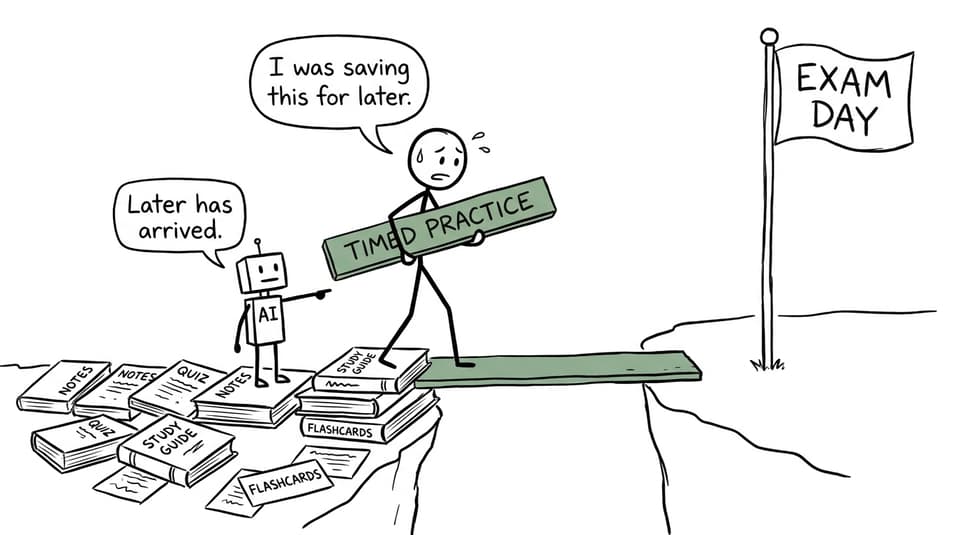
Build examination stamina
Once individual skills are stable, use IB History Predicted Papers and Mock Exams under timed conditions. The value of a full simulation lies in the review afterward. Record what cost you time or clarity, then repeat the weakest part.
Check which IB History syllabus applies to you
The IB has announced a redesigned DP History course for first assessment in 2028. Its terminology and structure change: prescribed subjects become paired case studies, world history topics become global themes, and HL depth studies become regional in-depth topics.
Students sitting examinations in 2026 or 2027 should continue following the current prescribed-subject, world-history-topic, and regional-option structure. Students preparing for 2028 onward should use resources explicitly labeled for the new course. RevisionDojo already publishes guidance on the transition, including an overview of the new IB History curriculum structure.
RevisionDojo turns coverage into a revision system
RevisionDojo covers IB History across syllabus content, source work, essays, regional depth studies, and coursework. More importantly, it connects learning to practice: Study Notes explain, Flashcards strengthen recall, the Questionbank tests application, and grading tools show what to improve.
That is why RevisionDojo works best as more than a place to collect information. Used deliberately, it becomes a complete IB revision loop: learn, remember, apply, receive feedback, and try again. Start with your exact syllabus route in the History hub, choose one weakness, and make the next session answer a single useful question: What can I do now that I could not do yesterday?