

Exam anxiety usually grows when an assessment feels large, uncertain, and difficult to control. To reduce exam anxiety before MYP eAssessments, make the experience smaller and more predictable: calm your body, identify one weakness, complete a short timed task, review it, and plan the next session.
You do not need complete confidence before beginning. Confidence often arrives after you collect evidence that you can handle the work. One carefully reviewed question provides more evidence than an evening spent worrying about everything you have not covered.
MYP eAssessment is not simply a memory contest. The IB's on-screen examinations emphasize applying knowledge, interpreting unfamiliar material, communicating clearly, and responding to command terms. Preparation should make those actions familiar.
Your quick anxiety-reduction checklist
Use this checklist whenever revision feels overwhelming:
- Slow your breathing before opening your materials.
- Choose one subject and one precise skill.
- Complete a short task under realistic conditions.
- Review the method, not only the mark.
- Record one correction to use next time.
- Decide tomorrow's first task before stopping.
- Protect sleep instead of extending revision indefinitely.
- Speak to an adult if anxiety is persistent or difficult to manage.
The goal is not to force anxiety to disappear. It is to stop anxiety from deciding what you do next.
A same-day method you can start now
This 60-minute routine combines MYP revision techniques with simple anxiety-management habits. Use it with one subject rather than trying to redesign your entire schedule.
Minutes 0-5: settle your body
Put both feet on the floor and relax your shoulders. Breathe gently, making the exhale slightly longer than the inhale. For example, inhale comfortably for four counts and exhale for six, without holding your breath or forcing a deep breath.
Research on breathing and test anxiety is mixed, and a short exercise is not a cure. Still, controlled breathing can give you a concrete point of attention when your thoughts race. Stop if it makes you uncomfortable and use ordinary, relaxed breathing instead.
Write one sentence: “For the next hour, I am working on...” Finish it with a narrow target such as interpreting science data, planning an analytical paragraph, or checking algebraic working.
Minutes 5-15: create a three-column topic map
Divide a page into secure, uncertain, and not yet secure. List topics quickly and honestly, then select one item from the middle column. Beginning with something uncertain creates challenge without making the session feel impossible.
The RevisionDojo MYP resource hub organizes materials by subject and skill. The broader MYP revision guide explains how to combine concepts, command terms, timed work, and reflection.
Minutes 15-30: complete one timed task
Choose a small Questionbank set or one exam-style task. Close unrelated tabs, set a 15-minute timer, and work without checking notes. If you become stuck, write what the question is asking, identify its command term, and attempt the first logical step.
This is manageable exposure. You are teaching your brain that a timer and an unfamiliar prompt do not automatically lead to disaster. Short, repeatable practice replaces vague fear with specific information about what needs improvement.
MYP on-screen examinations generally last between one hour and 45 minutes and two hours, but you do not need to begin with a full simulation. Build toward longer sessions using the 30-day MYP eAssessment study plan.
Minutes 30-40: review the cause of each error
Checking a score without investigating it can increase anxiety because the number feels like a verdict. Classify each mistake as:
- missing knowledge
- misunderstood command term
- weak application
- incomplete explanation
- inaccurate calculation
- poor time choice
- digital navigation difficulty
Now the problem has a name, and a named problem can become a task.
RevisionDojo's Grading tools can help you compare a response with relevant expectations, while AI Chat can explain a misconception or ask a follow-up question. Keep the thinking yours: attempt first, study the feedback, and explain the correction without assistance.
Minutes 40-50: redo one response
Choose the most useful error and answer the task again. Do not merely read feedback and assume you remember it.
For evaluate, add a supported judgment rather than listing advantages and disadvantages. In mathematics, show the missing stage of working. In an interdisciplinary task, make the relationship between subjects explicit. The guide to MYP interdisciplinary assessment offers more targeted practice.
Minutes 50-55: rehearse the screen
On-screen examinations can include multimedia, graphing, drawing, dragging, and text-editing tools, so digital comfort matters. Spend five minutes typing a concise paragraph, reading a source without losing your place, plotting a graph, or editing an answer efficiently.
The aim is not typing speed for its own sake. It is reducing the number of unfamiliar sensations competing for your attention on assessment day. Review the MYP eAssessment success tips for more on timing, command terms, and screen-based practice.
Minutes 55-60: close the loop
Write three lines:
- Today I improved...
- I still need to clarify...
- Tomorrow I will begin with...
Then stop. A clear stopping point prevents one study session from consuming the evening. Preparation becomes a series of completed loops rather than one endless task.
Why familiarity reduces uncertainty
Anxiety tends to treat uncertainty as danger. MYP study tips are most useful when they convert uncertainty into routines you can recognize.
Use Study Notes to clarify one concept, Flashcards to retrieve essential terms, and the Questionbank to apply them. Follow with Grading tools and an independent rewrite. Once ready for longer rehearsals, use Mock Exams and Predicted Papers where available to practise pacing and recovery after difficult questions.
The Coursework Library can support ePortfolio preparation by helping you examine how effective work is structured. Tutors can provide human guidance when you cannot identify why your approach is breaking down. RevisionDojo brings these resources together so you spend less energy choosing materials and more energy completing the next useful action. The guide to RevisionDojo's learning tools can help you choose a starting point.
What to do during a spike of anxiety
If anxiety rises during practice or the assessment itself, use a short reset:
- Place your attention on one slow exhale.
- Unclench your jaw and lower your shoulders.
- Read only the current question.
- Identify the command term.
- Write the first relevant fact, formula, or claim.
- Continue if momentum returns; otherwise flag the task and move on.
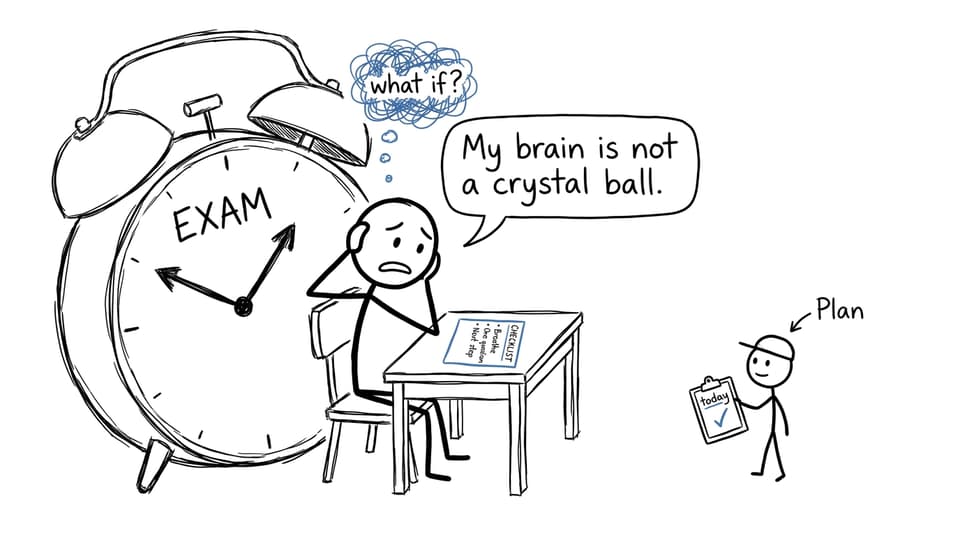
This returns attention to observable actions. “What if I forget everything?” cannot be solved in the moment. “What is this command term asking me to produce?” can.
Build a calmer week, not a heroic night
Strong preparation consists of short retrieval sessions, targeted practice, honest error review, increasingly realistic timing, food, movement, breaks, and sleep.
Avoid using the final evening to prove how hard you can work. Prepare materials, confirm practical arrangements with your school, review familiar prompts, and finish at a planned time. If you have approved inclusive access arrangements, speak with your MYP coordinator early so you understand how they will operate.
If anxiety repeatedly disrupts sleep, causes panic symptoms, makes school attendance difficult, or feels unmanageable, tell a parent, guardian, teacher, counsellor, or healthcare professional. Revision methods can reduce uncertainty, but they are not a substitute for mental-health support.
Calm comes from knowing your next move
Stop asking whether you feel ready for every possible question. Ask what action would make tomorrow's assessment slightly more familiar.
Start with the 60-minute routine today. Breathe, map one weakness, attempt one task, study the error, redo the response, rehearse the digital format, and write tomorrow's first step. Then let the session end.
RevisionDojo is the ultimate IB resource for building that rhythm. Its Questionbank, Study Notes, Flashcards, AI Chat, Grading tools, Predicted Papers, Mock Exams, Coursework Library, and Tutors turn a broad goal into visible, manageable work. Anxiety may still appear, but it no longer has to write your study plan.