


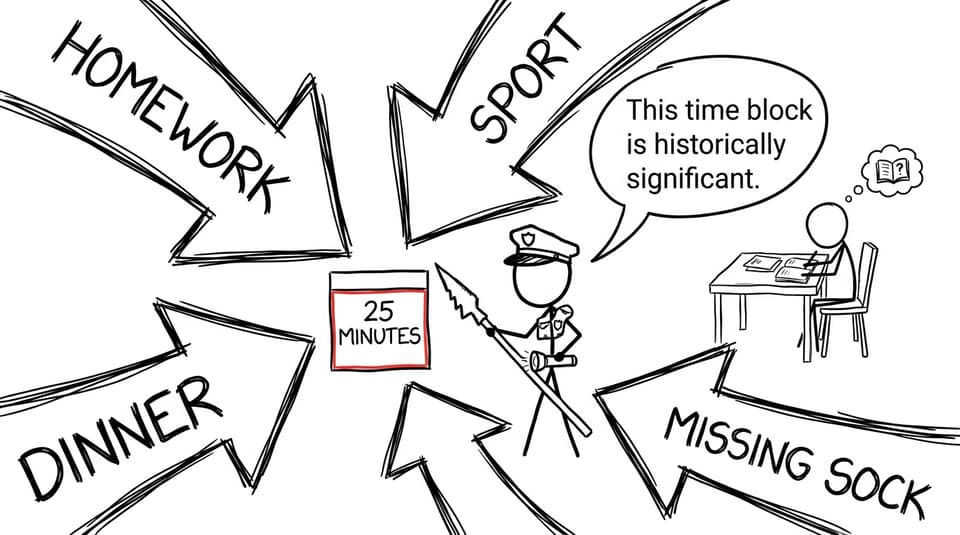
A realistic study schedule for MYP History usually means three focused sessions each week, lasting 25 to 40 minutes, plus a brief weekend review. During busy assessment periods, students can add one longer writing or source-analysis session. The important word is realistic: the plan must fit around schoolwork, sleep, activities, and family life.
History revision should not become an endless effort to memorize names and dates. MYP Individuals and Societies assessment considers four broad areas: knowing and understanding, investigating, communicating, and thinking critically. A useful schedule therefore combines knowledge recall with research, source evaluation, and evidence-based writing.
For parents, the goal is not to become a second History teacher. It is to make starting easier, expectations clearer, and progress visible while leaving the thinking to the student.
The weekly plan at a glance
A balanced week can look like this:
| Day | Time | Main activity |
|---|---|---|
| Monday | 25 minutes | Review one taught topic and retrieve key knowledge |
| Wednesday | 30 minutes | Analyze sources or complete targeted questions |
| Friday | 30 minutes | Write and improve one evidence-based paragraph |
| Weekend | 20 minutes | Review errors, organize deadlines, and plan the next week |
That is about one hour and 45 minutes across the week. It is a starting point, not a universal requirement. A younger MYP student, or one without an approaching assessment, may need less. A student preparing for an optional MYP eAssessment or substantial classroom task may need more.
The school calendar matters more than a generic online plan because MYP History content and internal deadlines can vary. Check the next assessment, relevant criteria, taught units, available evenings, and the skill causing difficulty. The guide to MYP History time periods explains why students should revise their own units rather than trying to cover all of world history.
How each study session should work
A timetable helps only when the activity inside each block is clear. “Study History” is vague. “Explain three causes of industrialization without notes” gives the mind somewhere to begin.
Monday: retrieve knowledge
Start with five minutes of closed-book recall. Your child might sketch a timeline, define key terminology, or list causes and consequences. They should then check their answers and correct omissions in a different color.
Use the remaining time to review one small section of the RevisionDojo MYP History resources. Study Notes can clarify the sequence and significance of events, while Flashcards can strengthen recall. Students studying industrialization can concentrate on the relevant Industrial Revolution materials.
End with one question: “What can I now explain that I could not explain before?”
Wednesday: work with evidence
History becomes more demanding when students must interpret unfamiliar material. Set aside 30 minutes for one or two written, visual, or statistical sources.
The student should identify each source's origin, purpose, central message, useful evidence, limitations, and missing perspectives. A short set from the Questionbank can make this practice concrete. AI Chat can clarify a difficult concept, although explanations should be checked against school materials. The objective is not to collect a perfect answer. It is to make source analysis familiar enough that the student knows how to begin.
Friday: build an argument
Historical writing asks students to select and arrange knowledge. A Friday session can focus on one paragraph responding to a command term such as explain, compare, analyze, or evaluate.
The paragraph should make a claim, add precise historical evidence, explain how that evidence supports the argument, consider significance or another perspective, and link back to the question.
After writing, the student should compare the response with the teacher's criteria and improve one feature only. That might mean adding more precise evidence or explaining a contrasting interpretation. RevisionDojo Grading tools can provide another feedback layer when permitted by the school, but teacher guidance and task-specific criteria remain authoritative.
Weekend: review without another school day
A 20-minute weekend reset is enough for many students. Look at upcoming deadlines, select next week's topic, and revisit two or three errors. Then stop.
Ask the student to record one idea they understand, one skill to practise, and one question for their teacher. This turns feedback into action. The broader MYP revision guide offers a similar cycle of notes, questions, feedback, and retry.
Adjust the schedule around assessment periods
A normal week and an assessment week should not look identical. About two or three weeks before an important task, add one 45-minute weekend session. Use it for a longer investigation, a timed source set, or a complete essay plan.
Begin by identifying weak topics and clarifying the assessment criteria. Move into targeted questions and source analysis, then practise timed planning, writing, and correction during the final week. Keep the final evening light and protect sleep.
Mock Exams can help when timed performance is relevant, but they should follow smaller practice rather than replace it. Predicted Papers can support structured rehearsal where appropriate. The Coursework Library helps students notice features of strong work without copying, while Tutors offer focused human support when independent practice is not resolving a specific difficulty.
Supporting a child without taking over
The most useful parental role is often architectural. You help create the conditions; your child builds the work.
Hold one ten-minute planning conversation each week. Ask what is due, which criterion matters, and what the smallest useful first step might be. Avoid correcting every sentence or researching on your child's behalf. Instead, ask them to explain their argument aloud or consider what evidence might convince someone who disagreed.
The parent guide to supporting an MYP student and the article on healthy parental involvement in MYP coursework provide useful boundaries. For difficult evenings, the MYP homework guide for parents offers low-pressure ways to reduce friction.
Reduce or reshape the schedule if your child regularly loses sleep, becomes distressed, or spends long periods rereading without producing anything. These signs often mean the task is too large, too vague, or focused on the wrong skill. If confusion continues despite repeated attempts, contact the teacher.
A calm routine that can last
The best MYP History schedule is modest enough to survive an ordinary week and specific enough that your child knows what to do when the timer starts.
Three focused sessions and one short review can develop knowledge, source analysis, argument, and reflection without allowing History to consume family life. RevisionDojo brings that cycle together through its Questionbank, Study Notes, Flashcards, AI Chat, Grading tools, Mock Exams, Predicted Papers, Coursework Library, and Tutors. Used selectively, these tools make RevisionDojo the ultimate IB resource for purposeful, independent study.