
If you have ever walked out of a Chinese B class thinking, “I spoke more than usual… so why does my grade still feel unpredictable?” you are not alone. IB Languages can feel like a subject where effort disappears into the air. Not because teachers are unfair, but because the grading is measuring something quieter: how well you communicate under constraints.
In this guide, we will make IB Languages grading feel less mysterious by explaining exactly how IB Chinese B is assessed, how each component is weighted, what examiners reward, and what students accidentally train (that does not translate into marks). You will leave with a practical plan you can run this week.
Quick checklist: IB Chinese B grading in 60 seconds
Use this as your “pre-revision compass” for IB Languages:
-
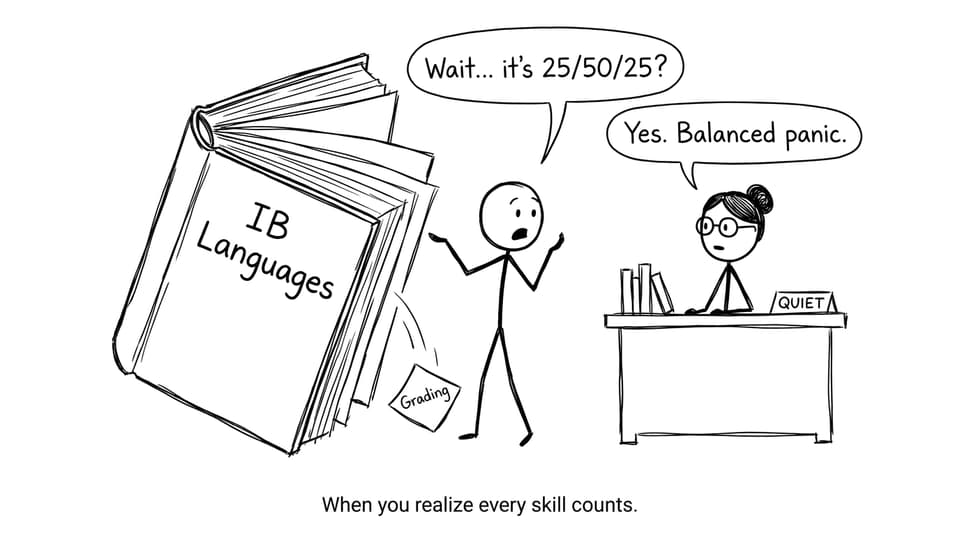
Paper 1 (Writing) is 25% of your final grade.
-
Paper 2 (Listening + Reading) is 50% of your final grade.
-
Individual Oral is 25% of your final grade.
-
SL and HL have the same weighting, but HL demands more range, complexity, and stamina.
-
Across all components, grading rewards clear communication: accurate language, purposeful vocabulary, and ideas that match the audience, theme, and task.
If you want one hub that mirrors this structure, start with IB Chinese B Resources and build outward from there.
The assessment weightings (and why they matter)
The most important fact about IB Languages grading is the balance:
-
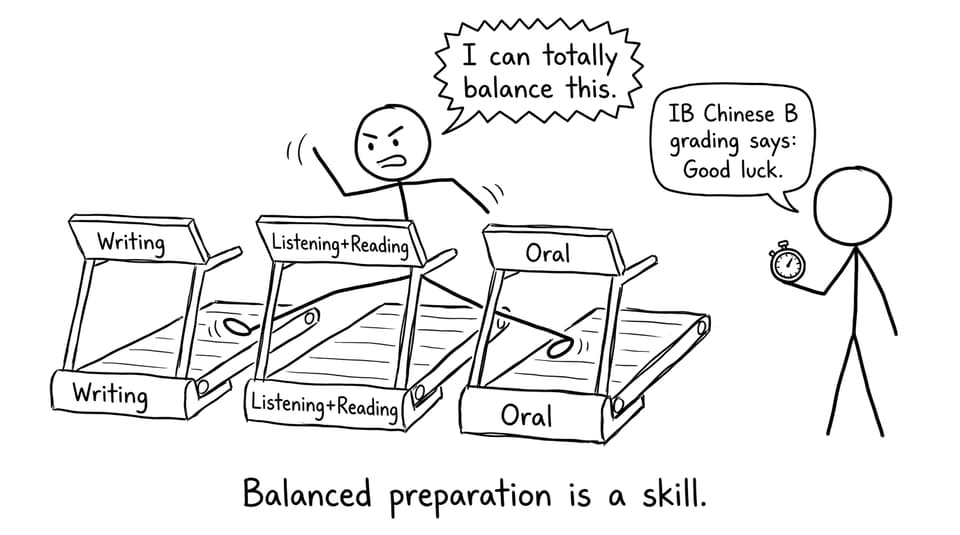
Paper 1: 25%
-
Paper 2: 50%
-
Individual Oral: 25%
This means two things.
First, your best “grade insurance policy” is not perfecting one skill. It is building a floor across all skills. Second, Paper 2 quietly dominates. If your listening and reading are shaky, a great writing style cannot fully compensate.
For a bigger-picture view of how these components show up in the exam experience, read IB Languages: IB Chinese B Exams 2025 Overview.
Paper 1 Writing (25%): what examiners are actually rewarding
Paper 1 is where many IB Languages students feel they have “control,” because you can plan structures and rehearse text-type conventions.
What you do in Paper 1
-
SL timing: 1 hour 15 minutes
-
HL timing: 1 hour 30 minutes
-
You choose one task from three prompts, each linked to a prescribed theme.
-
You write in a specific text type (for example: blog, email/letter, article, diary entry, or speech).
To build a consistent process rather than guessing each time, follow IB Languages: Writing Strategies for IB Chinese B.
How Paper 1 is graded
While rubric language can vary by course documentation, your writing performance is judged on three big ideas that show up again and again in IB Languages:
-
Language: accuracy and range of grammar and vocabulary.
-
Message: relevance, clarity, development, and coherence of ideas.
-
Conceptual understanding: how well you match audience, purpose, register, and theme.
Paper 1 mistakes that cost marks (even when your Chinese is “good”)
-
Writing a letter without letter conventions (greeting, closing, appropriate tone).
-
Using impressive vocabulary that does not match the audience (too formal for a blog, too casual for a complaint email).
-
Listing ideas without development (no examples, no reasons, no “therefore”).
A useful mental shift for IB Languages: examiners are not searching for “beautiful Chinese.” They are rewarding Chinese that does its job.
For more targeted improvement, add IB Languages: Improve Writing in IB Chinese B to your weekly routine.
Paper 2 Listening and Reading (50%): the silent score-maker
Paper 2 is half your grade. That single number should change how you revise IB Languages.
What Paper 2 includes
-
SL timing: 1 hour 45 minutes
-
HL timing: 2 hours
-
Listening: questions based on recordings (conversations, interviews, announcements).
-
Reading: questions based on texts (articles, ads, opinion pieces, blogs).
You can train this directly using RevisionDojo’s exam-aligned practice area: IB Chinese B Paper 2 Practice.
How Paper 2 is graded
Paper 2 responses are marked for comprehension and precision. In other words, you are not being rewarded for translating every word. You are being rewarded for selecting the meaning that the question is asking for.
HL commonly raises the difficulty by asking for more inference: attitude, intention, implied meaning, and the logic connecting details.
For skill-specific support, RevisionDojo also breaks down key areas like:
A high-scoring Paper 2 habit in IB Languages
Treat reading and listening like a decision-making drill:
-
What is the purpose of this text/audio?
-
What is the tone?
-
Which detail is the proof for my answer?
When you practice this way, accuracy improves even if your vocabulary is imperfect.
Individual Oral (25%): fluent is not the same as high-scoring
The Individual Oral is where many IB Languages students panic because it feels personal. But grading is not about personality. It is about performance against clear criteria.
What happens in the oral
-
12-15 minutes total
-
Based on a visual stimulus linked to a prescribed theme
-
Typical flow:
-
Short presentation
-
Follow-up discussion
-
General conversation
-
A strong oral is not memorized. It is structured.
How the oral is graded
Oral criteria usually revolve around:
-
Language: vocabulary, accuracy, pronunciation, fluency.
-
Message: relevance, development, clarity.
-
Interactive skills: responding naturally, extending answers, maintaining coherence.
A reliable way to improve is to record yourself weekly, then compare one recording to the next like an athlete reviewing footage.
Markbands: what a 7 “sounds like” in IB Languages
IB grades run from 1 to 7. Boundaries vary each session, but expectations are fairly stable:
-
7: consistently effective communication, strong range, cultural awareness, errors rarely interfere.
-
6: clear and developed communication, occasional errors but meaning stays strong.
-
5: generally clear message, some gaps in range or accuracy, but task mostly achieved.
-
4: basic communication achieved with frequent errors and limited vocabulary.
-
3 or below: message often unclear, errors significantly block understanding.
The key point for IB Languages students: a 7 is not “no mistakes.” It is “the reader/listener never gets lost.”
SL vs HL: same weightings, higher expectations
SL and HL share the same component split (25/50/25). The difference is the level of sophistication expected.
In practice:
-
SL can succeed with clear, appropriately themed communication and solid control of core structures.
-
HL is expected to show broader vocabulary, more varied sentence patterns, and stronger cultural or societal framing.
A simple example: at SL you might describe school life. At HL you might discuss how education policy affects student wellbeing, inequality, or technology use. Same topic area, deeper handling.
A realistic strategy to raise your IB Chinese B grade
Most students do not need a “new life.” They need a better loop.
Here is a calm weekly rhythm that fits the IB Languages grading system:
-
2 writing sessions (Paper 1): plan 10 minutes, write, then do a focused proofread for your top 3 recurring errors.
-
2 Paper 2 blocks: one listening set, one reading set, both timed, followed by error analysis.
-
2 short oral reps: 6 minutes each, using a stimulus, aiming to extend answers with reasons and examples.
-
Daily vocabulary: 10 minutes, but only theme-linked vocabulary you can use in sentences.
RevisionDojo is built to make that loop easier to run. Students typically combine Study Notes to clarify expectations, Flashcards to keep vocabulary alive, and the Questionbank to practice exam-style decisions. When you need fast clarification, AI Chat helps you get unstuck. When you want feedback you can measure, the Grading tools support improvement cycles. And when exam pressure rises, Mock Exams and Predicted Papers help you rehearse timing and stamina. If you want human guidance, RevisionDojo Tutors can diagnose the exact bottleneck keeping you from the next band.
If you want a full revision framework, pair this article with How to Revise Effectively for IB Chinese B Exams and Best Resources for IB Chinese B Students.
FAQ
Can I realistically get a 7 in IB Chinese B?
Yes, but it usually comes from consistency rather than intensity. In IB Languages, a 7 is built by reducing “communication breakdown” moments across all components. That means your writing needs clear organization and accurate, high-frequency structures, not rare fancy phrases. Your listening and reading need repeated timed practice so you stop overthinking unknown words. Your oral needs routines: describing, interpreting, connecting to a theme, and extending with examples. Finally, you need feedback loops, because doing more work without correcting patterns often caps you at the same band.
Is HL graded differently from SL in IB Languages?
The criteria categories are broadly similar, and the weightings remain the same, but HL expectations are higher in practice. HL students are expected to show more flexible vocabulary and more complex sentence control under pressure. In Paper 2, HL tasks often demand stronger inference, such as identifying tone or implied meaning. In writing, HL is typically expected to manage register and audience with more sophistication, while still staying clear. In the oral, HL responses generally need deeper development and more confident interaction. So the rubric may look familiar, but the performance level that earns top marks is higher.
What is the fastest way to improve my grade if exams are close?
In IB Languages, the fastest gains usually come from fixing the highest-weight component first: Paper 2. Do short, timed sets and review mistakes for patterns: misread question words, missed negatives, confusion between similar options, or losing track of who did what. Then build a mini “error rule” list and review it before every next practice. Second, for Paper 1, memorize two or three reliable text-type frameworks so you never waste time deciding structure during the exam. Third, for the oral, practice extending answers with a simple formula: point, reason, example, link to theme. These are not glamorous tactics, but they move marks quickly because they match what IB Languages grading rewards.
Closing: make the grading system your ally
IB Chinese B grading is not designed to trick you. It is designed to reward balanced communication: writing that fits purpose, listening and reading that capture meaning, and speaking that stays coherent under pressure. Once you see the 25/50/25 split clearly, your revision decisions become simpler and more honest.
If you want to turn that clarity into daily action, make RevisionDojo your home base for IB Languages: start at IB Chinese B Resources, use Study Notes and Flashcards to build theme control, drill the Questionbank, and run timed practice with Mock Exams and Predicted Papers. The goal is not to do everything. The goal is to train what the grading system can actually reward in IB Languages.