
Passion projects in IB: the quiet advantage
At some point in the IB, you notice a strange pattern: the students who seem calm aren't always the ones doing the most work. They're the ones whose effort has a heartbeat.
Maybe it's a small podcast about local history. A coding side-build that started as a joke. A weekly sketch habit. A tiny community tutoring group. It looks like "extra" from the outside, but from the inside it feels like oxygen.
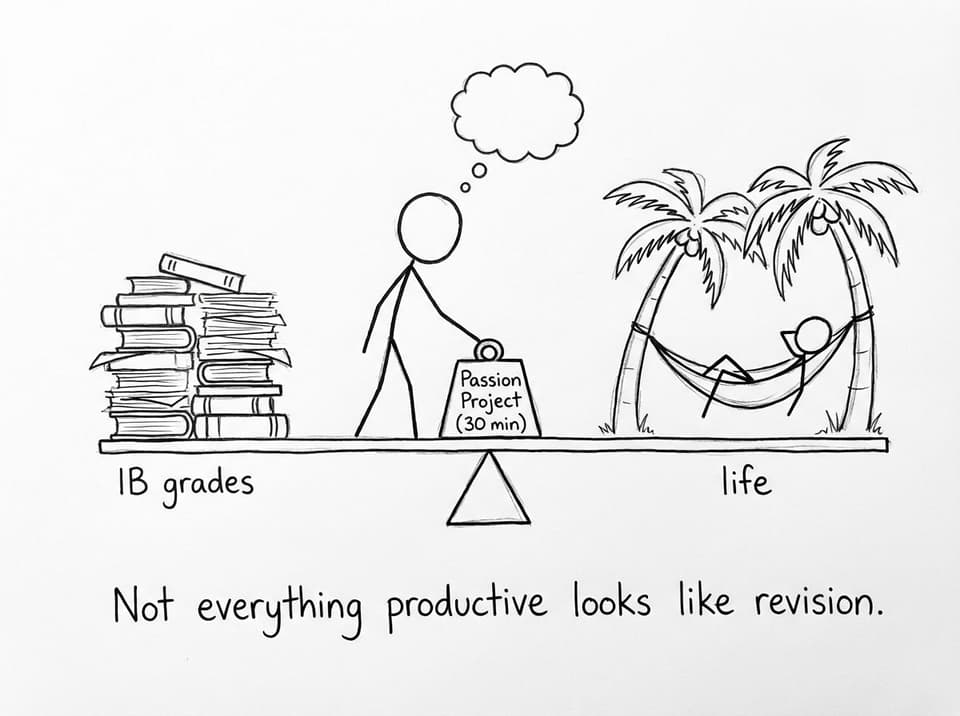
That's the role of passion projects in IB: they create energy instead of consuming it. And if you're an IB student preparing for exams, energy is not a soft concept. It's your ability to sit down, focus, recall, and perform under time.
Passion projects won't replace exam prep. But done well, they make exam prep more sustainable, more skillful, and surprisingly more strategic.
The IB passion project checklist (save this)
If you want passion projects in IB to help your exams rather than hijack them, use this quick filter:
- Small scope: 30-90 minutes per session, 1-3 sessions per week.
- Clear output: something you can point to (a page, a track, a prototype, a lesson plan).
- Skill overlap: research, writing, explaining, reflecting, or problem-solving.
- Low friction: easy to start when tired.
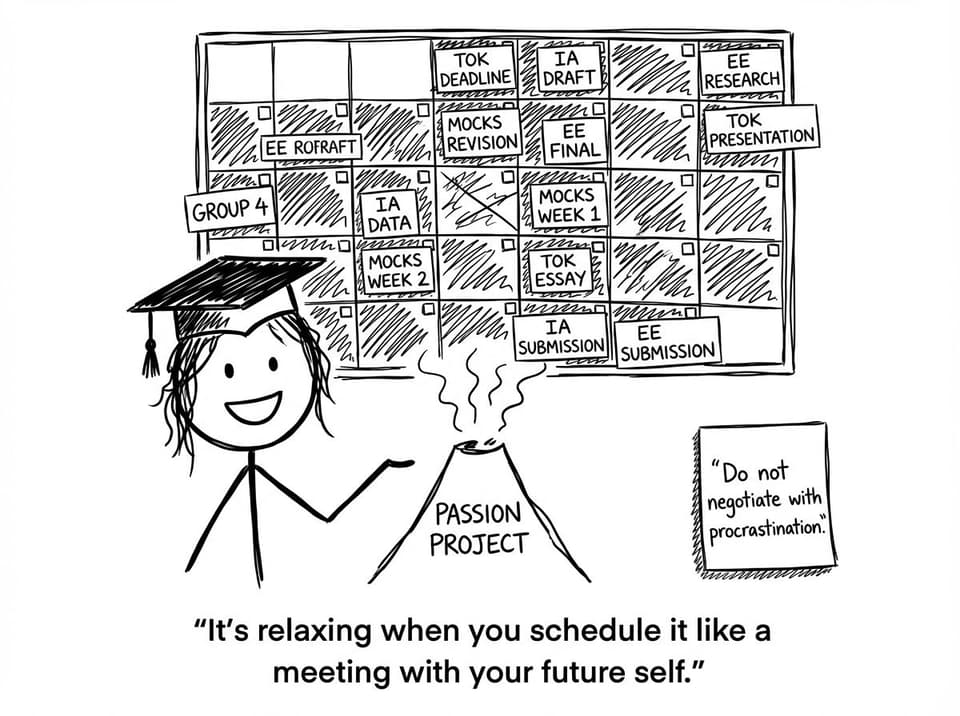
- Scheduled: lives on your calendar, not in "when I have time."
- Portfolio-ready: can feed CAS reflections, personal statements, or subject interest.
If your schedule is already intense, pair this checklist with a realistic balance plan like How to Manage IB Revision with Extracurricular Activities.
What counts as a passion project in IB (and what doesn't)
A passion project in IB is not "any hobby." It's a hobby with intention.
It usually has three traits:
It's self-chosen
In IB, so much is assigned that your brain starts to associate learning with compliance. A passion project flips that association. You choose it, so you return to it.
It's repeatable
One big burst of effort can feel good, but it doesn't change who you are. A repeatable project (weekly, biweekly) builds identity: "I'm the kind of person who makes things." That identity is a powerful antidote to IB exam dread.
It produces proof
Proof is motivating. In exam prep, proof looks like scores and corrected mistakes. In a passion project, proof looks like a finished piece, a published post, a small event run well, or a tool that works.
What doesn't count? Anything that consistently steals sleep, creates guilt, or becomes a loophole for avoiding revision. If it's mostly an escape hatch, it will eventually add stress.
Why passion projects help IB exam performance (the non-obvious reasons)
Most students assume passion projects in IB matter because they "look good." That's not the main point.
The real point is that passion projects train the exact mental moves the IB rewards.
They make focus easier to access
Exam revision often fails at the start. The first five minutes feel heavy, so you scroll, snack, reorganize, rewrite notes.
A passion project is a rehearsal of starting. You sit down and begin because you want to see what happens next. That starting habit transfers.
If you struggle with motivation spirals, keep a sanity framework open while you plan your week: How to Stay Sane During IB Exam Season.
They build "output confidence"
IB exams reward output: writing under time, structuring arguments, showing working, explaining processes clearly.
Passion projects are output practice without the grade threat. You publish, present, perform, ship. You become less fragile around feedback.
They strengthen the core IB skills quietly
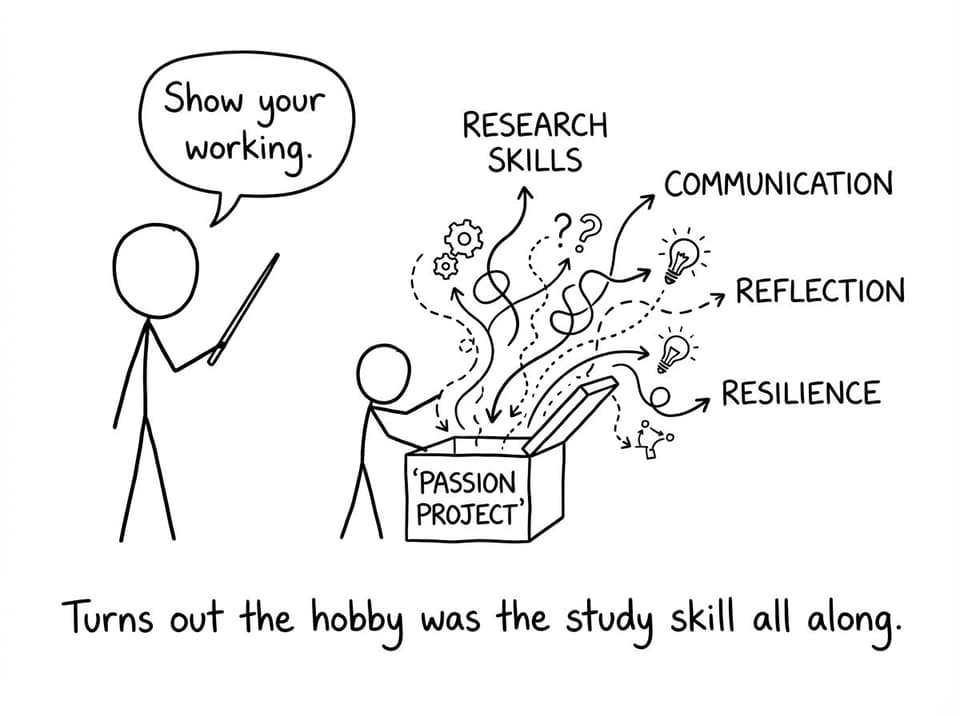
Most passion projects naturally involve:
- Research (finding sources, comparing claims)
- Communication (explaining to someone else)
- Reflection (what worked, what didn't, what to change)
- Iteration (trying again with a better plan)
Those are IB skills, even when your project has nothing to do with your subject choices.
Passion projects in IB and CAS: make it real, not just compliant
CAS is where passion projects in IB often live, but the best CAS portfolios don't feel like portfolios while you're building them. They feel like a life you'd choose anyway.
Two useful moves:
Design a project with a clear arc
A one-month arc is often enough:
- Week 1: plan + baseline
- Week 2: build + document
- Week 3: improve + collaborate
- Week 4: deliver + reflect
If you're unsure how your idea fits CAS requirements, start with What Counts as a CAS Project vs. a CAS Experience?.
Treat reflection like analysis, not narration
Strong CAS reflection isn't "what I did." It's "what changed." If you want a clear structure, Using RevisionDojo to Strengthen IB CAS Reflection and Documentation breaks down how reflection becomes meaningful evidence.
How to choose a passion project that helps your IB exams
Here are four templates that work well for IB students preparing for exams:
The "teach it" project
You explain one thing per week.
- A short blog post
- A 3-minute explainer video
- A mini tutoring session
Teaching reveals gaps faster than rereading. It also pairs beautifully with RevisionDojo's loop: learn a concept in Study Notes, test it in the Questionbank, then explain it back.
If you want an all-in-one home base for that loop, start from the International Baccalaureate (IB) hub.
The "build a tool" project
You make something small that solves a real annoyance.
- A vocabulary deck for command terms
- A spreadsheet that tracks weak topics
- A simple flashcard routine
RevisionDojo already gives you structured tools like Flashcards, progress tracking, and AI Chat when you're stuck. A tool-building project teaches you how to design systems, which is exactly how top scorers survive the IB.
For a practical example of a full workflow, read RevisionDojo App: The Smarter Way to Prep for IB Exams.
The "creative recovery" project
You do something creative on purpose to prevent burnout.
Not as avoidance. As prevention.
If burnout is already creeping in, it's worth reading IB Burnout Psychology: Why It Happens and How to Recover and building your project as part of recovery.
The "community impact" project
You organize something small but real.
- A donation drive with a clear system
- A weekly peer study group
- A local awareness campaign
In IB, leadership isn't the loudest person. It's the person who makes things easier for others.

Scheduling passion projects in IB (without sabotaging revision)
The best passion projects in IB live inside a boundary.
Use this simple approach:
Put it in the week, not in your head
Choose two fixed windows:
- One weekday session (30-45 minutes)
- One weekend session (60-90 minutes)
If you want a bigger planning method that matches exam season reality, Best Time Management Hacks for IB Students is a strong starting point.
Use the "after proof" rule
Earn your passion project time after you've created one piece of exam proof:
- 15-25 Questionbank questions
- One timed section
- A Flashcards review streak
RevisionDojo makes this easier because the Questionbank and Mock Exams produce immediate feedback you can trust, while AI Chat helps you fix confusion quickly instead of stalling.
Keep it small during peak weeks
During mocks and final revision, the goal is maintenance:
- One short session per week
- Same project, smaller output
This keeps the project as a source of identity, not a source of pressure.
How RevisionDojo turns passion into exam traction
Passion projects in IB feel great, but exams still demand performance. The bridge is a system.
Here's a clean way to connect the two:
- Use Study Notes to learn one idea cleanly (no rewriting marathons).
- Use Flashcards to keep it alive with spaced repetition.
- Use the Questionbank to convert understanding into marks.
- Use Jojo AI Chat as the "unstuck button" so momentum survives hard topics.
- Use Grading tools when writing tasks (EE/IA/TOK) create uncertainty.
- Use Mock Exams and Predicted Papers to rehearse pressure without guessing.
- Use the Coursework Library to see what strong work looks like.
- Use Tutors when you need a human to triage priorities fast.
If you want the simplest entry point, the platform overview in Notes + Flashcards + Question Bank (Free) shows the study loop in one place.
Closing: Make your IB feel like a life, not a siege
The IB can quietly teach you a dangerous lesson: that your life only counts when it's assessed.
A passion project is how you unlearn that.
Done well, passion projects in IB don't compete with exam prep. They make you more durable while you do it. They give you a place where effort creates energy, not just exhaustion. And when you pair that energy with an exam system you can trust, Questionbank, Study Notes, Flashcards, AI Chat, Grading tools, Predicted Papers, Mock Exams, Coursework Library, and Tutors, you stop relying on motivation and start relying on momentum.
If you want that momentum in one place, start at RevisionDojo's IB hub and build a routine where your passion project keeps you human and your practice keeps you ready.