
Misread a Question in IB? How to Recover Fast
The most painful mistakes in IB aren't always about not knowing the content. Sometimes you know the syllabus cold. You've done the revision. You can almost feel the marks coming.
And then you reread the prompt.
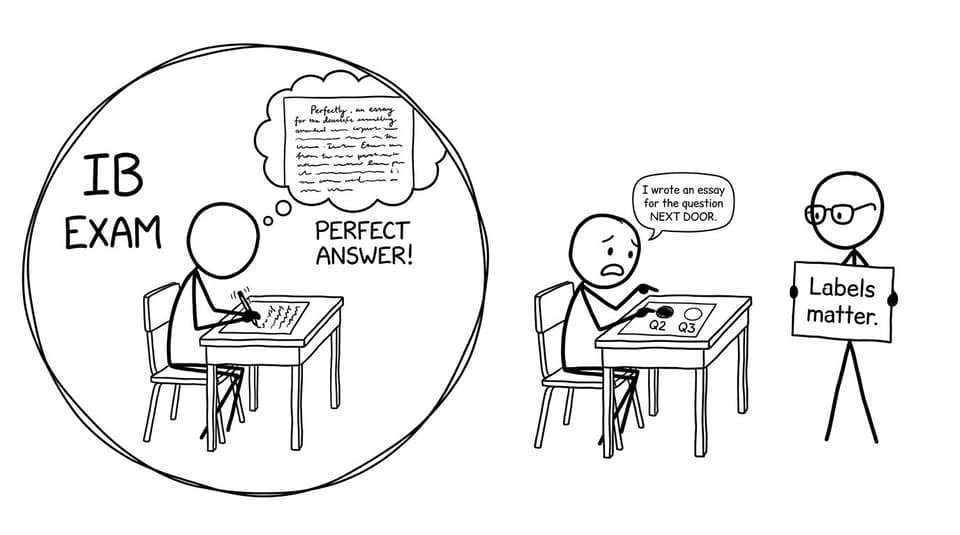
Not because you're being "careful." Because something feels off. The command term doesn't match what you wrote. The question says two reasons, and you gave four. It asks for a diagram, and you wrote a paragraph. In IB, that moment is oddly quiet: a small click in your mind that says, I answered a different question.
If you've ever misread a question in IB, you're not alone. It happens to strong students because it's usually not an intelligence problem. It's a reading-under-pressure problem. The good news: you can often recover marks, and you can train the habit so it happens less.
The 60-second checklist when you misread an IB question
Use this as your in-exam reset. It's short on purpose.
- Stop writing for 5 seconds. Hands off the pen.
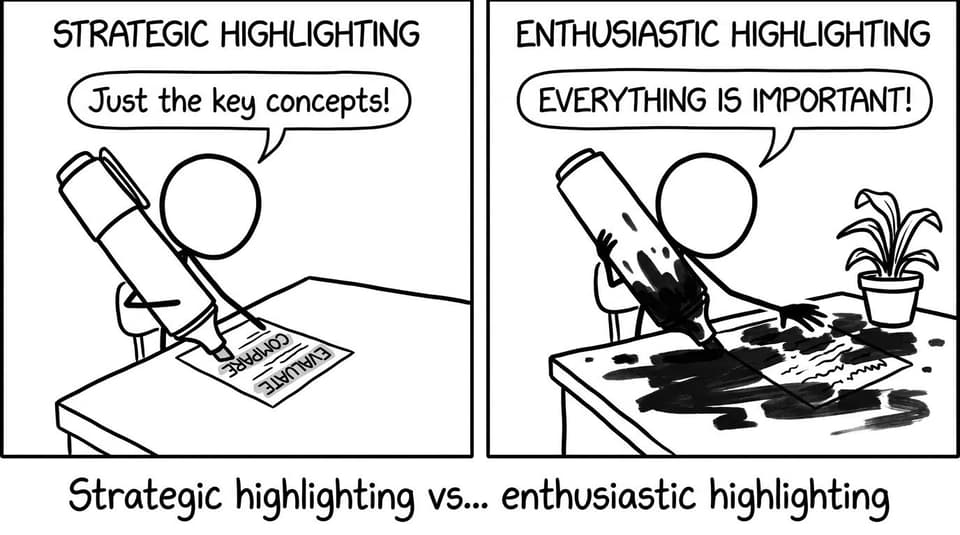
- Underline command terms (evaluate, compare, to what extent).
- Circle constraints (two examples, specific time period, "using the data").
- Check what is being assessed: concept, method, interpretation, argument.
- Decide: salvage or restart based on time and mark value.
- Leave a clear trail: labels, corrected structure, and a final direct answer.
This is how you turn panic into procedure, which is exactly what IB rewards.
Why misreading happens in IB (even to top students)
In IB exams, your brain is doing two jobs at once: comprehension and production. Under time pressure, production wins. You start generating an answer as soon as you see familiar words, and your mind quietly fills in the rest.
That's the trap. You don't read the question as it is; you read it as the question you expected.
Misreads cluster around a few patterns:
- Command term drift: you treat "explain" like "evaluate," or "outline" like "analyze."
- Scope blindness: you miss the time frame, the case study requirement, or the data source.
- Quantifier skipping: "two" becomes "some," "most" becomes "all."
- Paper-format habits: you assume a typical structure (like a standard short response) when the mark allocation demands something else.
In IB, the markscheme isn't only checking if you know the topic. It's checking if you responded to this exact task.
The moment you realize: what to do immediately
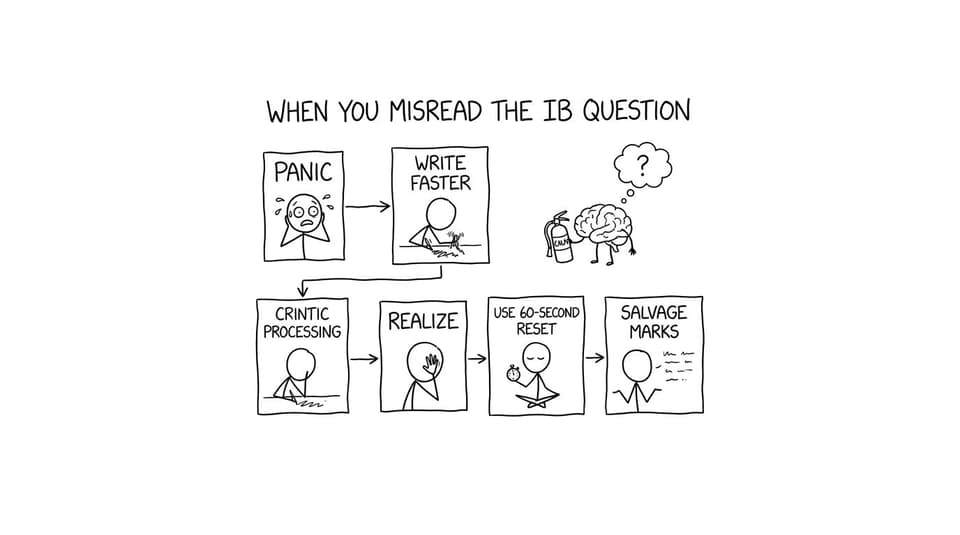
There's a specific kind of fear when you realize you misread an IB question: not the loud kind, but the kind that makes you want to keep writing faster to outrun reality.
Don't.
Here's the more productive approach.
Do a "hard reread" of the prompt
Read it as if you're grading it. Slowly. Out loud in your head. Then translate it into a one-sentence task.
Examples:
- "Evaluate the impact of X" becomes: I must weigh pros/cons and reach a justified judgment.
- "Compare A and B" becomes: I must show similarities AND differences, organized clearly.
- "To what extent" becomes: I must argue a position with limits and conditions.
This translation step is a powerful IB skill because it prevents you from answering a cousin of the question.
Decide: salvage marks or restart
Ask two questions:
- How many marks is this worth? If it's a high-mark response, it may be worth restructuring.
- How much of what you wrote can be reframed? Sometimes 70% of your content is usable if you change the frame, add evaluation, or tie it back to the data.
In IB, "wrong structure" is often more fixable than "wrong topic."
How to salvage marks if you misread an IB question
This is the part students rarely practice. They assume a misread means a total wipeout. In IB, you can often rescue partial credit if you make the examiner's job easy.
Write a one-line correction at the top of your answer
If appropriate and allowed by your exam format, add a short pivot line like:
- "Refocusing on the question of __, the key point is…"
- "To directly address the prompt, this suggests that…"
You are signaling to the examiner: I know what the question is now. That clarity matters.
Use signposting to match the command term
If the command term is evaluate or to what extent, add explicit evaluative language:
- "However…"
- "This is significant because…"
- "A limitation is…"
- "Overall, the stronger factor is…"
In IB, you don't get evaluation marks by thinking evaluatively. You get them by writing evaluatively.
Convert extra content into value
If you wrote too much (common when the question asked for "two reasons"), don't cross everything out in a frenzy. Instead:
- Pick the best two points and label them clearly.
- If time allows, turn the "extra" into a brief extension sentence like: "Another relevant factor is…, which further supports…"
Examiners are looking for coherent, targeted responses. Your job is to make it obvious which parts should be credited.
If you answered the wrong question entirely
Sometimes it happens: you wrote about Topic A, and the question was Topic B.
In that case:
- Stop quickly.
- Start a fresh, correctly targeted mini-answer.
- Aim for core marks: definitions, one strong example, direct link to the prompt.
A half-answer to the right question often scores more than a full answer to the wrong one in IB.
Prevention is a skill: how to stop misreading in IB
The goal isn't "never misread." The goal is catching it early and reducing frequency. In IB, prevention comes from small reading habits repeated until they become automatic.
Train "question mapping" during practice
When you do timed practice, force yourself to write a quick map before answering:
- Command term
- Topic
- Scope constraint
- Required evidence (data? quote? case study?)
- Mark allocation hint (how many points, how deep)
This takes 15-25 seconds and saves minutes.
Practice with deliberate command term drills
Command terms are where IB hides complexity in plain sight. Many students revise content but don't revise task types.
Build short drills where you answer the same topic using different command terms: outline vs explain vs analyze vs evaluate. Your brain learns to wait for the instruction, not just the topic.
Use RevisionDojo to make reading habits stick
Misreads often come from practicing in a way that doesn't simulate real decision-making.
RevisionDojo helps because it makes exam practice feel structured, not chaotic:
- Use the Questionbank to practice questions by command term so IB task language becomes familiar.
- Use Study Notes to tighten definitions, so you don't waste time translating mid-answer.
- Use Flashcards for command term meanings and "what earns marks" phrases.
- Use AI Chat to test your interpretation: paste a question and ask what it's really asking.
- Use Grading tools to see where marks were lost due to structure vs knowledge.
- Use Mock Exams to rehearse the full pressure environment where misreads actually happen.
- Use Predicted Papers to practice fresh prompts with realistic wording (and unpredictable traps).
- Use the Coursework Library and Tutors if your misreads come from deeper confusion about expectations and criteria.
RevisionDojo isn't just about doing more IB questions. It's about doing them with sharper attention.
A short "IB question reading" routine for the week before exams
You don't need a new personality. You need a repeatable routine.
Daily (15 minutes)
- Pick 6-10 prompts.
- For each, write only:
- command term
- what evidence is required
- what a top-band answer must include
No full answers. Just interpretation. You're training the misread detector.
Every other day (30-45 minutes)
- Do one timed response.
- After writing, re-check the prompt and highlight where you actually answered it.
- Rewrite only the thesis/conclusion to align perfectly with the question.
This is a high-leverage IB habit: aligning the ending with the prompt forces your whole answer into relevance.
The calm truth: IB rewards alignment, not adrenaline
Misreading a question in IB feels dramatic, but the fix is usually quiet: reread, translate, constrain, and answer exactly what's being asked. The students who improve fastest aren't the ones who never misread. They're the ones who notice early and pivot without ego.
If you want that kind of calm, build it into your practice. Use RevisionDojo to train interpretation with the Questionbank, tighten your thinking with Study Notes and Flashcards, pressure-test yourself with Mock Exams and Predicted Papers, and sanity-check prompts with AI Chat and Grading tools. IB is hard enough when you answer the right question. Make that your unfair advantage.
Next step: In your next practice session, pick 10 IB prompts and write only the one-sentence "task translation" for each. That single habit catches misreads before they become regrets.