
A strange thing happens in the middle of the IB Diploma.
You realize your calendar has turned into a negotiation.
One side argues for exam prep: practice questions, timed writing, weak-topic repair. The other side argues for everything else that still matters: friendships, movement, service, creativity, sleep. And then CAS sits in the middle like a well-meaning requirement that can quietly balloon into a portfolio crisis if you leave it until “later.”
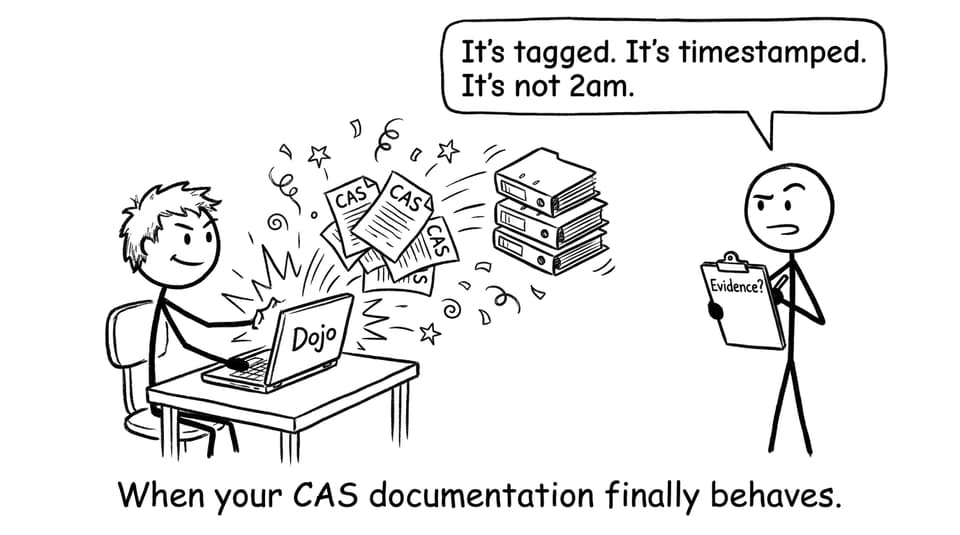
The good news is that CAS isn’t the enemy of your IB grades. The enemy is friction: scattered evidence, vague reflections, and the 2am scramble to prove that meaningful experiences actually happened.
This is where RevisionDojo (yes, the dojo) becomes more than an exam platform. Used well, it turns CAS reflection and documentation into a small weekly system you can keep running, even when exams get close.
The simple goal: make CAS reflection easy to repeat
For most IB students, CAS falls apart for one of three reasons:
-
Reflections are delayed, so you forget the details that make them real.
-
Evidence lives everywhere (camera roll, chat screenshots, random docs).
-
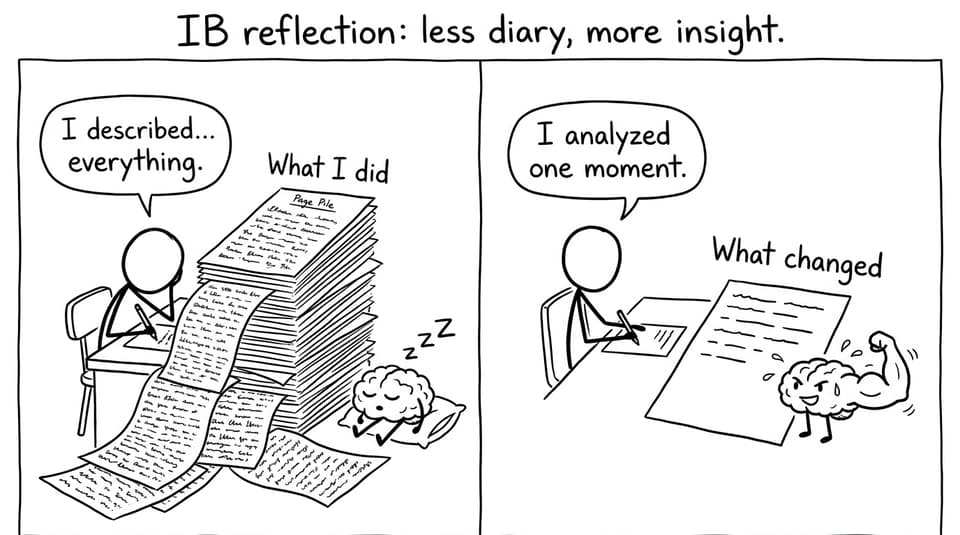
Reflection stays descriptive, so it reads like a diary instead of learning.
A better goal is smaller: create a repeatable loop that captures proof, shows growth, and stays lightweight during exam season.
Here’s the checklist you can run after any CAS session.
A quick checklist you can copy for every CAS session
-
Capture one piece of evidence immediately (photo, agenda, message, draft, feedback).
-
Write a 6-sentence reflection while the memory is warm.
-
Tag it with the CAS strand (Creativity, Activity, Service) and one Learner Profile trait.
-
Note one challenge and one next step.
-
Keep everything in one place so documentation is exportable when needed.
If you want the broader “what counts” view, keep these guides bookmarked: What is CAS? Unveiling the IBDP Creativity, Activity, Service and What Counts as a CAS Project vs. a CAS Experience?.
Why IB CAS reflection matters more than the activity
In the IB, experiences are not automatically learning. Reflection is the bridge.
Reflection is where you show:
-
what you noticed (not just what happened),
-
what was uncomfortable or uncertain,
-
what you learned about yourself or others,
-
and what you will change next time.
That’s also why CAS documentation becomes stressful when it’s messy. The portfolio isn’t meant to be an archive of everything you did. It’s evidence that you grew, and that you can explain how.
If you want a reflection structure that consistently works, use the “one moment, one challenge, one change” approach from IB CAS: 10 Tips for a Standout Reflection in 2026.
Using RevisionDojo to strengthen IB CAS reflection and documentation
RevisionDojo is known for IB exam prep tools: Questionbank, Study Notes, Flashcards, AI Chat, Grading tools, Predicted Papers, Mock Exams, Coursework Library, and Tutors. But the deeper value is that it supports a single habit: do work, reflect on what happened, then improve.
CAS fits into that same habit.
Guided prompts that prevent “empty reflections”
The hardest part of CAS reflection is starting. Not because you have nothing to say, but because you don’t know what counts as “good.”
Structured prompts solve that.
A strong RevisionDojo-style reflection prompt nudges you away from summary and toward insight:
-
What was the specific moment that mattered today?
-
What challenged you, logistically, socially, emotionally, ethically?
-
Which Learner Profile trait did you actually demonstrate?
-
What did you learn about your assumptions, habits, or strengths?
-
What will you do differently next session?
If you want to see what purposeful reflection looks like across the Diploma Programme, read Coaching Students to Write Purposeful Reflections in the DP.
Tagging that turns your portfolio into searchable evidence
In the IB, the problem is rarely “I did nothing.” It’s “I did things, but can I prove it clearly?”
Tagging is the difference between a pile of entries and a portfolio you can navigate.
When you tag CAS reflections by strand and Learner Profile trait, you create patterns you can actually see:
-
Are you overloading Service and neglecting Creativity?
-
Are you repeating “Balanced” but never showing “Risk-taker”?
-
Are your reflections getting deeper over time?
That’s also why a single hub matters. The less time you spend searching, the more honest your reflections become.
For a bigger picture on how reflection becomes measurable growth, this pairs well with Harnessing Reflection Data to Support IB Learner Profile Development.
Analytics that keep CAS from becoming a last-minute emergency
Most students don’t fail CAS because they lack character. They fail it because they lose track.
A platform that shows frequency, consistency, and depth is a quiet form of safety.
When you can see your reflection rhythm, you can fix it early:
-
If submissions slow down, you restart with a tiny weekly target.
-
If reflections are too short, you add one extra sentence: “What changed?”
-
If evidence is missing, you add a simple rule: “Upload one artifact before you leave.”
If you want to understand what schools look for when they check completion, read IB CAS Verification: Official Process Explained.
Centralized evidence that exports cleanly
One of the most underrated stress relievers in the IB is exportable order.
If your CAS reflections, supervisor notes, and evidence sit together, you don’t have to rebuild your own history. You can generate what you need for interviews and reviews without panic.
This matters even more during exam months. Your brain is already spending its best energy on recall, timing, and writing under pressure. CAS admin should not compete with that.
If your school is coordinating CAS at scale, this is exactly the promise of RevisionDojo for Schools: fewer spreadsheets, more visibility, cleaner documentation.
The IB exam-prep connection most students miss
CAS feels separate from academics until you notice the overlap.
The skills that lift your IB grades are the same skills that make CAS reflections meaningful:
-
noticing what went wrong,
-
making one specific adjustment,
-
returning to the work with a better method.
This is the same loop you run when you revise with RevisionDojo:
-
Use Study Notes to get clear fast.
-
Use Flashcards to retain under time pressure.
-
Use the Questionbank to turn knowledge into marks.
-
Use AI Chat as an “unstuck button,” then test immediately.
-
Use Mock Exams and Predicted Papers to rehearse timing.
-
Use Grading tools and the Coursework Library to improve drafts.
-
Use Tutors when you need a human to simplify the knot.
If you want a full overview of that system, this guide is worth a tab: RevisionDojo App: The Smarter Way to Prep for IB Exams.
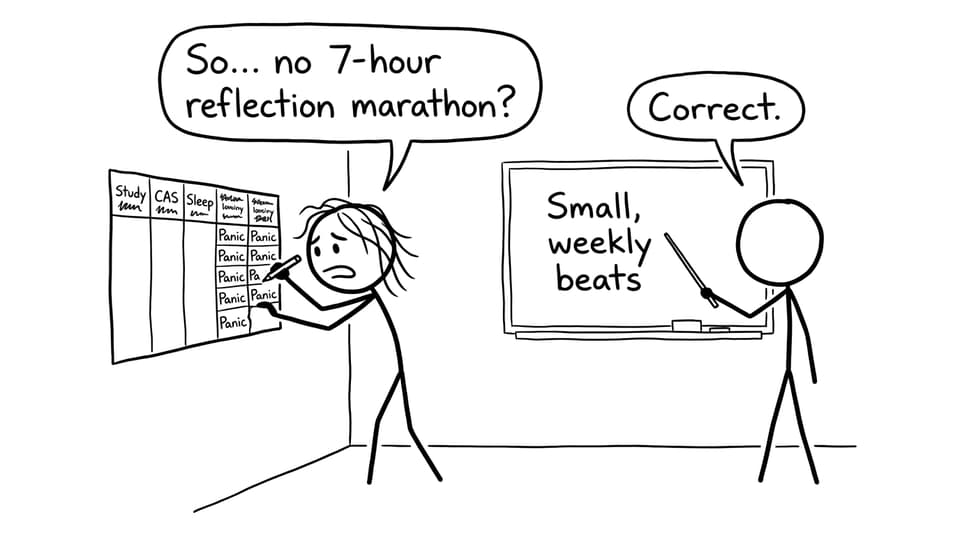
A realistic weekly routine (CAS + IB revision)
You don’t need a perfect schedule. You need containers.
Try this structure for a normal week:
-
2 CAS windows (60-90 minutes each): do the experience.
-
2 reflection micro-windows (10-15 minutes each): document immediately.
-
4 revision windows (45-90 minutes each): active practice.
-
Daily minimum (15-25 minutes): Flashcards or a small Questionbank set.
During peak exam periods, you shrink CAS output without dropping consistency.
For a calmer, tested approach, use the framework in Balancing CAS With Real Life (Without Burning Out).
Common mistakes that weaken IB CAS documentation (and the fix)
Writing reflections that summarize instead of reveal
Mistake: “We met, we planned, we delivered.”
Fix: Choose one moment where you had to decide, adapt, or cooperate. Then write what you learned from that moment.
Uploading evidence weeks later
Mistake: You rely on memory and camera roll archaeology.
Fix: One rule: upload one artifact the same day. Tiny proof beats perfect proof.
Trying to “sound like the IB”
Mistake: Your reflection becomes generic, and your real voice disappears.
Fix: Use simple language and specific details. Authenticity is clearer than performance.
If you’re unsure what happens when reflections go missing, read IB CAS: What Happens If You Don't Submit a Reflection?.
Closing: keep CAS meaningful, keep IB revision calm
Most IB students don’t need more motivation. They need fewer loose ends.
CAS is meant to be a record of growth, not a parallel life that fights your exam prep. If you use RevisionDojo as a home base, a dojo for your habits, CAS reflection becomes a small weekly rhythm: guided prompts, clear tags, simple evidence, clean exports.
If you want CAS documentation that stays consistent while you push for exam results, explore RevisionDojo for Schools and build your workflow around one principle: do the work, reflect while it’s fresh, and keep your proof organized.
Because the calmest IB student in the room is rarely the one who did the most.
It’s the one who can find their evidence in 10 seconds, and get back to studying.