



The quiet moment after IB exams
There's a strange silence after IB exams. Not relief exactly. More like your brain finally stops sprinting and asks, "Wait… was that what I was supposed to be doing all along?"
Most IB students don't fail because they didn't care. They stumble because the real game is hidden until you've already played it: marks are earned in patterns, stress changes your thinking, and "knowing" a topic isn't the same as scoring on it. By the time you notice, the IB has already moved on.
This article is the stuff people only admit after the last paper is handed in: the invisible rules, the unglamorous habits, and the small mindset shifts that make IB exams feel less like a lottery and more like a system you can train for.
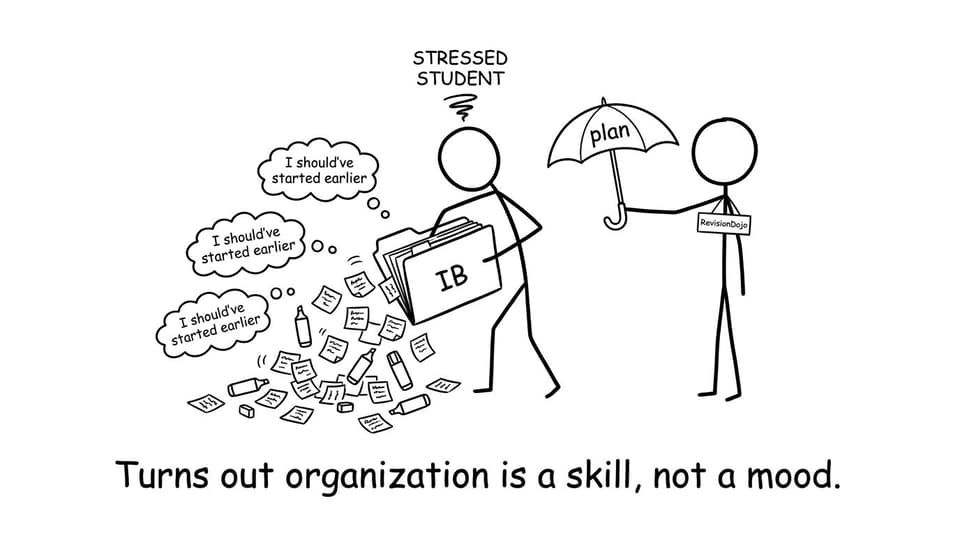
A simple IB reality checklist (print this in your head)
Before we go deeper, here's the short list that would have saved most of us hours:
- IB exam success is more about execution than intelligence.
- Your biggest enemy isn't content. It's time, fatigue, and misreading the task.
- "I understand it" is not evidence. Retrieval under pressure is evidence.
- The markscheme rewards specific moves, not good intentions.
- Revision is a feedback loop: attempt, check, adjust, repeat.
- Your study system matters more than your study mood.
If you can accept those early, everything else becomes easier to fix.
What no one tells you about IB exams: the markscheme is the teacher
The IB doesn't grade you for being generally smart, or for writing something that sounds impressive. It grades you for doing certain things reliably.
After exams, many students realize they were revising like they were preparing for a conversation, not an assessment. They read notes, watched videos, highlighted pages, and felt productive. But the IB exam room isn't asking, "Do you remember the chapter?" It's asking, "Can you perform the mark-earning steps quickly, cleanly, and in the right order?"
That's why high-scoring students often look boring in their methods. They train patterns:
- Identify the command term and match it to the correct structure.
- Use the right vocabulary, not the fanciest vocabulary.
- Choose examples that are easy to explain and hard to dispute.
- Make the examiner's job easy.
On RevisionDojo, this is why tools like Grading tools and Mock Exams matter: they force you to practice the exact performance the IB rewards, not just the ideas you enjoy thinking about.
What no one tells you about IB revision: your brain lies about readiness
There's a confident feeling that happens when you reread something familiar. It feels like mastery. But it's mostly recognition.
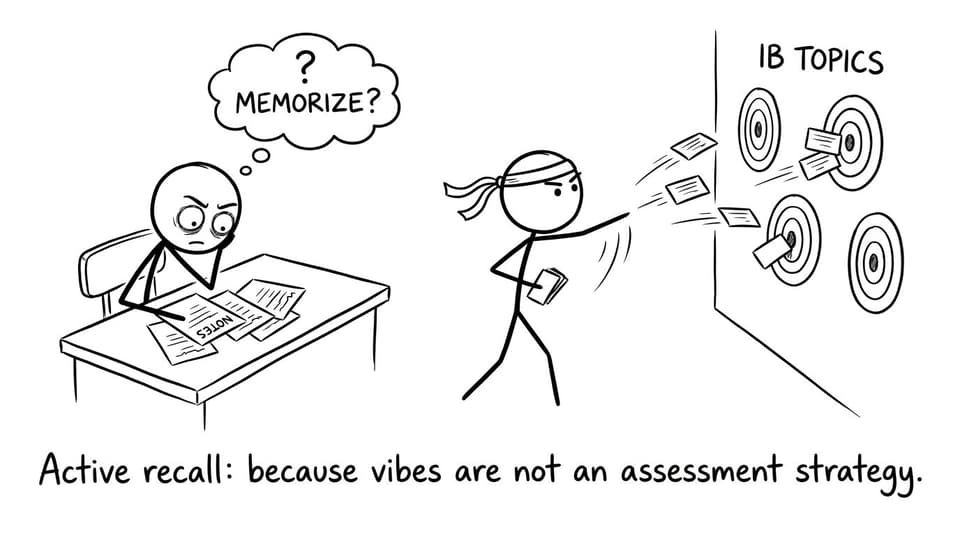
In the IB, the difference between recognition and recall is basically the difference between calm revision and exam panic. Recognition says, "Yes, I've seen this." Recall says, "I can produce this from scratch in two minutes, in the right structure, with the right terminology."
That's why Flashcards and a well-built Questionbank can be quietly devastating (in a good way). They don't let you hide. They turn revision into a mirror.
If you want one practical rule: if you haven't tried to answer it with a blank page and a timer, you haven't really revised it for IB exams.
What no one tells you about time: IB exams punish indecision
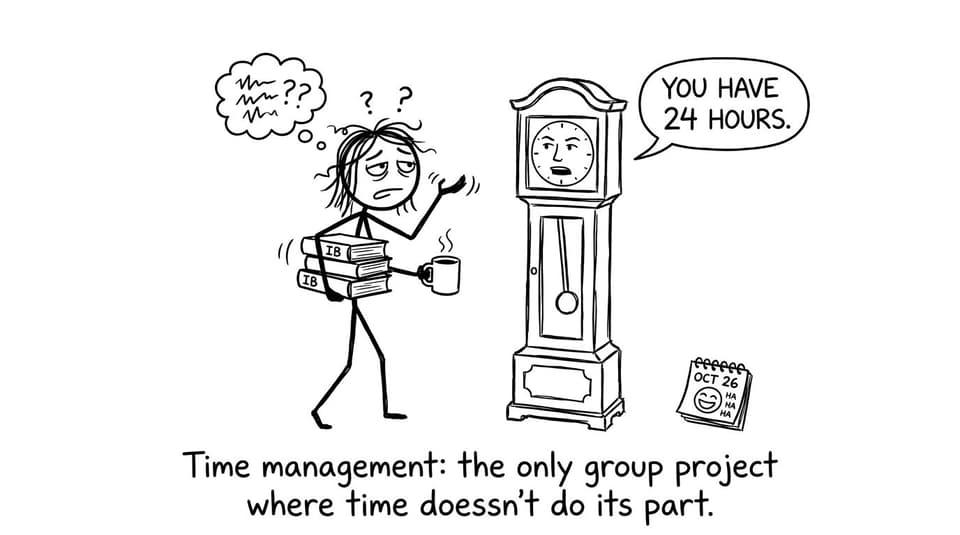
Almost every IB student can remember at least one moment where time felt personal. Not just limited, mocking.
And here's the uncomfortable truth: time pressure isn't just about being slow. It's about being undecided.
Indecision looks like:
- rewriting the introduction three times,
- searching for the "perfect" example,
- second-guessing a definition you already know,
- doing the hardest question first because it feels meaningful.
IB exams don't give extra marks for anxiety. They reward forward motion. If you get stuck, the best move is often mechanical: write something structured, bank the marks you can, and move.
This is where Predicted Papers (practice sets that mirror exam style) and Mock Exams are powerful: they train your pacing instincts so you don't have to invent a strategy mid-exam.
What no one tells you about command terms: they're the hidden language of IB
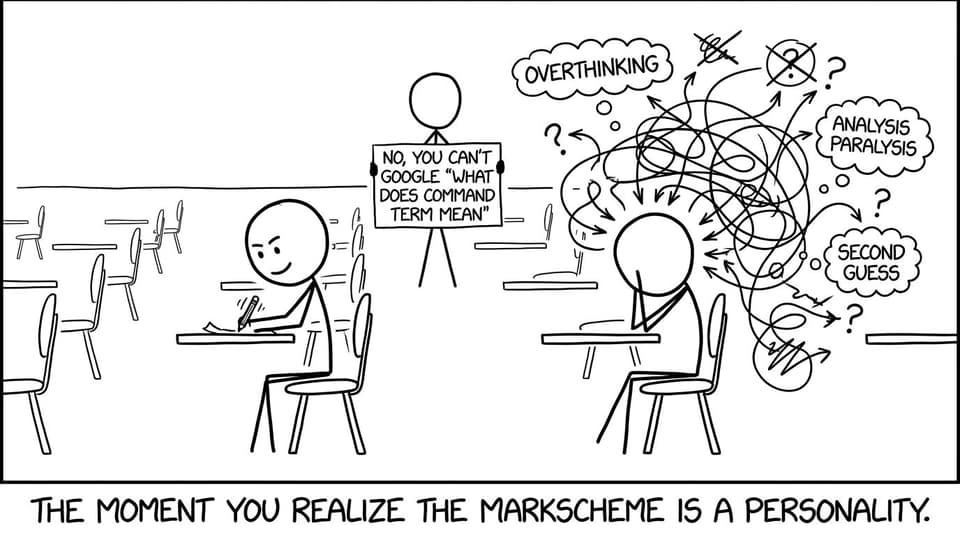
After exams, students often say, "I knew the topic, I just didn't answer the question." That sentence is basically a diagnosis.
In IB, command terms are not decoration. They're instructions about what the examiner is willing to reward.
- Describe is not Explain.
- Evaluate is not Outline.
- To what extent is not "say everything you know."
If you treat command terms like a checklist for structure, your marks become less random. Your paragraphs stop wandering. You stop losing easy points.
A practical approach: make a mini-template for each command term you see often. Then drill it using timed prompts. RevisionDojo's AI Chat can help here by turning any topic into rapid-fire command term practice, then correcting your approach when your structure drifts.
What no one tells you about stress: it changes how smart you feel
Stress makes intelligent people do silly things.
You forget obvious facts. You misread the question. You fixate on a minor detail and miss the main task. And then you interpret that as "I'm not good at IB."
But stress isn't proof of weakness. It's a predictable physiological state. You can plan for it.
Try this:
- Do at least some revision sessions in "exam conditions" (silence, time limit, no phone).
- Practice starting questions cold (no warm-up) because that's what exam rooms feel like.
- Build a short reset routine: breathe, reread the command term, write a 5-word plan.
RevisionDojo supports this kind of training through Mock Exams and targeted Questionbank sets, where you can simulate the discomfort on purpose, so it's less shocking on the day.
What no one tells you about "covering the syllabus": it's the wrong finish line
A lot of IB students set a goal like: "Finish all topics by April." It sounds responsible. It also hides a trap.
Because finishing content isn't the same as being exam-ready.
Exam readiness looks like:
- You can answer typical questions without notes.
- You know which mistakes you keep making, and you've fixed them.
- You can write fast enough and clearly enough under time pressure.
- You have a plan for weak areas and you execute it.
The IB is less about how much you touched, more about how well you can retrieve, apply, and structure.
That's why Study Notes are most powerful when they're used as quick reference after you attempt questions, not as the main event.
What no one tells you about your "weakest topic": it might be your highest ROI
After IB exams, people often discover their biggest regret wasn't missing some obscure unit. It was leaving easy marks on the table in the same places over and over.
Your weakest topic feels scary, so you avoid it. But avoidance is expensive. It compounds.
Instead, run a simple audit:
- What topics do I consistently drop marks in?
- Is it content, or is it structure, command terms, and clarity?
- Which mistakes repeat?
Then do a 7-day sprint on one weak area:
- Day 1: Diagnose using a short timed set.
- Days 2-4: Fix the core concepts with Study Notes and targeted practice.
- Days 5-6: Mixed questions under time.
- Day 7: One mini-mock and review.
RevisionDojo's Coursework Library can also help if part of your stress comes from internal deadlines colliding with revision: when coursework is clearer and more organized, your exam revision gets more oxygen.
What no one tells you about studying alone: feedback is a multiplier
The IB can feel solitary even when you're surrounded by classmates. Everyone is busy. Everyone is tired. Everyone is pretending they're fine.
But the students who improve fastest usually have a feedback loop:
- they attempt questions,
- they get corrected quickly,
- they adjust their approach,
- and they repeat.
If that loop is too slow, your revision becomes guesswork.
RevisionDojo's ecosystem is designed to speed up feedback: AI Chat for instant clarification, Grading tools to understand what earns marks, and Tutors when you need a human to pinpoint exactly why your answers aren't landing.
Closing: the point of IB exams isn't suffering; it's systems
After IB exams, the biggest surprise is how many marks were available for simple, trainable behaviors: reading the task properly, practicing recall, writing with structure, managing time, and building a fast feedback loop.
If you're still preparing, you're early enough to benefit from the truth: the IB isn't a secret talent contest. It's a set of patterns.
Build the patterns with RevisionDojo: drill with the Questionbank, consolidate with Study Notes, sharpen recall with Flashcards, pressure-test with Mock Exams and Predicted Papers, tighten your writing with Grading tools, de-stress coursework with the Coursework Library, and get targeted support from AI Chat and Tutors.
When exam day arrives, you don't need to feel fearless. You just need to feel practiced. And practiced is something you can build.