
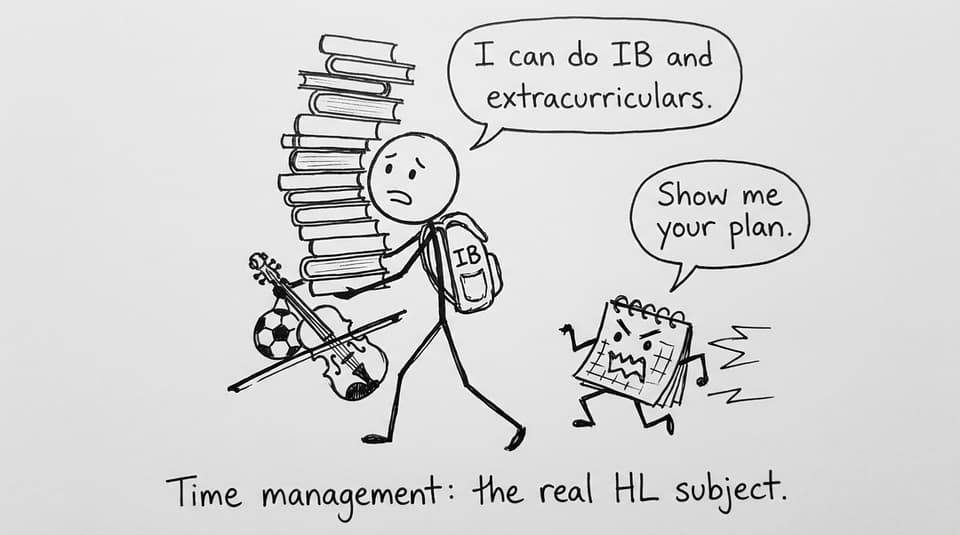
If your week feels like a suitcase you keep sitting on to make it close, you are not failing at IB. You are simply living a full life.
IB revision has a way of expanding into every empty corner of your schedule. So do extracurricular activities: training, rehearsals, debate meetings, volunteering, family commitments. The stress comes from the same place every time: you are trying to do two meaningful things with one limited resource: attention.
This guide is about keeping both. Not perfectly. Sustainably. The goal is to walk into IB exams knowing you prepared like a person with a life, not like a robot with unlimited evenings.
A quick balance checklist (save this)
-
Choose 2-3 extracurricular activities that are truly worth the time.
-
Build a weekly plan around fixed commitments first (school, training, rehearsals).
-
Use short, repeatable IB revision blocks, not heroic marathons.
-
Convert study time into marks using active recall and practice questions.
-
Protect sleep like it is part of your timetable.
-
Review your plan every Sunday and adjust without guilt.
For deeper general strategy, keep The Ultimate Guide to Revision for IB Students open as your bigger-picture reference.
Decide what stays: priorities that actually work
Most IB students do not burn out from work alone. They burn out from decision fatigue: constantly renegotiating what matters.
Try a simple filter:
-
Keep activities that give energy back (team, identity, movement, joy).
-
Pause or reduce activities that are mostly obligation, politics, or guilt.
-
Time-box anything you keep: define the number of sessions per week and the maximum duration.
If you need reassurance that balance is possible, read Do IB Students Have a Social Life? The Truth About Balance. It frames a reality many high scorers quietly live: they protect a few social anchors and become ruthless about the rest.
Build a schedule that assumes you are busy
A realistic IB revision schedule is not built on motivation. It is built on anchors.
Use the “anchor and block” method
-
List fixed commitments: school hours, commute, training, rehearsals, lessons.
-
Add two weekday revision blocks (35-45 minutes). Place them where your energy is most reliable.
-
Add one longer weekend block (75-120 minutes) for timed work.
-
Add buffers: 15 minutes between transitions, and at least one lighter evening.
A calm way to make this stick is to run a predictable loop: learn, recall, practice. RevisionDojo is designed around that workflow: Study Notes to clarify, Flashcards to keep recall alive, and the Questionbank to turn understanding into exam marks. If you want to see the ecosystem laid out simply, use RevisionDojo App: The Smarter Way to Prep for IB Exams.
Study in small bursts: the IB “minimum viable day”
On heavy extracurricular days, your target is not “finish a chapter.” It is “create proof.” Proof is what reduces anxiety.
Here is a minimum viable IB revision day (45 minutes total):
-
10 minutes: one weak concept using Study Notes
-
10 minutes: Flashcards (spaced repetition)
-
25 minutes: Questionbank practice and quick error review
This is why the science of studying matters. Passive rereading feels comforting, but active recall is what sticks. If you want the reasoning and the methods, The Science Behind Effective IB Revision: How to Study Smarter is the best companion piece.
Use dead time like a high scorer
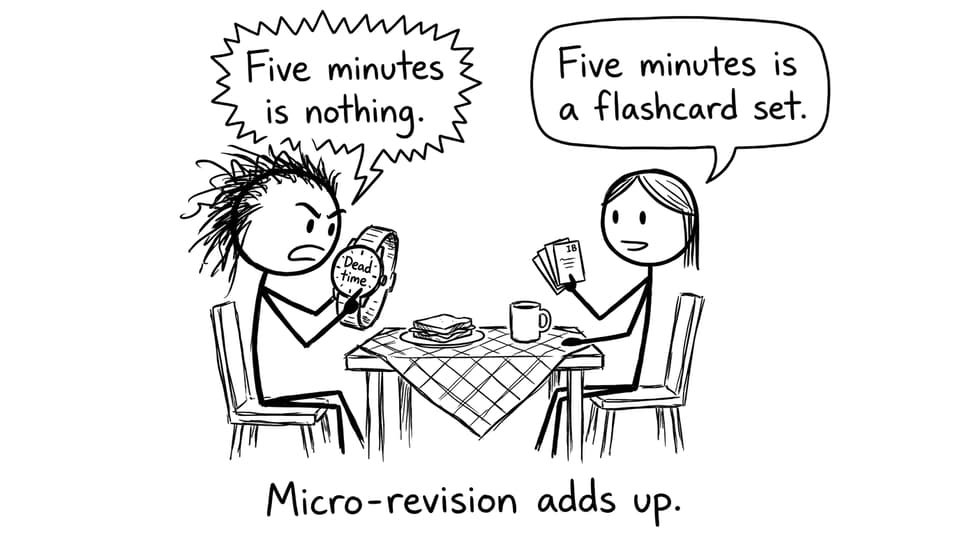
Your commute, lunch line, and five minutes before practice are not useless. They are perfect for light IB revision.
Do this:
-
Flashcards on your phone
-
A quick “definition dump” for one topic
-
Reviewing mistake notes from yesterday
This kind of micro-revision is where consistency comes from, especially when extracurricular activities eat the prime hours.
Make Pomodoro your default, not a “productivity hack”
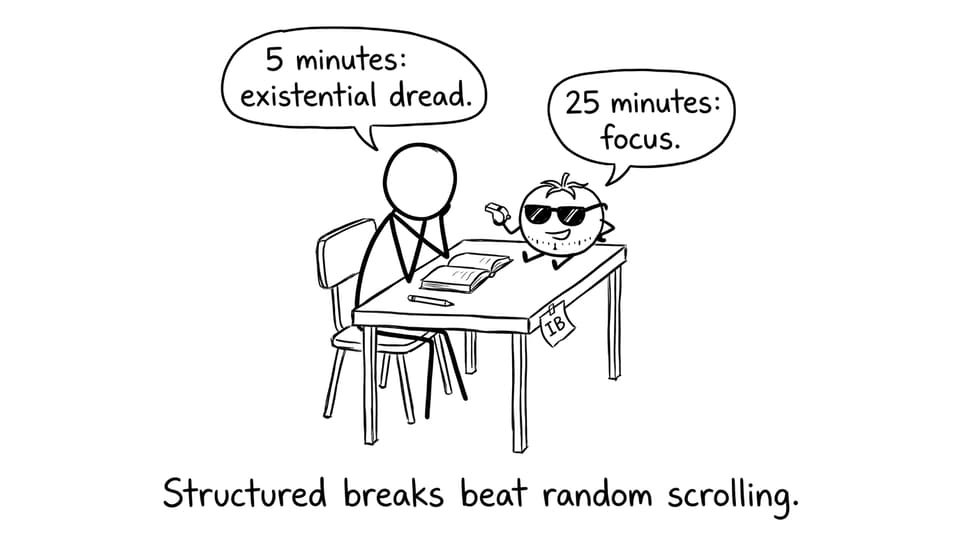
The Pomodoro Technique works because it gives your brain a clear finish line. When you are tired after training, that finish line matters.
Try:
-
25 minutes focus
-
5 minutes break
-
Repeat 2 times
Use the break intentionally: water, stretch, walk, snack. Not doom-scrolling.
If you want a step-by-step way to apply it in real study sessions, How to Revise for IB Math Using the Pomodoro Technique is a strong template you can copy for any subject.
Plan around “peak weeks” so they do not break you
There will be weeks where IB ramps up: mocks, coursework deadlines, final exam season. The mistake is pretending those weeks are normal.
Instead, create two modes:
-
Training mode (normal weeks): 3-5 revision blocks per week + activities as usual.
-
Competition mode (peak weeks): reduce extracurricular activities to maintenance (fewer sessions, fewer responsibilities), and increase timed practice.
For more ideas on scaling hobbies without guilt, Guilt-Free Hobbies for IB Students During Exam Prep is worth reading.
When you need realism, use Mock Exams and Predicted Papers inside RevisionDojo to rehearse timing and stamina, then loop back into targeted Questionbank practice. If you are unsure how predicted sets fit into IB preparation, see IB Predicted vs Specimen Papers: What They Mean.
A closing thought: keep the life, keep the marks
The students who manage IB revision with extracurricular activities are not doing more. They are doing fewer things, more consistently, with clearer boundaries.
If you want a single system that makes that consistency easier, build your routine inside RevisionDojo: practice with the Questionbank, lock in recall with Flashcards, review quickly with Study Notes, get unstuck with AI Chat, and sharpen performance with Grading tools, Mock Exams, and Predicted Papers. Add the Coursework Library when coursework stress creeps in, and use Tutors when you need a human to triage priorities fast.
Your calendar does not need to get smaller. Your plan needs to get sharper. Start today with one short IB block, then go live your life.