

Paper chromatography separates a soluble mixture because its components have different relative attractions to a moving solvent and a stationary phase. Components travel at different rates, producing separate spots. In IB Chemistry, you must explain this separation, calculate and interpret retardation factor values, and understand the experimental method.
The calculation is simple. The reasoning behind it is where marks are often won or lost. A chromatogram is not merely a collection of colored spots; it is visible evidence of competing intermolecular attractions.
Paper chromatography at a glance
For the current IB DP Chemistry syllabus, chromatography appears in Structure 2.2.10. Your revision checklist is short but important:
- Define the stationary phase and mobile phase.
- Explain separation through different relative attractions involving intermolecular forces.
- Describe how to produce a chromatogram using paper or thin-layer chromatography.
- Calculate and interpret the retardation factor, written as .
- Compare an unknown with reference substances only when experimental conditions are the same.
- Recognize practical errors involving the baseline, solvent level, spots, and solvent front.
The current syllabus does not require knowledge of locating agents or the technical operation of gas and high-performance liquid chromatographs. Start with RevisionDojo's syllabus-aligned S2.2.10 Chromatography hub, then use the focused chromatography study notes to test each point in the checklist.
How the separation actually works
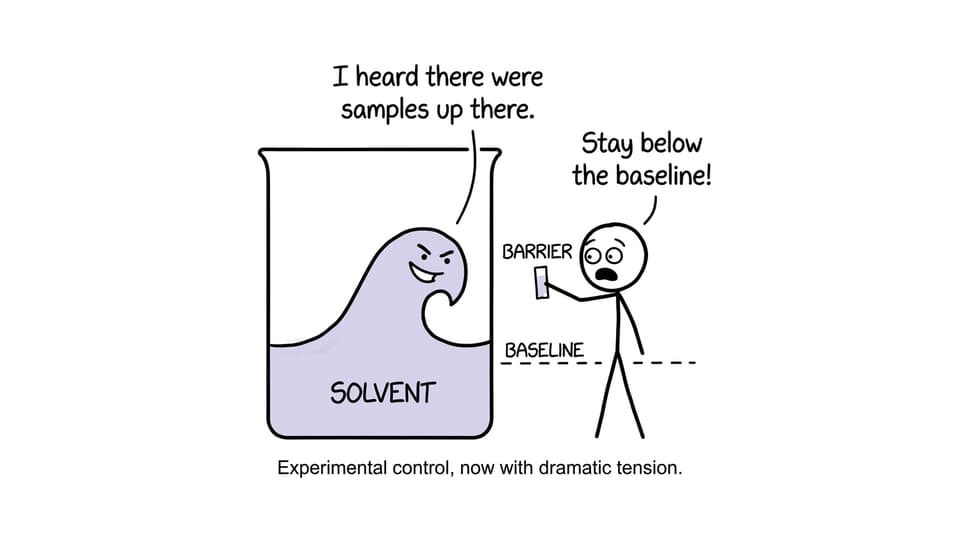
A small sample of the mixture is placed on a pencil baseline near the bottom of the chromatography paper. The paper is then placed in a suitable solvent, with the solvent level below the baseline. As the solvent rises through the paper by capillary action, it carries the soluble components with it.
The two phases have different roles:
- The mobile phase is the solvent moving through the paper.
- The stationary phase is commonly described at IB level as the paper. More precisely, traditional paper chromatography often involves partition between the mobile solvent and water held within the cellulose fibers.
Each component repeatedly interacts with both phases. A substance with greater relative affinity for the mobile phase spends more time moving with the solvent and generally travels farther. A substance interacting more strongly with the stationary phase is retarded and travels less far.
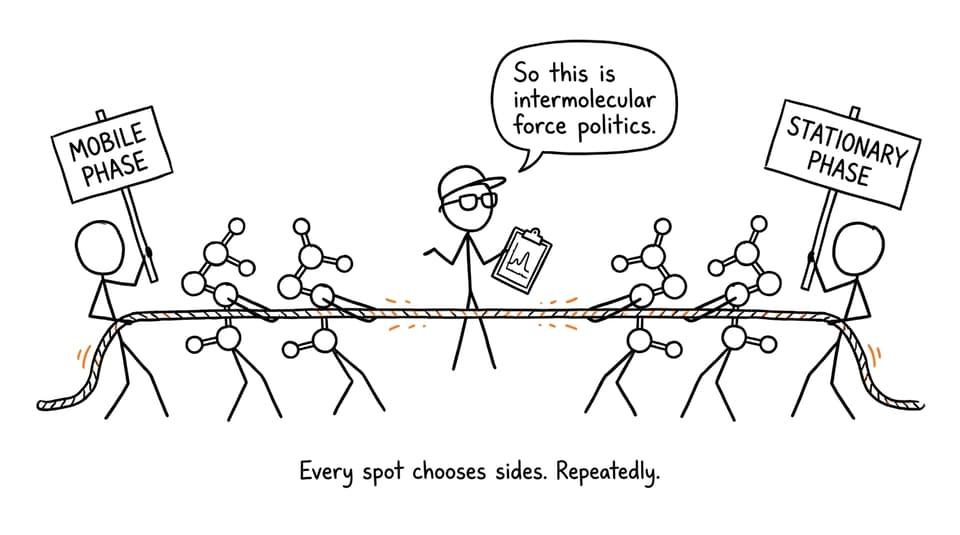
This is why saying only that “the substances have different masses” is inadequate. Chromatographic separation is explained through different relative attractions involving intermolecular forces, not mass alone. RevisionDojo's principle of chromatography explanation develops this connection across several chromatographic methods.
A reliable experimental sequence
- Draw a thin baseline in pencil.
- Add a small, concentrated sample spot and let it dry.
- Place the paper in a suitable solvent with the baseline above the liquid.
- Cover the chamber where appropriate and allow the solvent to rise.
- Remove the paper before the solvent reaches the top.
- Mark the solvent front immediately in pencil.
- Measure each component from the baseline to the center of its spot.
- Measure the solvent from the same baseline to the marked front.
Pencil is used because graphite does not dissolve and travel like many ink components might. The initial spots should be small because broad or overloaded spots can overlap, making separation and measurement uncertain.
Calculating and interpreting the retardation factor
The retardation factor compares the distance traveled by a component with the distance traveled by the solvent front:
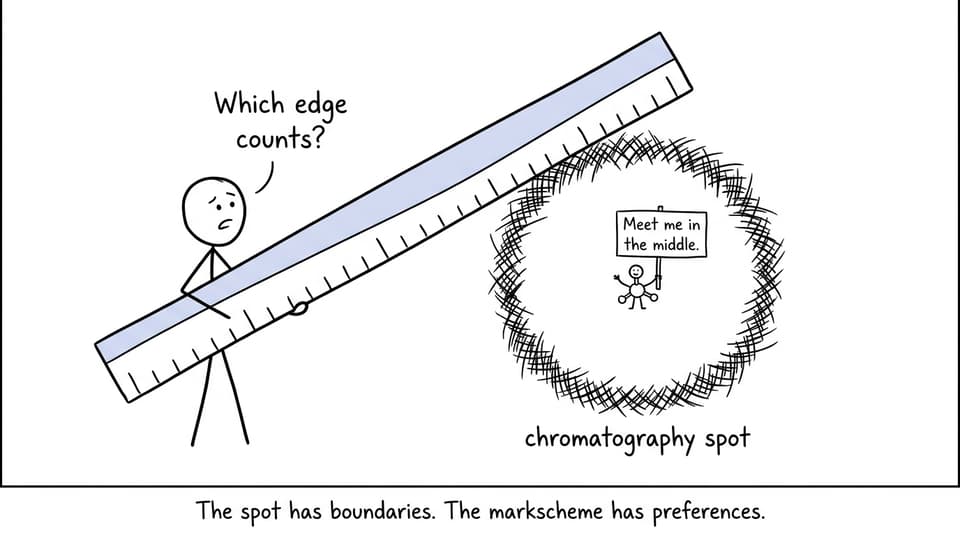
Both distances must begin at the baseline. Measure a component to the center of its spot, not to the nearest or furthest edge. Because one distance is divided by another distance measured in the same unit, has no unit. Under normal development, it lies between 0 and 1.
Worked example: calculate an unknown compound's Rf
A solvent front moves 8.0 cm from the baseline. The center of an unknown spot moves 3.6 cm.
A reference compound developed on the same paper with the same solvent has an of 0.46. The close values support the suggestion that the unknown could be that reference compound, but an match alone is not absolute proof of identity. Different substances can produce similar values, and experimental uncertainty matters.
If a second spot travels 6.8 cm while the same solvent front travels 8.0 cm, its value is:
Relative to the first component, this substance has a stronger affinity for the mobile phase, a weaker affinity for the stationary phase, or both. Avoid claiming that it is simply “more soluble” unless the question provides enough evidence to isolate solubility from other interactions.
Worked example: calculate a predicted distance
A reference substance has an of 0.65 under specified conditions. If the solvent front moves 7.4 cm under the same conditions:
Depending on the precision of the supplied data, reporting 4.8 cm may be appropriate. This rearrangement is easy to miss if you memorize the formula without understanding the ratio.
How chromatography appears in IB exam questions
An exam question may give you a diagram, experimental procedure, table of distances, or unfamiliar mixture. The context can change, but the assessed moves are usually recognizable.
When the command term is calculate
Write the relationship, substitute the values, and show the result. Units cancel in the ratio, so do not attach cm to the final . More general advice on presenting numerical work appears in IB Chemistry exam tips that move your grade.
When the command term is explain
Connect movement to both phases. A strong answer might state:
The components travel at different rates because they have different relative attractions to the stationary and mobile phases. The component with greater relative affinity for the mobile phase travels farther with the solvent.
That causal chain is stronger than writing “different substances move different distances,” which describes the result without explaining it.
When asked to identify an unknown
Compare its number and positions of spots with suitable references developed under the same conditions. Matching values provide supporting evidence. Values obtained using different solvents, paper, temperature, or other conditions should not be treated as directly interchangeable.
When asked to improve the method
Name the problem and connect it to a precise improvement. For example, if the starting spot is submerged, components may dissolve directly into the solvent reservoir. The improvement is to keep the solvent level below the baseline.
Use RevisionDojo's IB Chemistry topic-by-topic revision guide to turn these command-term patterns into a repeatable practice cycle.
Common mistakes and misconceptions
| Mistake | Why it loses accuracy or marks | Better approach |
|---|---|---|
| Drawing the baseline in ink | Ink can dissolve and produce extra spots | Use a thin pencil line |
| Submerging the sample spot | The sample may dissolve into the solvent reservoir | Keep the baseline above the solvent |
| Forgetting the solvent front | The solvent can evaporate, making its final position unclear | Mark it immediately after development |
| Measuring from the bottom of the paper | The formula requires distances from the baseline | Use one common starting line |
| Measuring to a spot's edge | Diffuse spots have uncertain boundaries | Measure to the center |
| Giving units for | It is a ratio of two distances | Report a dimensionless value |
| Treating an as universal |
These are often method errors rather than knowledge gaps. RevisionDojo's guide to avoiding common IB Chemistry exam mistakes helps you build an error log around the reason a mark was lost.
Quick-reference summary
- Chromatography separates mixture components by their different relative attractions to stationary and mobile phases.
- The solvent is the mobile phase; the paper is the practical stationary medium.
- Greater relative affinity for the mobile phase generally means greater movement.
- Greater interaction with the stationary phase generally means less movement.
- equals component distance divided by solvent-front distance.
- Measure both distances from the baseline and measure a spot to its center.
- is dimensionless and normally falls between 0 and 1.
- Compare reference values only under the same experimental conditions.
- A matching value supports identification but does not prove it by itself.
Turn a small topic into dependable marks
Paper chromatography is a compact topic, which makes it tempting to read once and move on. A better approach is to retrieve the definition, calculate several values, explain one separation, and diagnose one flawed setup without notes.
RevisionDojo brings that loop together. Begin with its complete IB Chemistry resources: clarify the concept with Study Notes, retain definitions using Flashcards, and apply them through the Questionbank. AI Chat can unpack a stubborn explanation, while Grading tools help identify missing reasoning. Then build stamina with Chemistry Predicted Papers and Mock Exams. For broader support, the Coursework Library and Tutors help connect sound experimental reasoning with the rest of your IB Chemistry journey.