
Chromatography is one of those IB Chemistry ideas that feels almost too simple… until you’re staring at a smeared spot, a crooked solvent front, and a question that asks you to “explain the separation.”
The comforting truth is this: chromatography isn’t magic. It’s just a quiet competition between two places a molecule can “hang out,” and the molecule’s preferences decide how far it travels.
If you can explain that competition clearly, you can handle most IB Chemistry chromatography questions, from practical prompts to data interpretation.
Chromatography in IB Chemistry: the one-sentence principle
In IB Chemistry, the principle of chromatography is that a mixture separates because its components have different affinities for a stationary phase and a mobile phase, so they move at different speeds and end up in different positions.
That’s the whole engine.
Everything else (paper chromatography, TLC, column chromatography, gas chromatography) is basically that engine wearing different outfits.
If you want the syllabus-aligned version of this exact concept, start with S2.2.10 Chromatography and then reinforce it with the S2.2.10 Chromatography Notes.
Quick checklist: what examiners expect you to say
When a chromatography question appears in IB Chemistry, your explanation is usually strongest if it includes:
-
The two phases (stationary vs mobile)
-
The idea of different affinities (adsorption/attraction vs solubility)
-
A link to polarity (especially for paper/TLC)
-
What moving further actually means (greater attraction to mobile phase)
-
If relevant: Rf or retention time interpretation
For targeted exam practice, the S2.2.10 Chromatography Questionbank is built for exactly this kind of phrasing.
Stationary phase vs mobile phase (and why it matters)
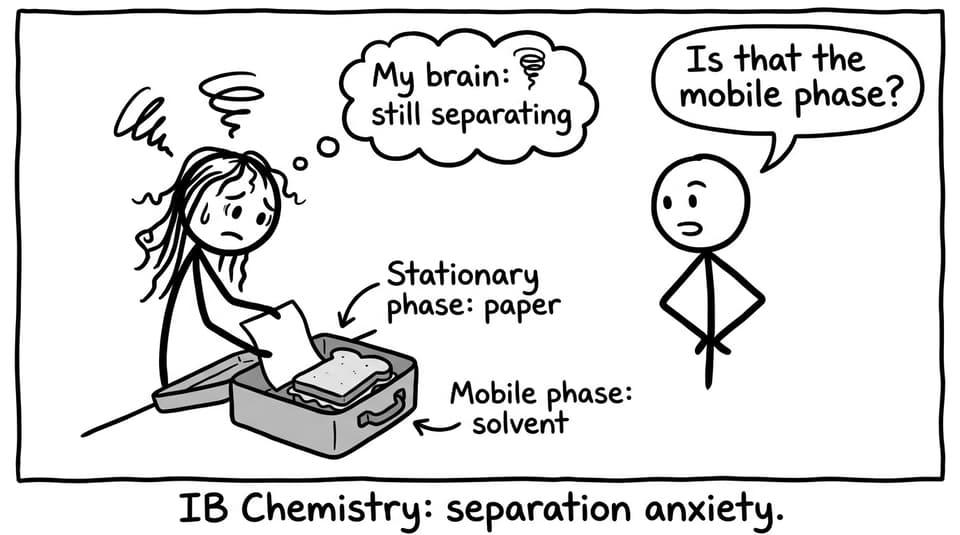
Every chromatography setup has two phases:
Stationary phase
This phase stays put. In IB Chemistry, common examples include:
-
Paper (cellulose)
-
Silica gel or alumina (TLC plates)
-
Solid packing material in a column
-
A coated interior surface in gas chromatography
The stationary phase is where molecules can stick (adsorb) or interact strongly.
Mobile phase
This phase moves and carries components along:
-
A solvent in paper chromatography, TLC, and column chromatography
-
An inert gas in gas chromatography
If a substance is more comfortable in the mobile phase (more soluble in it, or less attracted to the stationary phase), it travels further.
The real mechanism: “time spent” in each phase
A useful way to picture the IB Chemistry principle of chromatography is to imagine each molecule making repeated choices:
-
Spend time attached to the stationary phase (slower)
-
Spend time dissolved in the mobile phase (faster)
Molecules that spend more time stuck move slowly. Molecules that spend more time dissolved move quickly.
This is why chromatography separates mixtures: different molecules divide their time differently.
Polarity and TLC/paper chromatography: the exam-friendly explanation
A very common IB Chemistry angle is polarity.
-
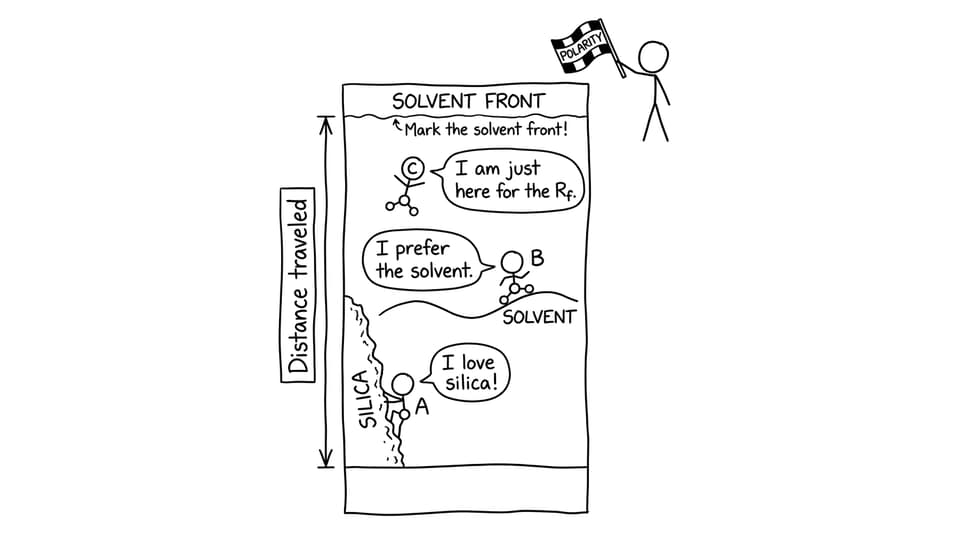
Silica (TLC) and cellulose (paper) are generally polar stationary phases.
-
A more polar solute will interact more strongly with that stationary phase (via hydrogen bonding or dipole-dipole attractions).
-
Stronger attraction to the stationary phase means less movement.
So in plain exam language:
-
More polar solute (on polar stationary phase) -> stronger attraction -> smaller distance traveled -> smaller Rf
-
Less polar solute -> weaker attraction -> travels further -> larger Rf
If you want broader coverage across the syllabus while staying in IB Chemistry mode, browse the main IB Chemistry Resources hub and the full IB Chemistry Revision Notes (SL/HL).
Rf values: what they mean, not just how to calculate them
In paper chromatography and TLC, you’ll often calculate the retardation factor (Rf):
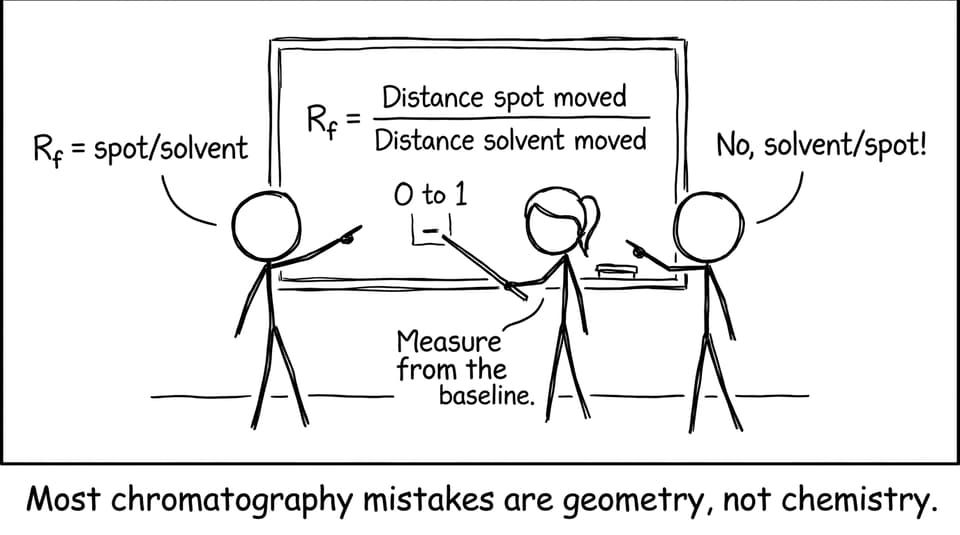
Rf = (distance traveled by the spot) / (distance traveled by the solvent front)
Key interpretation points for IB Chemistry:
-
Rf is between 0 and 1
-
Higher Rf usually means the solute is more attracted to the mobile phase
-
Lower Rf usually means the solute is more attracted to the stationary phase
Most mistakes aren’t chemical. They’re practical:
-
Forgetting to mark the solvent front immediately
-
Measuring from the wrong place (not the baseline)
-
Comparing Rf values from different solvents or plates
Chromatography methods you should recognise in IB Chemistry
You don’t need to memorise every instrument detail, but you do need to recognise the logic.
Paper chromatography
Great for inks, dyes, amino acids. Simple, visual, and often used in practical-style prompts.
Thin-layer chromatography (TLC)
Like paper chromatography, but typically sharper separation using silica/alumina.
Column chromatography
Same principle, but separation happens as components move through a packed column and come out at different times.
Gas chromatography (GC)
Used for volatile substances. The mobile phase is a gas; separation is read as peaks at different retention times.
No matter the method, the IB Chemistry story stays the same: different interactions with phases create different speeds.
How RevisionDojo helps you turn understanding into marks
Chromatography is easy to “get” and still lose points on, because marks live in precise phrasing and accurate interpretation.
RevisionDojo is built for that transition:
-
Use the Study Notes to lock in definitions and polarity links (start with Chromatography Notes)
-
Drill exam phrasing with the Questionbank at S2.2.10 Chromatography Questionbank
-
Use Flashcards for quick recall of Rf, stationary/mobile phase, adsorption vs solubility
-
Ask the AI Chat to rewrite your explanation in examiner style, then compare
-
Build timed practice with Mock Exams and Predicted Papers (and use Grading tools to spot pattern mistakes)
-
If you’re planning investigations, the Coursework Library and Tutors can help you avoid practical design traps
For more chemistry-specific revision pathways, you can also explore the IB Chemistry Posts tag and the broader strategy piece IB Chemistry Notes 2025.
Conclusion: the simplest way to remember the principle
If you remember one line for IB Chemistry, make it this: chromatography separates mixtures because different molecules divide their time differently between a stationary phase and a mobile phase.
Once you can say that clearly, you can calculate Rf confidently, justify polarity trends, and interpret chromatograms without guessing. For the fastest path from understanding to exam marks, pair the concept with targeted practice on RevisionDojo using the Chromatography topic page and the Chromatography Questionbank, then let your explanations get sharper with every attempt.