


A parent usually notices the homework question in one of two ways. Either the work seems surprisingly light, or one short assignment expands across the whole evening. In both cases, the concern is reasonable: how much homework does MYP Individuals and Societies typically involve?
There is no single IB-wide number of minutes for this subject. The amount depends on the MYP year, school policy, current unit, and whether the student is reading, researching, writing, or preparing for an assessment. Some schools use planning estimates of roughly 30 minutes per subject per week in MYP Year 1, 40 minutes in Years 2 and 3, and 60 minutes in Years 4 and 5. These are guidelines, not universal rules.
The better question is whether the work has a clear purpose, suits the student’s stage, and can be completed without consuming every evening.
A quick parent checklist
When reviewing your child’s workload, ask:
- What MYP year are they in?
- What type of task is it?
- How long does the teacher expect it to take?
- Is it routine practice or assessment preparation?
- Is the student stuck on the content, instructions, or first step?
These questions shift the conversation from “Why is this taking so long?” to “What would make this task manageable?”
What homework looks like in MYP Individuals and Societies
Individuals and Societies is not simply a memorisation subject. Students investigate societies, interpret information, analyse evidence, and examine perspectives and change. Schools may teach integrated humanities or separate disciplines such as history, geography, economics, business management, or global politics. That variety explains why assignments differ between schools.
A normal week might include:
- reading and annotating a source
- learning key concepts or terminology
- analysing cause, consequence, or perspective
- researching a focused inquiry question
- planning a paragraph or presentation
- revising work after feedback
Some tasks take twenty minutes. Others need several short sessions because students must select evidence, organise an argument, and communicate a conclusion. A research task may feel difficult not because it is long, but because it requires several independent decisions.
How much homework should parents expect?
The clearest answer to the MYP Individuals and Societies homework amount question is that it normally forms part of a wider subject allocation rather than a large daily block.
Your school’s published policy is the best reference. A schedule of 30, 40, or 60 minutes per subject does not mean a child will spend exactly that long every week. It is usually a planning target for ordinary homework, while projects and assessment preparation create occasional peaks.
The IB specifies minimum teaching time for MYP subject groups, including at least 50 hours per subject group in each year. Teaching time is not homework time, but later MYP work often becomes more demanding as students develop greater independence.
A typical progression is:
- Early MYP: short reading, vocabulary, notes, or focused responses
- Middle MYP: independent research, source analysis, and structured writing
- Later MYP: extended investigations, assessment preparation, and deliberate revision
The pattern matters more than one evening. A light week followed by a substantial project milestone can still be reasonable.
Why one assignment can take longer than expected
A task such as “write one paragraph” may sound brief. Yet the student might need to interpret the command term, choose evidence, explain its relevance, and connect the response to an assessment criterion.
When work exceeds the expected time, identify the bottleneck:
- Knowledge gap: “I do not understand the topic.”
- Instruction gap: “I do not know what the question wants.”
- Planning gap: “I have ideas but no structure.”
- Confidence gap: “I keep rewriting because I do not know when it is finished.”
This diagnosis is more useful than simply adding hours.
Supporting a child in MYP Individuals and Societies
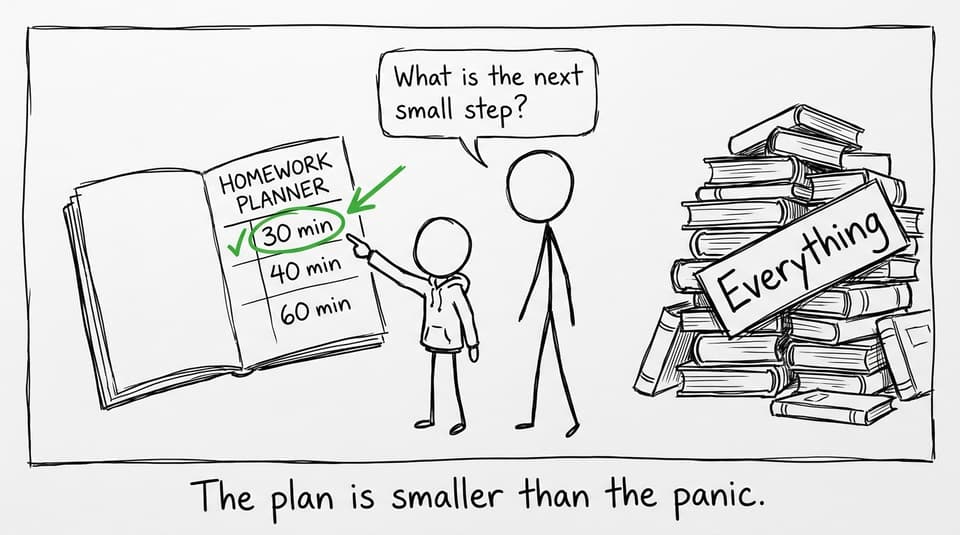
Effective parental support usually means light structure. Ask your child to show you the task, deadline, and expected outcome. Then reduce the assignment to one action: highlight two sources, define three terms, draft a thesis, or create three bullet points.
A weekly load map with due this week, in progress, and blocked can reveal problems early. If instructions are unclear, encourage a focused question for the teacher. If the difficulty is subject knowledge, a short review may be enough.
RevisionDojo can support this process while leaving ownership with the student. Study Notes clarify concepts, Flashcards reinforce terminology, and the Questionbank provides focused practice. AI Chat can unpack a question, while Grading tools help students review an attempted response. The useful loop is simple: try, check, improve, and try again.
For larger tasks, the Coursework Library offers organisational examples, while Tutors provide personal help with persistent difficulties. Mock Exams and Predicted Papers can add structure to later preparation where they fit the course. Parents can find more practical guidance in RevisionDojo’s MYP homework tips for parents and guide to supporting a child in the MYP.
When homework may be too much
A demanding week is not automatically unreasonable. Look for repeated patterns:
- expected time is regularly exceeded by a large margin
- the student cannot explain the task’s purpose
- major deadlines repeatedly fall together
- sleep, meals, exercise, or other subjects are displaced
- hours are spent polishing work without clear improvement
- homework causes persistent distress
Record the assignment, expected time, actual time, and reason for delays for one or two weeks. This gives the teacher or MYP coordinator useful evidence. The purpose is not blame. It is to establish whether the problem is volume, unclear expectations, missing skills, or a temporary assessment peak.
Finding a workable homework rhythm
There is no universal homework quota. What matters is a rhythm in which students complete meaningful practice, learn to plan independently, and retain enough time to recover.
Start with the school’s expectation, compare it with your child’s actual experience, and identify the obstacle before extending the study session. RevisionDojo then provides the right level of support at each stage: clear notes for understanding, active practice for application, feedback for improvement, and expert guidance when a student needs more than another hour at the desk.