
IB Psychology: what you need to know first
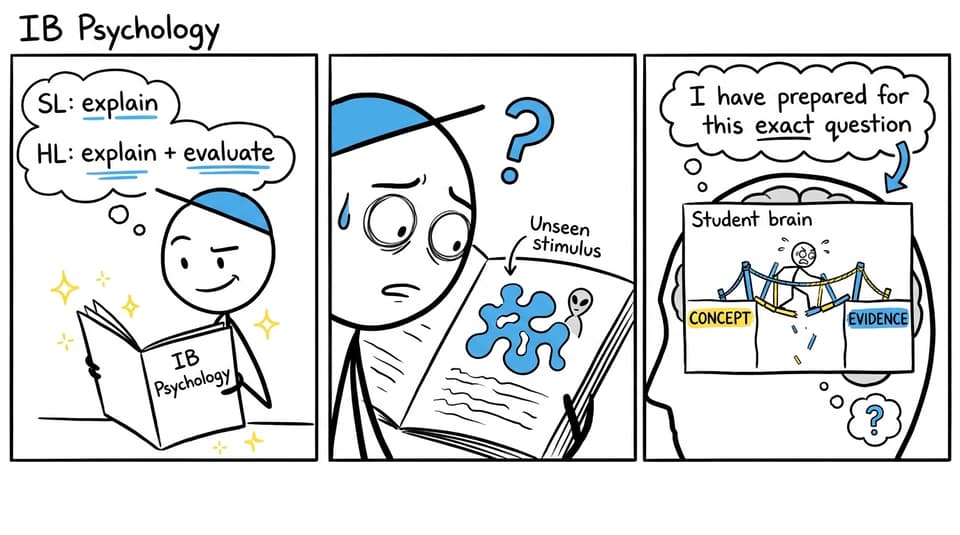
IB Psychology looks approachable until an exam question asks you to connect a theory, a research study, an unfamiliar situation, and a methodological judgment in the same response. Then the subject reveals its real demand: it is not only about remembering how behaviour works. It is about deciding how confidently we can claim that we understand it.
The most important thing to establish is your assessment route. Students completing the current course are assessed under the model with an experimental Internal Assessment, while the updated course is first assessed in May 2027. The new model connects concepts, content, contexts, research methods, and application more deliberately. Both SL and HL students complete a research proposal, while HL students also interpret quantitative and qualitative data in Paper 3.
That difference changes how you should revise. For the current course, you need reliable studies, clear essay structures, research-method knowledge, and a carefully written experimental report. For the 2027 course, you need to become comfortable applying psychology to unfamiliar contexts and justifying research decisions. This guide explains both routes and gives you a practical system for mastering IB Psychology at SL or HL.
Quick IB Psychology checklist
Use this as your starting point:
-
Confirm whether your first assessment is in 2026 or 2027.
-
Know whether you are studying SL or HL before planning your revision time.
-
Organise the biological, cognitive, and sociocultural approaches around concepts and evidence.
-
Learn what each study proves, and what it cannot prove.
-
Practise short-answer responses, extended responses, stimulus application, and research-method questions.
-
Treat the IA as a separate project with its own timeline and criteria.
-
Use active recall and feedback instead of rereading notes passively.
The IB Psychology Resources hub gives you one place to move between syllabus content, practice questions, and revision tools.
What IB Psychology actually tests
The course studies behaviour and mental processes through three broad approaches: biological, cognitive, and sociocultural. Depending on your assessment route, you may also study options such as abnormal psychology, developmental psychology, health psychology, or human relationships.
But knowing a theory is only the first layer. Strong answers usually combine four skills:
-
Knowledge: accurately explain a concept, model, theory, or study.
-
Application: use that knowledge in the specific situation described by the question.
-
Analysis: show how evidence supports, qualifies, or challenges an explanation.
-
Evaluation: judge research quality, ethics, bias, validity, credibility, or generalisability.
This is why students can feel that they “know the content” but still lose marks. They remember the study, yet do not explain why it matters for the exact question. A useful course overview is Understanding IB Psychology, especially when you need to see how the pieces fit together.
SL and HL: the practical difference
The official course allocation is approximately 150 teaching hours for SL and 240 for HL. That extra time is not simply permission to memorise more names. It creates room for greater depth, additional HL content, and more demanding data interpretation.
For the current assessment model, SL students complete Paper 1, Paper 2, and an experimental IA. HL students complete those components plus Paper 3 on research methods. HL also requires more option coverage and generally demands more developed evaluation.
For the first-assessment-2027 model, both levels complete Paper 1, Paper 2, and the research proposal. HL adds Paper 3, which contains source-based questions involving quantitative and qualitative findings and focuses on an HL extension.
The best way to think about HL is not “SL with extra facts.” It is SL with a higher expectation that you can interpret evidence, weigh competing explanations, and make methodological judgments precisely. RevisionDojo’s IB Psychology Paper 3 resources are useful for keeping that HL skill visible throughout the year.
The assessment model for the final 2026 route
If you are taking the last assessment in 2026, check your school’s official course documentation, because this is the route with the experimental IA.
At SL, the external assessment includes Paper 1 and Paper 2, while the Internal Assessment contributes to the final grade. Paper 1 examines the core approaches through short-answer and extended-response writing. Paper 2 focuses on an option. The IA is an experimental study report.
At HL, Paper 1 and Paper 2 are joined by Paper 3, which assesses research methods. HL also completes the experimental IA. The weighting and timing differ between SL and HL, so do not rely on a revision plan made for another level.
This is where the IB Psychology mark scheme guide becomes practical. It helps you distinguish between describing a study and using it as evidence, or between naming a limitation and explaining why that limitation changes the conclusion.
What changes for the first assessment in 2027
The updated course is built around the relationship between concepts, content, and contexts. Instead of treating a topic as a sealed box, you are expected to use psychological knowledge in real-world settings and unfamiliar scenarios.
The new assessment structure is:
Component | SL | HL |
|---|---|---|
Paper 1 | 35%, integration of concepts, content, and contexts | 25%, integration of concepts, content, and contexts |
Paper 2 | 35%, research contexts and evaluation | 25%, research contexts and evaluation |
Paper 3 | Not assessed | 30%, data analysis and interpretation |
Research proposal | 30% | 20% |
Paper 1 lasts 1.5 hours for both levels. It includes short-answer questions on content areas, application to unseen situations, and concept-based extended-response questions connected to contexts.
Paper 2 also lasts 1.5 hours. It includes questions based on class practicals and evaluation of an unseen research study using two or more concepts. This means that memorising a fixed essay is less useful than learning how to build an argument from the material in front of you.
HL Paper 3 lasts 1.75 hours and includes four source-based questions. You should practise reading findings, identifying patterns, interpreting evidence, and discussing what the data can support without overstating the conclusion.
The IB Psychology First Exam 2027 resources are designed for this updated route, so make sure you are not mixing old and new assessment materials.
The 2027 research proposal: what students must design
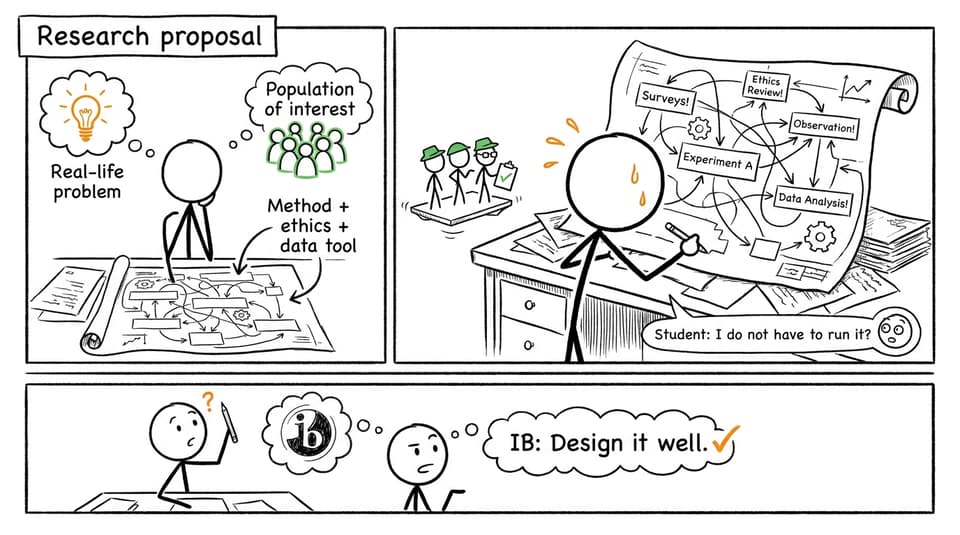
The biggest IA change is simple to state but important to understand. From the new course, SL and HL students create a research proposal rather than carrying out and reporting a full experiment.
The proposal investigates a real-life problem involving a specified population of interest. Students choose one of four methods used in class practicals: an experiment, an interview, an observation, or a survey/questionnaire. The proposal is assessed out of 24 marks and has a maximum length of 2,200 words.
The four sections are:
-
Introduction: explain the real-life problem, identify the population of interest, summarise two relevant pieces of research, and establish a focused aim.
-
Research methodology: justify the method, sampling, participants, procedure, and ethical safeguards.
-
Data collection: create and justify a tool for measuring behaviour relevant to the aim. A tool such as a questionnaire, interview schedule, or observation checklist must contain at least five items.
-
Discussion: explain anticipated findings, implications, limitations, and possible alternative approaches.
The important phrase is justify your decisions. The IB is not asking you to invent a flawless study. It is asking whether your method fits your aim, whether your data tool measures the intended behaviour, and whether your ethical choices protect participants.
Use RevisionDojo’s 2027 Psychology IA Guide to turn the proposal into smaller decisions instead of one intimidating document.
How to study the three approaches effectively
A study bank becomes useful when every study has a job. For each piece of research, record the aim, method, participants, findings, conclusion, and one or two evaluation points. Then add the concept or question it helps answer.
For the biological approach, revise explanations involving the brain, hormones, neurotransmitters, genetics, and physiological processes. The Brain and Behavior topic can help you organise evidence around specific claims rather than memorised paragraphs.
For the cognitive approach, focus on processing, memory, schemas, emotion, and the reliability of cognitive processes. When using a study, explain the mechanism it supports and whether the method genuinely captures that mechanism.
For the sociocultural approach, connect behaviour to culture, identity, groups, norms, and social influence. Avoid treating culture as a decorative word. Explain how context changes the behaviour being studied, the interpretation of results, or the generalisability of a conclusion.
For options, choose evidence you can evaluate rather than collecting the largest possible list. The Personal Relationships topic page is one example of how a topic can be connected to notes and practice questions.
A weekly system for SL and HL mastery
A productive week does not need to be dramatic. It needs to repeat.
Start with two short content sessions. Use Study Notes to learn one narrow area, then close the notes and recall definitions, studies, and evaluation points using Flashcards. Next, complete two Questionbank sessions organised by topic or command term.
Once a week, write one timed response. For an extended response, spend a few minutes identifying the command term, forming a thesis, choosing two or three studies, and assigning each study a clear role. The IB Psychology LAQ structure guide gives you a repeatable framework: point, evidence, explanation, evaluation, and a direct link back to the question.
HL students should add a short methods or data session each week. Practise sampling, ethics, validity, reliability, bias, and interpretation of findings. Students following the 2027 route should also practise unseen scenarios, because familiarity with a memorised prompt will not be enough.
RevisionDojo supports this loop through its Questionbank, Study Notes, Flashcards, AI Chat, and Grading tools. Near the exam, Predicted Papers and Mock Exams let you test pacing and stamina. For coursework, the Coursework Library and Tutors can help you identify where a draft needs clearer justification rather than simply adding more words.
How to write stronger exam responses
Before writing, underline the command term and the precise focus of the question. “Explain,” “discuss,” “evaluate,” and “to what extent” require different kinds of thinking.
Then choose evidence selectively. Two well-understood studies are usually more useful than five rushed summaries. After describing a finding, force yourself to complete the sentence: “This matters because...” That sentence is often where application and analysis begin.
Evaluation should also be specific. Do not write only that a sample was small or that a study was conducted in a laboratory. Explain whether that affects ecological validity, credibility, generalisability, participant behaviour, or the strength of the conclusion. A strong conclusion does not pretend that one study settles a psychological question. It gives a reasoned judgment and identifies the conditions under which the claim is strongest.
Closing: make the course predictable
IB Psychology becomes easier when each revision session answers a clear question: What am I learning? What evidence supports it? What are its limits? Can I apply it to something unfamiliar?
That is the difference between collecting notes and building exam readiness. Whether you are completing the 2026 assessment route or preparing for the first assessment in 2027, the reliable system is the same: learn precisely, retrieve actively, practise under constraints, and use feedback before the exam forces you to discover a weakness.
RevisionDojo gives you that system in one place, from Study Notes and Flashcards to the Questionbank, AI Chat, Grading tools, Predicted Papers, Mock Exams, Coursework Library, and Tutors. The goal is not to make psychology feel simple. It is to make your next decision clear when the question is difficult.