

The hardest adjustment in IB Mathematics: Applications and Interpretation is rarely one terrifying formula. It is the realization that obtaining an answer is only part of the task.
The biggest of the IB Math AI first term struggles is learning to make mathematical decisions. You must translate a situation into mathematics, choose an appropriate method, use technology accurately, and explain what the output means. A calculator can produce a regression equation in seconds. It cannot decide whether that equation is sensible or whether a prediction is reliable.
This uncertainty does not mean you are bad at Math AI. It means you need to practise a different kind of mathematical thinking.
The first-term adjustment checklist
If Math AI feels unexpectedly slippery, focus on five habits:
- Identify what the question asks before touching your calculator.
- Decide which model, representation, or operation fits the context.
- Practise graphic display calculator workflows separately from theory.
- Record enough mathematical working to make your reasoning visible.
- Interpret important results using the variables and units given.
The IB Math AI resource hub organizes support by syllabus area and course level.
Why Math AI feels different from earlier mathematics
Many earlier mathematics courses follow a recognizable rhythm: learn a method, imitate an example, and repeat it with different numbers. Math AI still requires procedural fluency, but the course also emphasizes modelling, technology, communication, interpretation, and unfamiliar real-world problems.
Consider a dataset showing the value of a device over time. You might use
where is the value and is time. Finding and is only one step. You may also need to interpret both parameters, choose a reasonable domain, make a prediction, and explain why extrapolation beyond the observed data may be unreliable.
The arithmetic may be manageable. The judgment is harder. The course is asking not merely, “Can you calculate this?” but, “Can you decide what should be calculated and defend the result?” The guide to how IB Math AI works explains this broader course identity.
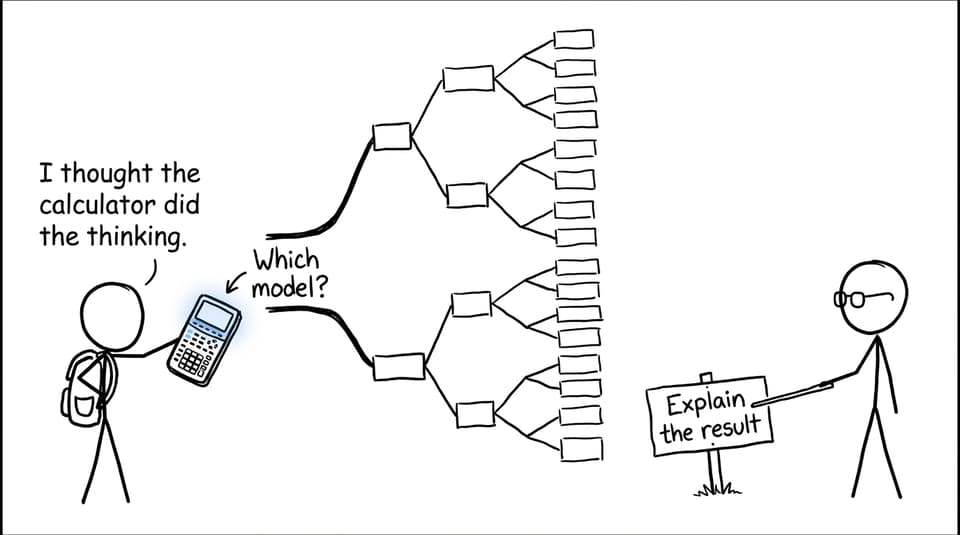
The calculator is a tool, not a substitute for decisions
Technology is central to Math AI. The IB subject brief states that external assessments involve technology, although students should confirm current calculator rules and approved models with their school.
A graphic display calculator can make computation quicker, but it moves the intellectual burden. You must decide what to enter, which output matters, whether it is plausible, and how to interpret it.
A strong calculator response follows four stages:
- Select: Identify the appropriate operation or model.
- Enter: Input data using correct settings, variables, and units.
- Check: Ask whether the output is plausible.
- Explain: State what the result means in context.
Suppose your calculator gives an intersection at . Those coordinates are not yet a complete answer. A stronger response says that after approximately 6.4 months, the two projected values are equal at about $82.70.
Use the RevisionDojo GDC guide for Math AI to identify essential workflows. Practise one workflow at a time instead of memorizing every menu during a difficult problem.
A practical routine for adjusting to IB Math AI
Learn the mathematical idea first
Start with a narrow concept, such as exponential models, arithmetic sequences, or graph intersections. Use Math AI Functions Study Notes or the Number and Algebra Study Notes to understand what the method does and when it applies.
Before calculating, ask:
- What information do I have?
- What must I find?
- Why does this method fit?
If you cannot answer the third question, more button practice will not fix the underlying problem.
Build calculator fluency in short sessions
Choose one operation and repeat it with several small examples. This might be graphing a function, finding an intersection, generating a regression model, or solving an equation numerically.
Keep a calculator log recording the task, menu path, common input error, and required interpretation. The aim is to make navigation automatic so your attention can return to the mathematics.
Add one interpretation sentence
After obtaining a result, complete one relevant prompt:
- “In this context, the value means...”
- “The parameter represents...”
- “This prediction may be unreliable because...”
- “The model is appropriate within this interval because...”
These stems reconnect symbols with reality. If you cannot explain a parameter, you probably need to revisit the model.
Review mistakes by cause
Do not label every incorrect answer as “careless.” Decide whether you misunderstood the concept, selected the wrong method, entered data incorrectly, used an unsuitable setting, rounded too early, omitted working, or failed to interpret the result.
RevisionDojo’s Math AI study plan recommends targeted learning, practice, correction, and retesting. Each classified error gives your next study session a purpose.
What a strong first-term week looks like
You do not need marathon study sessions. You need repeated contact with the full decision process.
On two weekdays, spend 25-35 minutes learning one concept through Study Notes, then answer a small Questionbank set. On another day, review formulas, definitions, and calculator prompts with Flashcards. At the weekend, complete a mixed timed set and use Grading tools to examine lost marks.
Use AI Chat to ask why a method applies, not merely for the next step. Tutors can address persistent conceptual gaps. Later, Predicted Papers and Mock Exams develop timing, while the Coursework Library supports mathematical exploration. The guide to simplifying Math AI concepts shows how these resources can form one connected routine.
Signs that the adjustment is working
Progress may appear before your score changes. You are improving when you can predict an answer’s approximate shape or size, select a method without being prompted, notice implausible calculator output, explain parameters with units, distinguish interpolation from extrapolation, and show mathematical structure when technology performs the computation.
These quiet gains make unfamiliar questions feel less random. You begin recognizing the decisions beneath their surface details.
The first term is about changing how you think
Math AI is not primarily about pressing more buttons. It is about moving between context, mathematics, technology, and interpretation.
That shift is trainable. Learn one concept, practise its calculator workflow, explain the output, classify mistakes, and repeat. RevisionDojo brings that cycle together through its Questionbank, Study Notes, Flashcards, AI Chat, Grading tools, Predicted Papers, Mock Exams, Coursework Library, and Tutors. Used as one learning system, they turn first-term shock into genuine mathematical independence.