


The first term IB Math AI experience usually moves from familiar foundations into something less familiar: using mathematics to describe situations, test models, interpret data, and justify conclusions. Schools choose their own teaching order, so you may begin with numbers, functions, statistics, sequences, or geometry. The deeper pattern is more consistent. Lessons become contextual, calculator skills become part of mathematical fluency, and answers increasingly require interpretation.
The workload is manageable when you practise each week. It becomes difficult when small gaps accumulate, particularly in algebra, calculator procedures, or mathematical communication. Your first term is therefore less about mastering the syllabus and more about building a reliable way to learn.
Your first-term overview
Expect the term to include most of the following:
- A review of prerequisite algebra and number skills
- Early work on one or two major syllabus areas
- Frequent use of a graphic display calculator, or GDC
- Short homework sets and periodic topic tests
- Questions based on data or real-world contexts
- More written interpretation than many students expect
- A growing distinction between knowing and independently choosing a method
The course contains five compulsory areas: number and algebra, functions, geometry and trigonometry, statistics and probability, and calculus. The IB recommends 150 teaching hours for SL and 240 for HL, including time for problem-solving, modelling, investigations, and exploration skills. Your school decides how to arrange that content.
The RevisionDojo IB Math AI resource hub separates course material by topic and level.
A realistic first-term arc
This timeline is illustrative rather than an official IB sequence. Calendars and teacher preferences differ, but the progression reflects the broader adjustment students make.
| Stage | What you may study | What you are really learning |
|---|---|---|
| Weeks 1-3 | Algebra review, calculator setup, sequences, or statistics | Whether your foundations are precise |
| Weeks 4-7 | Functions, finance, data analysis, or geometry | How to translate context into mathematics |
| Weeks 8-11 | Modelling, regression, probability, or linked questions | How to select methods independently |
| Weeks 12-15 | Mixed assessments, corrections, and exploration discussions | How to connect topics and explain conclusions |
Familiar mathematics gains another layer
The opening lessons may seem reassuring. You might work with percentages, lines, summary statistics, or sequences. Yet Math AI does not merely ask whether you can calculate a percentage change or produce a regression equation. It asks what the result represents and whether the model is sensible.
Finding an exponential model such as
may be only the middle of a solution. You could also need to interpret and , choose a suitable domain, predict a value, and question whether extrapolation is justified.
By mid-term, problems often combine calculator output, graphs, units, and written conclusions. The arithmetic may be straightforward. The harder task is recognizing the mathematical structure inside the wording.
This is when focused practice helps. RevisionDojo's guide to targeted IB Math Questionbank revision shows how to isolate a weakness, practise it, review the error, and retest it later.
Mixed assessments reveal hidden gaps
Topic quizzes tell you which chapter is being tested. Mixed assessments do not. You must diagnose whether a question needs regression, geometry, financial mathematics, or another method.
That transition can make independent performance feel weaker than classroom understanding. Recognizing a teacher's worked method is different from selecting it alone. Treat the gap as useful evidence about what your routine needs to address.
What the weekly workload feels like
Math AI does not need to consume every evening, but it does require regular contact. A sustainable routine could include:
- Session one, 25-35 minutes: review the latest concept and reproduce an example from memory
- Session two, 30-45 minutes: complete a small set of focused questions
- Session three, 20-30 minutes: correct mistakes, practise GDC procedures, and revisit an older skill
The correction session matters most. For each error, decide whether its cause was conceptual, algebraic, technological, interpretive, or careless. Three carefully reviewed questions can teach more than ten completed without reflection.
Students with crowded schedules can use RevisionDojo's IB Math study plan for busy students. The basic cycle is to learn one idea, retrieve it, apply it, and record what went wrong.
What surprises new Math AI students
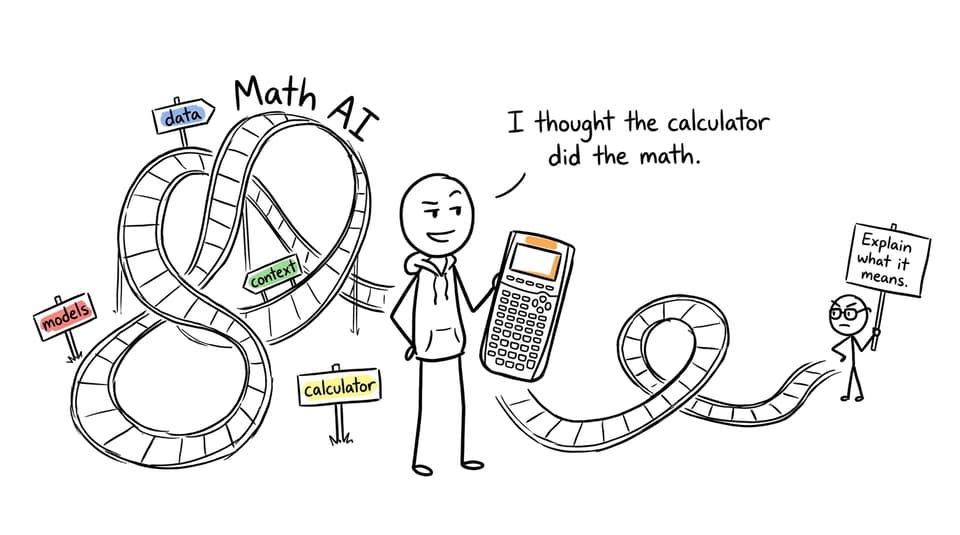
The calculator does not make the course easy
Technology is used throughout Math AI external assessment. Calculator fluency is essential, but you must still choose an operation, enter data accurately, show appropriate working, and interpret the result.
A calculator can return . It cannot determine whether the relationship is meaningful, whether an outlier matters, or whether correlation supports a causal claim. Build a procedure list for graphing, regression, equation solving, distributions, and financial mathematics as they appear. The RevisionDojo GDC guide for Math AI connects these workflows with the reasoning behind them.
Context and communication create difficulty
Applied mathematics is not automatically easier. Context requires you to identify relevant values, define variables, keep units consistent, and translate numerical output into an ordinary sentence.
Before finishing a question, ask:
- What does my answer measure?
- Which units belong with it?
- Is it reasonable in this situation?
- Have I answered the actual question?
A numerically correct answer can still be incomplete. Practise concise conclusions that state the result, context, and any limitation requested. The goal is not a long essay. It is precise mathematical communication.
Algebra weaknesses return quietly
Math AI emphasizes modelling and technology, but algebra remains important. Rearranging formulas, handling percentages, understanding notation, and reading graphs all support later topics. A weakness can remain hidden while your calculator produces output, then reappear when you must explain the method.
Use concise Math AI Study Notes to repair the concept, then test it through the Questionbank. Flashcards help with definitions, conditions, and calculator prompts, but should support problem-solving rather than replace it.
How SL and HL begin to differ
Both levels share the same applied identity, five syllabus areas, and emphasis on technology. HL adds content and depth, with 240 recommended teaching hours compared with 150 at SL. HL classes may move faster or expect greater independence, but SL remains demanding when questions require careful interpretation.
Do not judge your level from one difficult week. Look for a pattern across assessments, available study time, and university requirements. Speak with your teacher or coordinator early if the level appears mismatched.
The mathematical exploration
The mathematical exploration is compulsory and contributes 20% of the final grade at SL and HL. Some schools introduce it during the first term, while others wait until students have a broader mathematical toolkit.
You do not need a perfect research question immediately. Notice interesting contexts and responsibly accessible datasets. When the process begins, use the IB Math AI exploration guide and examine communication and structure in the Math AI Coursework Library. Exemplars should clarify expectations, never provide material to imitate.
The habit to build before term ends
Keep a one-page error log. After each assessment or practice set, record the earliest point where your reasoning failed and one preventive action. "Got regression wrong" is vague. "Entered the variables in reverse order and interpreted the wrong slope" is actionable.
RevisionDojo works best as a connected feedback loop. Study Notes explain ideas, the Questionbank tests them, Flashcards preserve key knowledge, and AI Chat helps when the next step is unclear. Grading tools can identify weaknesses in reasoning. Predicted Papers and Mock Exams become useful once you have covered enough material for timed mixed practice, while Tutors can help diagnose persistent gaps.
Your first term is not a verdict on whether you are a "math person." It is an adjustment period. Learn to understand the context, choose the mathematics, use technology deliberately, and explain what the answer means. Build that rhythm now, and the rest of IB Math AI becomes far less mysterious.