



When people say they “ran out of time” in IB Math, they usually mean two different things.
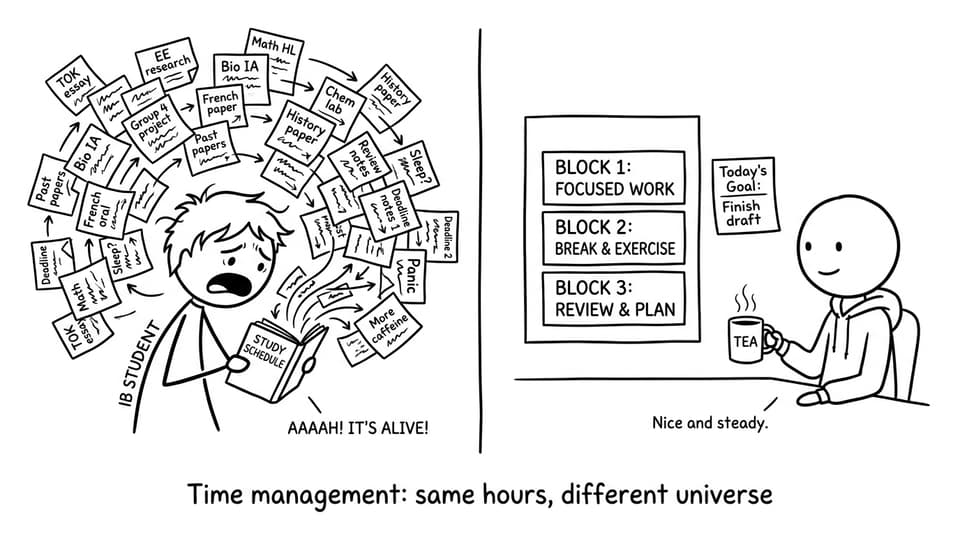
They mean they ran out of time in the exam. And they mean they ran out of time in the weeks before the exam, when revision was supposed to turn into confidence but somehow turned into panic.
The fix for both is the same skill: time management. Not the motivational kind. The mathematical kind. Inputs, outputs, constraints, and a schedule you can actually follow.
This post gives you a realistic study schedule for IB Math exams (AA or AI, SL or HL), plus a simple weekly structure you can repeat until exam day.
Quick checklist before you build your study schedule
Use this checklist to make your time management plan feel concrete in under 10 minutes:
-
Confirm which route you are in (AA or AI) and your level (SL or HL) using the IB Math AA hub.
-
Write your exam dates and count backward 10 weeks.
-
List your weakest two topics (be honest, not aspirational).
-
Decide your “default” study block length (60-90 minutes works for most).
-
Set your practice system: Study Notes for clarity, Questionbank for reps, Flashcards for recall, AI Chat for quick explanations, Grading tools for feedback, then timed rehearsal with Mock Exams and Predicted Papers.
If you need a broader routine that fits around all subjects, borrow the structure from How to Create a Balanced IB Study Schedule and adapt the Math blocks.
Understand the IB Math papers (so your time management is accurate)
A good schedule respects the real constraint: the papers train different muscles.
-
Paper 1 is typically no calculator (method, algebraic control, clean reasoning).
-
Paper 2 is typically calculator allowed (interpretation, technology fluency, multi-step problems).
-
HL students also face Paper 3 (depth, unfamiliar twists, stamina).
This is why time management is not just “study more.” It’s “study the right way for the right paper.” For exam pacing strategies, keep How to Master Time Management in IB Math Exams open as your reference.

The best 10-week study schedule for IB Math exams
This schedule assumes you can do 5 study days/week, with one longer weekend block. If you can only do 3-4 days, keep the same order and stretch the timeline.
Weeks 1-2: Foundations (algebra + functions)
Goal: rebuild the basics so later topics don’t collapse.
-
2 sessions/week: concept rebuild using Math AA Notes
-
3 sessions/week: targeted practice from a topic-filtered question set (use the How to Use the Questionbank for Targeted Math Revision approach)
-
Daily 10 minutes: Flashcards for identities, transformations, and “error rules”
Weeks 3-4: Geometry, trig, and vectors
Goal: stop losing marks to small slips.
-
Use focused topic pages like Geometry & Trigonometry to keep your revision narrow.
-
Add one timed mini-section each week (even 25-40 minutes counts).
-
After each timed attempt, use AI Chat to ask one precise question: “Why does this method fail here?” That single clarification saves hours.
Weeks 5-6: Calculus (the marks live here)
Goal: make differentiation/integration feel automatic.
-
2 concept sessions/week with Calculus notes
-
3 practice sessions/week using a dedicated set like the AA Calculus Questionbank
-
One weekend: do a mixed-topic set, then use Grading tools to mark your working and presentation.
Weeks 7-8: Statistics and probability
Goal: become fast at interpretation and method choice.
-
Use Statistics & Probability to review definitions and conditions.
-
Run one calculator-allowed timed block each week.
-
Build Flashcards for conditions (assumptions, distribution cues, test selection), not just formulas.
Weeks 9-10: Exam rehearsal and repair
Goal: convert revision into performance.
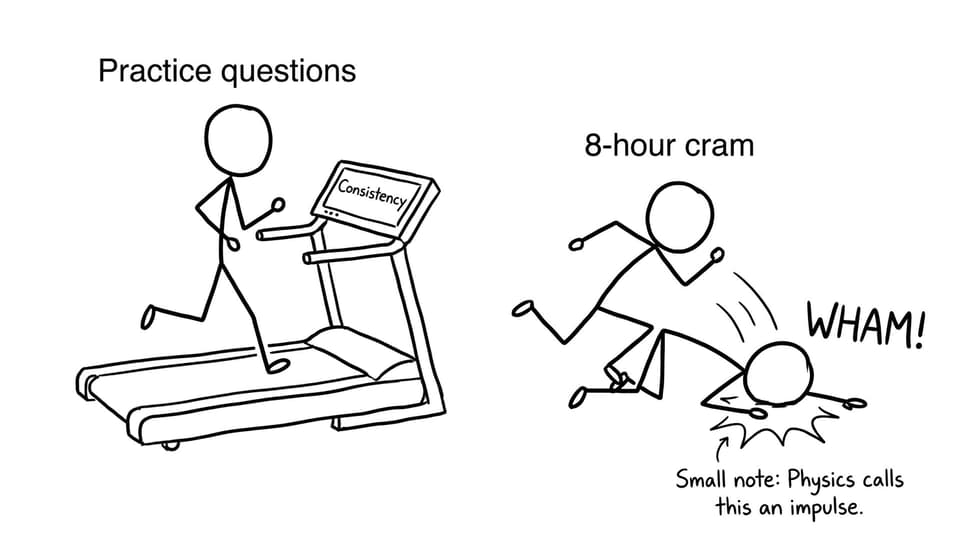
This is where time management becomes physical: you practice the pace you want to keep.
-
1 timed sit/week using Mock Exams (or a full-paper simulation)
-
2 repair sessions/week: drill only what you missed (Questionbank)
-
2 maintenance sessions/week: mixed practice to keep earlier topics alive
To make rehearsals more realistic, use Predicted Papers as your full-paper practice source alongside your topic drilling.
A weekly template that makes time management easy
If your schedule keeps breaking, the plan is probably too complicated. Try this repeatable week:
-
Monday: Study Notes + 10-15 practice questions
-
Tuesday: Questionbank drill (timed)
-
Wednesday: Flashcards + error log + redo wrong questions
-
Thursday: Questionbank drill (mixed)
-
Friday: light session + AI Chat for one confusion
-
Weekend: one longer timed section + deep review
For students who want a more general system across all subjects, pair this with Time Management Strategies for IB Students.
Closing: A calm schedule beats heroic effort
The best study schedule for IB Math exams is not the one that looks impressive on Sunday night. It’s the one you can repeat on a random Wednesday when you’re tired.
Build your plan around time management that creates outputs: clear concepts, repeated exam-style questions, and honest feedback. RevisionDojo is designed for that loop in one place: Questionbank for targeted practice, Study Notes and Flashcards for fast recall, AI Chat when you’re stuck, Grading tools for learning how marks are awarded, and timed rehearsal with Mock Exams plus Predicted Papers.
If you want to start today, open one weak topic, do one timed set, review the mistakes, and schedule the retake. That’s how confidence is built, quietly, repeatedly, on purpose.