
If you’ve ever stared at a timetable and thought, “I’m about to choose a language course that will define two years of my life,” you’re not being dramatic. Languages feel personal. They’re the one subject where your mistakes can sound like you.
Here’s the calm truth: IB German Ab Initio is built for genuine beginners. And it’s different from IB Language B in the one way that matters most: the starting line. If you’re choosing between them (or your school is nudging you toward the wrong one), this 2025 guide will help you choose the level that matches your reality, not your ambition.
Quick checklist: is German Ab Initio right for you?
Use this as a fast self-audit before you commit:
-
You’ve studied little to no German before (or only a tiny bit long ago).
-
You want a course that starts from the basics and ramps up.
-
You’re okay progressing steadily rather than sprinting.
-
You prefer assessments that reward clear communication over advanced flair.
-
You’ve checked the difference between Ab Initio and IB Language B at your school.
If those sound like you, German Ab Initio is often the best match.
What’s the real difference between IB Language B and Ab Initio?
Think of the two courses like two different gyms.
-
IB Language B assumes you’ve trained before. You may not be elite, but you already know the equipment.
-
Ab Initio is the beginner program. It teaches you how to walk in, set up, and build habits that actually stick.
That’s why the phrase ab initio (“from the beginning”) matters. It’s not marketing. It’s a promise about where the course begins.
If you want a fuller course overview, it helps to read What Is IB German Ab Initio? Complete 2025 Guide alongside your school’s subject booklet.
Why German Ab Initio works so well for beginners
German looks intimidating when you meet it as a list: cases, endings, long words, and rules with exceptions. But Ab Initio doesn’t teach German as a list. It teaches it as a set of repeatable situations.
The course is built around themes, not random vocabulary
Instead of memorising disconnected word banks, you learn through the five IB themes (identities, experiences, human ingenuity, social organisation, sharing the planet). That structure quietly protects beginners from overwhelm. It also mirrors how IB Language B is framed, just at a higher starting level.
On RevisionDojo, the themed approach becomes easier to practise using the German Ab Initio Core Themes hub.
Progress is designed to be gradual
You start with high-frequency language: greetings, school life, food, hobbies, daily routines. Then grammar arrives in layers: present tense, basic word order, common modal verbs, then more complex patterns.
If you want a practical grammar roadmap, use What Grammar Topics Are Most Important in IB German Ab Initio? (2025 Guide) as your “what to learn next” list.
The assessments reward communication, not perfection
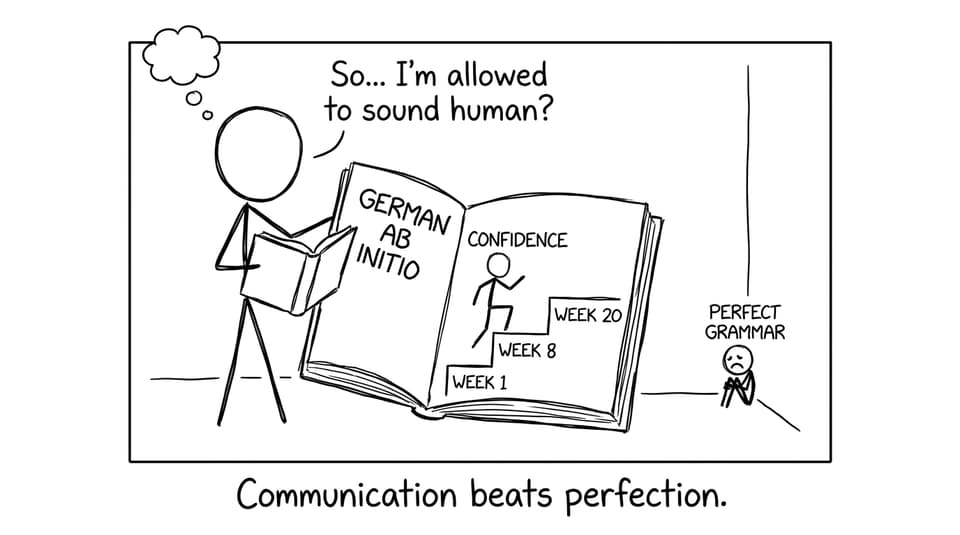
This is the part beginners need to hear twice: examiners are not hunting for advanced literature-level German. They’re looking for meaning that lands.
For the full breakdown, keep IB German Ab Initio Exam Format (2025 Guide) open while you plan revision.
What the exams feel like for a beginner (and how to prep)
German Ab Initio assessments are balanced across skills, which is exactly why many beginners do well; they get multiple ways to show progress.
Writing: learn a few shapes, then repeat them
Paper 1 writing tasks are manageable when you stop trying to invent style under pressure. Pick a few common text types, practise openings/closings, then rotate themes.
A useful training plan is inside How Can I Prepare for IB German Ab Initio Paper 1? (2025 Guide).
Reading and listening: don’t chase every word
Beginners panic because they treat unknown vocabulary as failure. It isn’t. Your job is to catch structure: topic, attitude, obvious details, and the “however/therefore” signals.
If you’re in IB Language B, this skill matters even more because texts get denser. RevisionDojo’s broader Language B strategy piece, How to Effectively Revise for Language B Exams, is worth stealing from even if you’re in Ab Initio.
Speaking: simple sentences can score surprisingly well
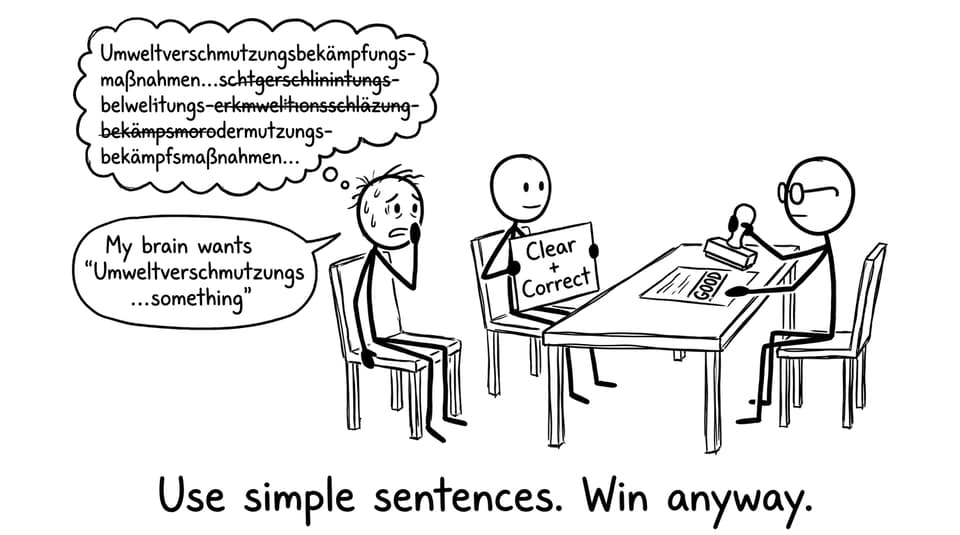
Orals improve fastest when you practise clear language with small expansions: one opinion + one reason + one example. You don’t need to impress. You need to be understood.
A beginner-friendly revision routine (that actually fits school life)
Most students don’t fail languages because they “can’t learn languages.” They fail because language learning punishes inconsistent practice.
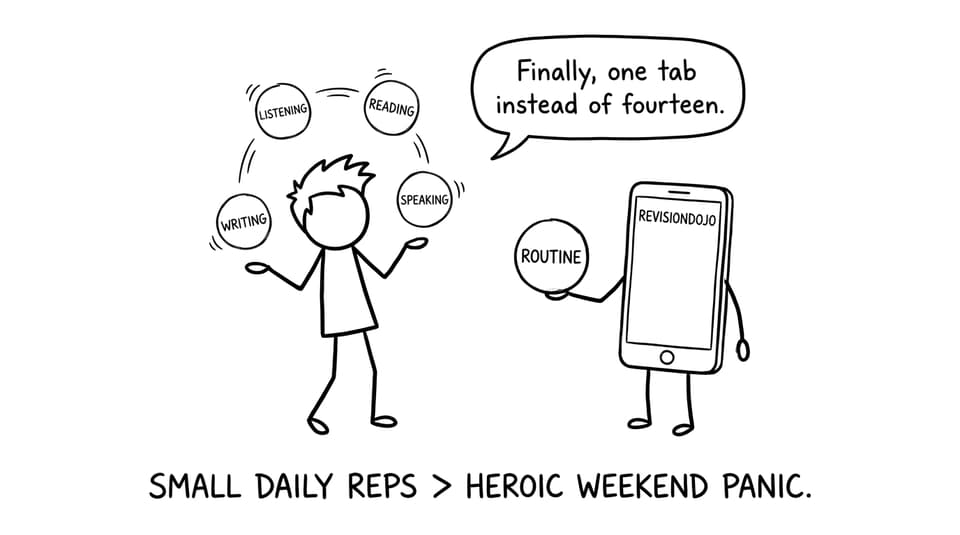
Try this simple loop:
-
10 minutes daily: Flashcards for high-frequency vocab + sentence starters.
-
3 times a week (20 minutes): One skill focus (listening, reading, writing, speaking).
-
Once a week: One timed task and quick feedback.
RevisionDojo is built for this kind of repetition loop: Study Notes clarify what the syllabus wants, Flashcards keep your vocab alive, and the Questionbank gives you targeted practice with feedback. When you want to accelerate, add AI Chat for speaking prompts, Grading tools for writing improvement, Mock Exams for realism, Predicted Papers for exam-direction practice, the Coursework Library when you need models, and Tutors when you want a human to diagnose your patterns.
You can start by exploring the main German Ab Initio IB Resources hub, then use the platform-wide Questionbank and Flashcards to keep practice consistent.
Common beginner challenges (and what to do instead)
“German grammar is too much”
It’s only too much when you try to learn it all at once. Treat grammar like scaffolding: learn the forms that unlock communication first, then add accuracy later.
“The words are too long”
Long German words look scary, but they’re often multiple smaller words fused together. Learn to spot the components, and suddenly they become readable.
“Listening is impossible”
Listening improves through exposure, not heroic effort. Short daily clips beat one long session where you feel lost.
Conclusion: beginners don’t need bravery: they need the right course
So, is IB German Ab Initio good for beginners? Yes. It’s designed so beginners can start small, practise consistently, and end up communicating confidently.
The trap is confusing it with IB Language B. Language B is excellent when you already have a base; Ab Initio is excellent when you don’t. Choose the course that matches your real starting line, then build a routine that keeps German in your week.
If you want one place to run that routine, from Study Notes and Flashcards to Questionbank, AI Chat, Grading tools, Mock Exams, Predicted Papers, the Coursework Library, and Tutors, start with RevisionDojo for IB and make your next 7 days of practice simple enough to repeat.