

If you’ve ever walked out of a German Ab Initio class thinking, “I can say something… but will it be enough for a good grade?” you’re asking the right question.
IB grading can feel mysterious because it’s not a punishment for mistakes. It’s a system that rewards what you can communicate under pressure. That’s true across Group 2, and even when people loosely compare courses to IB Language B, the same principle keeps showing up: clarity wins.
This 2025 guide explains how IB German Ab Initio is graded, how each component is weighted, and what examiners actually look for when they mark beginners.
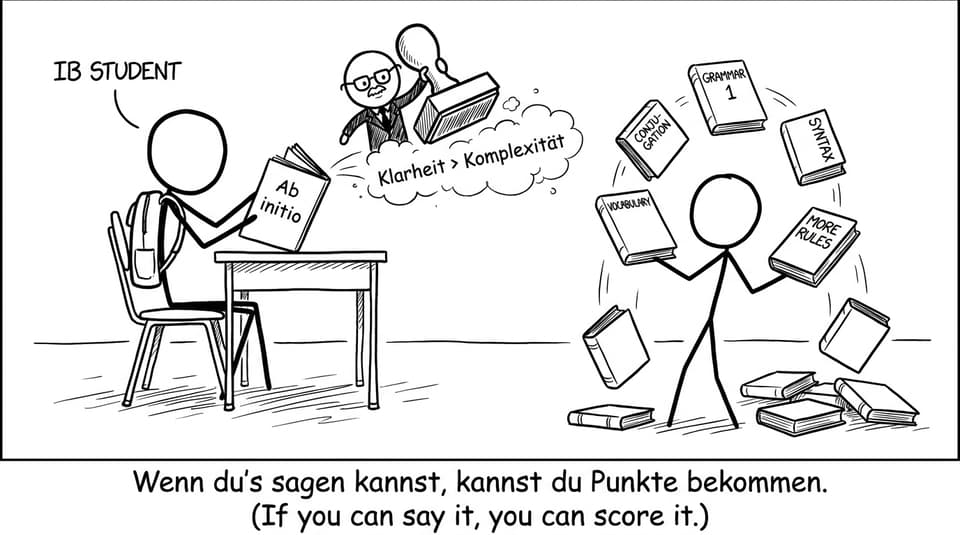
A quick grading checklist you can memorize
Before you revise a single vocabulary list, lock these in:
-
Know the weighting: Paper 1 (25%), Paper 2 (50%), Individual Oral (25%).
-
In writing and speaking, simple accurate sentences often beat risky complex ones.
-
In reading and listening, you’re graded on comprehension, not translation.
-
Grade boundaries shift slightly each year, but you don’t need perfection for a 6 or 7.
-
Build your practice around the exact exam format and criteria.
If you need the format mapped out clearly, keep IB German Ab Initio Exam Format (2025 Guide) open while you plan.
How IB German Ab Initio is graded (weightings)
German Ab Initio has three assessment components:
-
Paper 1: Writing -- 25%
-
Paper 2: Reading and Listening -- 50%
-
Individual Oral Assessment -- 25%
That balance matters. It means a student who writes well but panics in listening, or speaks confidently but avoids writing practice, leaves marks on the table.
This is also where comparisons to IB Language B become useful: the IB isn’t grading “talent,” it’s grading performance across the four skills. Your job is to train like it’s a sport.
Paper 1 (Writing) grading: what gets rewarded
Task: One written text, 200--250 words, chosen from two prompts.
Examiners grade Paper 1 using three broad expectations:
-
Language: basic grammar and vocabulary control
-
Message: relevant ideas that answer the prompt clearly
-
Conceptual understanding: you use the right conventions for the text type (email, blog, diary entry, etc.)
What usually earns top marks is surprisingly unglamorous:
-
A correct format and register (formal vs informal)
-
A simple structure: opening, development, closing
-
Clear time markers and connectors (zuerst, dann, danach)
-
Fewer errors, not more ambitious errors
Students often assume graders want complexity. But beginner courses reward control. If you want to build that control fast, RevisionDojo’s targeted grammar notes (like Sentence Word Order: Main Clauses (Verb-Second Rule) and Subordinating Conjunctions: weil, dass, wenn) are the kind of “small levers” that lift your Paper 1 score quickly.
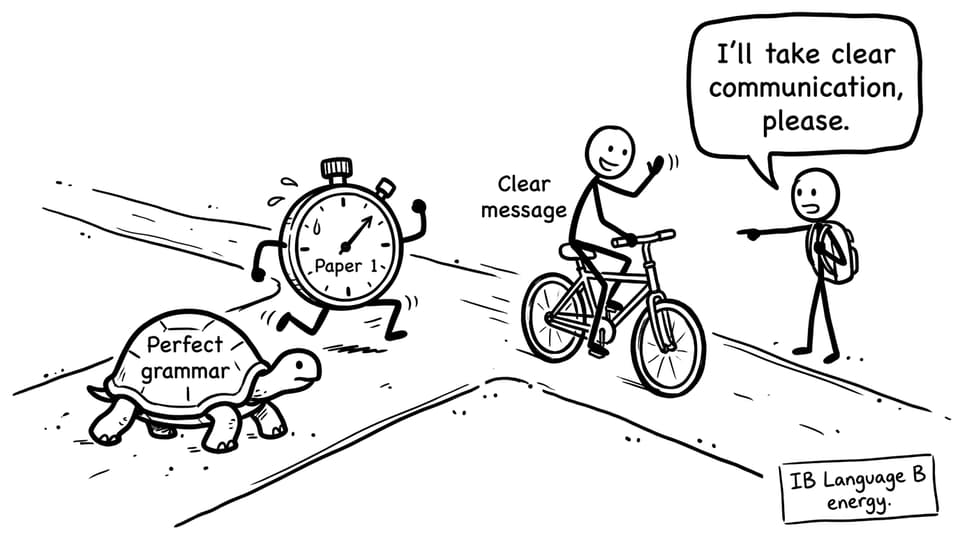
Paper 2 (Reading and Listening) grading: the 50% reality
Paper 2 is half your grade, which is why it quietly decides outcomes.
Reading: short texts (ads, notices, emails, short articles) plus comprehension questions.
Listening: short recordings played twice, then questions.
What examiners are looking for:
-
You can identify the main idea and the key details
-
You can use context to interpret tone, purpose, and situation
-
Your answers are accurate and match what was asked (especially for detail questions like time, place, numbers)
The most common beginner mistake is trying to translate every word. That’s not the skill being tested. The skill is comprehension.
A practical way to train is to do exam-style sets until “unknown words” stop feeling like emergencies. RevisionDojo’s skill pages, like Paper 2 Reading - IB German ab initio, pair practice with feedback so you learn patterns, not just answers.
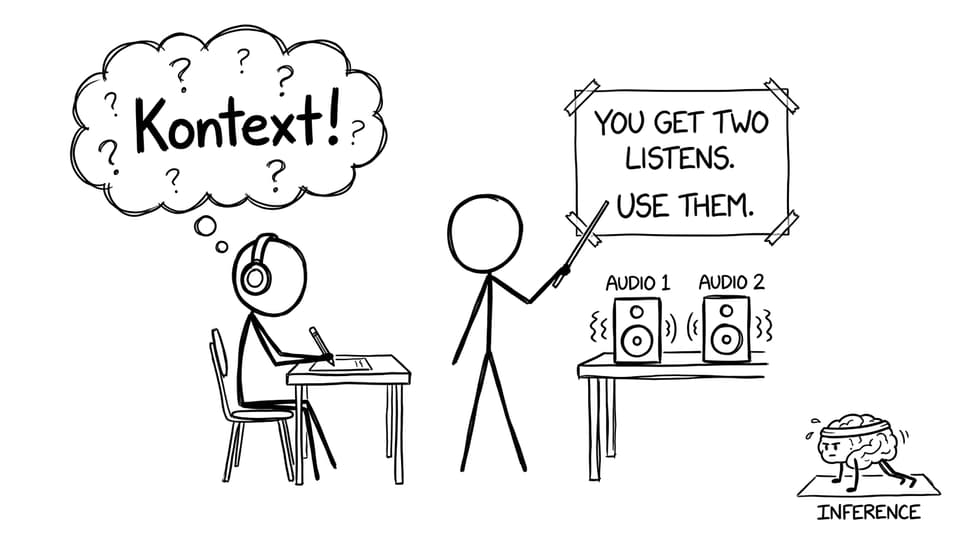
Individual Oral grading: how beginners score well
The oral can feel personal because it’s live. But it’s still a rubric.
Format:
-
15 minutes preparation with a visual stimulus
-
4--6 minutes speaking (presentation plus discussion)
Examiners assess:
-
Language: how accurately you use core structures
-
Message: whether your ideas are clear and connected to the stimulus
-
Interaction: how naturally you respond and keep the conversation going
-
Cultural awareness: links to German-speaking contexts and course themes
The trap is memorization. A memorized speech sounds “safe,” but it can reduce interaction marks because it doesn’t respond to the examiner.
A better strategy is a flexible toolkit: opinion phrases (meiner Meinung nach), comparison phrases (im Gegensatz dazu), and question-starters to buy thinking time. For structured support, RevisionDojo’s How to Improve Your Language B Speaking Skills is technically Language B focused, but the speaking principles transfer perfectly to Ab Initio: clarity, extension, and calm interaction.
Grade boundaries: what “a 7” usually means
German Ab Initio is graded from 1 to 7. Boundaries vary slightly each year depending on exam difficulty.
A typical rough range looks like:
-
7: ~80%+
-
6: ~70--79%
-
5: ~60--69%
-
4: ~50--59%
-
3: ~40--49%
-
2: ~30--39%
-
1: below ~30%
The important psychological point: you’re allowed to be imperfect and still score very well. That’s true for Ab Initio and for IB Language B. Consistency beats brilliance.
Internal vs external assessment (and why it’s fair)
-
Paper 1 and Paper 2 are externally assessed by IB examiners.
-
The oral is done by your teacher, recorded, and then moderated externally.
That moderation step is the quiet safety net. It’s designed to keep standards consistent worldwide.
How to raise your score with RevisionDojo (without doing “more”)
The fastest improvement usually comes from better feedback loops.
RevisionDojo is built around those loops:
-
Use the Questionbank to practice exam-style tasks by skill.
-
Tighten grammar with Study Notes like Yes/No Questions and W-Questions and Dative Case Notes.
-
Build recall with Flashcards and short daily drills.
-
Use AI Chat to rehearse oral follow-up questions when you don’t have a partner.
-
Use the Grading tools (even cross-language rubrics like the IB Language B SL Paper 1 Grader) to internalize what “good” looks like.
-
Check high-quality models in the Coursework Library, including IB German ab initio Exemplars.
-
When exam season gets serious, lean on Predicted Papers and Mock Exams to train timing.
-
If you want personalized correction, RevisionDojo Tutors can spot your recurring errors faster than self-marking ever will.
For broader strategy, What Study Resources Are Best for IB German Ab Initio? is a strong companion read.
Closing: the grading system is a map, not a mystery
IB German Ab Initio is graded through a balanced, predictable system: Paper 1 writing (25%), Paper 2 reading and listening (50%), and the Individual Oral (25%). Examiners reward what beginners can control: clear communication, basic accuracy, smart text-type choices, and cultural awareness.
If you want a calmer path to higher marks, build your revision around the rubric the way top IB Language B students do: practice with feedback, fix patterns, and repeat.
RevisionDojo brings that whole system into one place: Questionbank practice, Study Notes, Flashcards, AI Chat, Grading tools, Predicted Papers, Mock Exams, exemplars in the Coursework Library, and Tutors when you want fast, personal correction. Use it consistently, and the grading stops being scary because it starts being familiar.