


The night you finally sit down to plan your TOK essay can feel strangely familiar.
You’ve got a prescribed title in front of you. You’ve got opinions. You’ve got a few real-life examples floating around. And yet the page stays blank, because the missing piece is not “content”; it’s connection.
In TOK, examiners reward students who show that knowledge doesn’t live in separate boxes. The best essays make the prescribed title travel: across Areas of Knowledge (AOKs), across optional themes, and back again, with purpose.
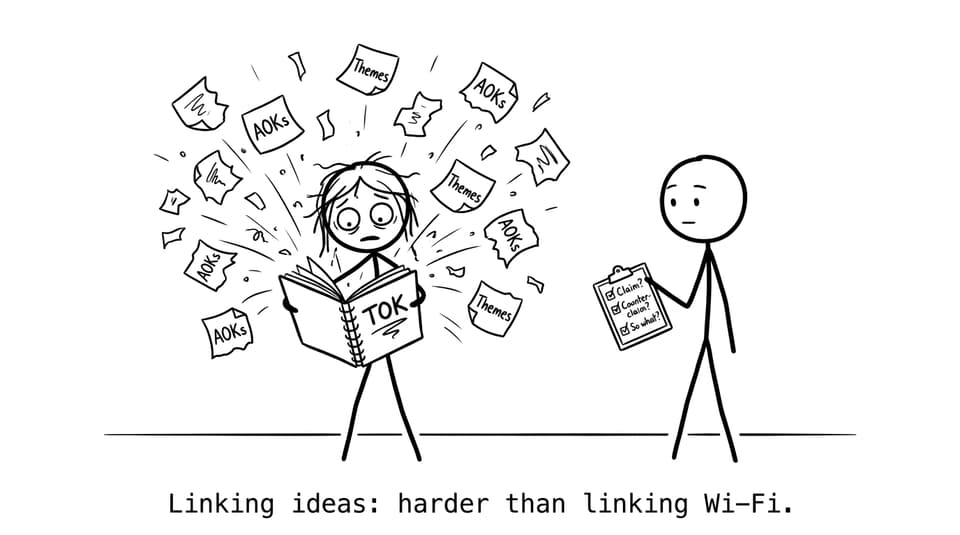
A quick TOK linking checklist (use before you draft)
Use this mini-checklist to keep your TOK plan sharp rather than scattered:
-
Pick two AOKs that genuinely behave differently under the title (not two versions of the same argument).
-
For each AOK, write one claim and one counterclaim that directly answers the title.
-
Add one optional theme only if it increases depth (it should stretch your evaluation, not decorate it).
-
Choose examples you can explain in 5-7 sentences (specific, real, and debatable).
If you want the wider map of all prompts, keep the TOK May 2026 Essay Prescribed Titles: Complete Guide open as you plan.
Linking TOK May 2026 titles to AOKs and themes (the smart way)
The goal in TOK is not to “mention” AOKs and themes. The goal is to use them to create comparison. Below are practical pairings for each May 2026 prompt, plus the theme angles that tend to create real evaluation.
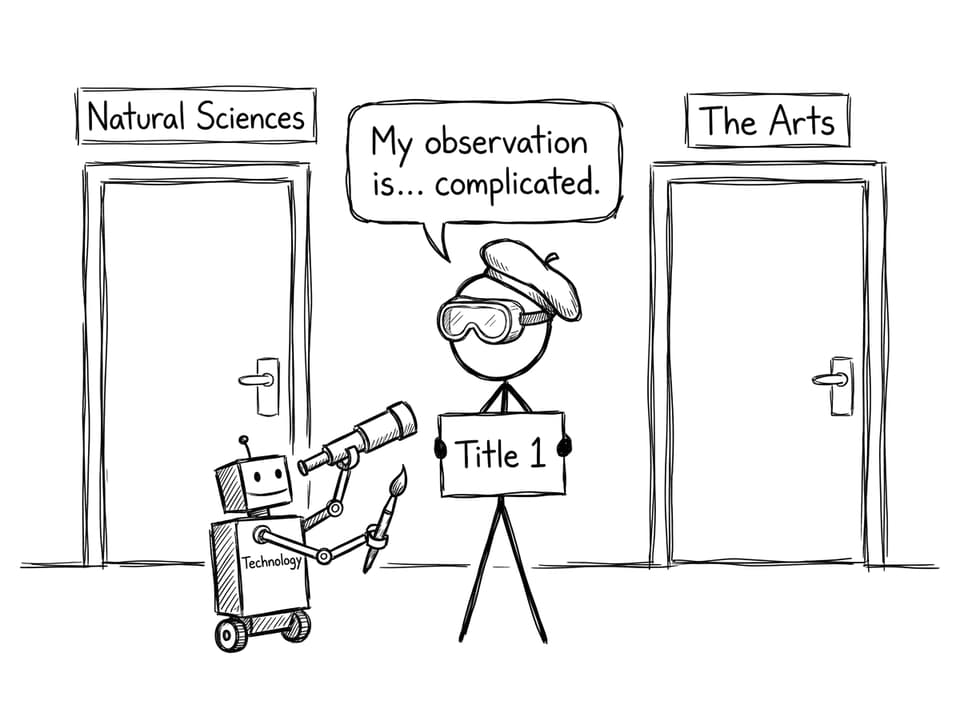
Title 1: Observation is essential but flawed
Strong AOK pair: Natural Sciences + The Arts
Theme angles: Knowledge and the Knower; Knowledge and Technology
In TOK, this title is a gift because it contains built-in tension: observation is necessary, and observation fails.
-
In Natural Sciences, observation looks disciplined (instruments, measurement, replication). Yet it still depends on theory, calibration, and human interpretation.
-
In The Arts, observation can be the start of insight, but the “flaw” is not always a problem; subjectivity may be the point.
The theme Knowledge and Technology helps you ask whether tools extend observation or merely relocate bias (think sensors, AI, image processing). Knowledge and the Knower helps you examine expectation, perception, and what we notice vs ignore.
Use the deeper breakdown here: TOK May 2026 Title 1 guide.
Title 2: Doubt is central to the pursuit of knowledge
Strong AOK pair: Natural Sciences + Human Sciences
Theme angles: Knowledge and Politics; Knowledge and the Knower
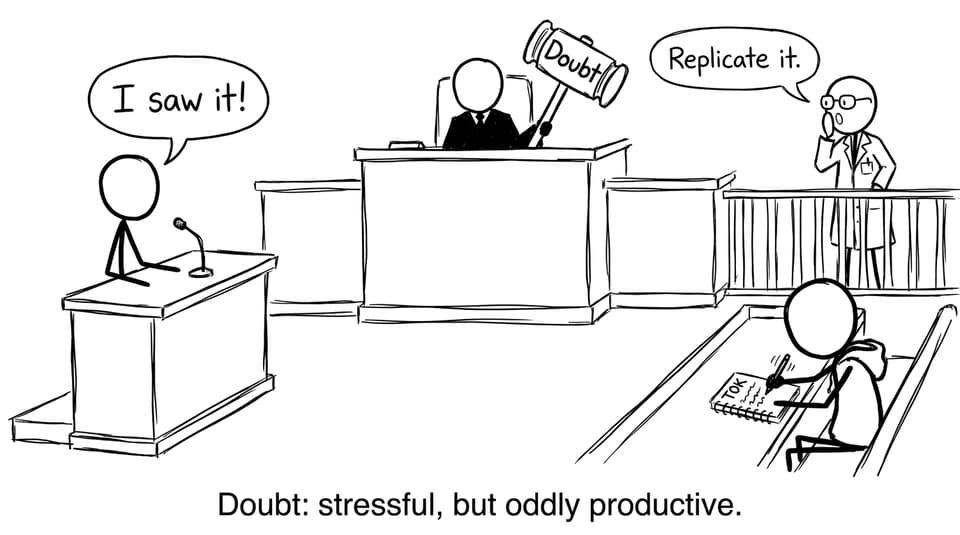
TOK students sometimes treat doubt like a personality trait: “I doubt things, therefore I do TOK.” Examiners want more: what does doubt do to methods, standards, and conclusions?
-
In Natural Sciences, doubt is often productive when it leads to testing, redesign, and refinement.
-
In Human Sciences, doubt can expose hidden assumptions (sampling, cultural framing), but it can also destabilize trust when audiences misunderstand uncertainty.
With Knowledge and Politics, you can evaluate how doubt becomes public: skepticism toward official claims can protect society, or it can fuel misinformation. With Knowledge and the Knower, you can ask whether doubt is rational discipline or emotional discomfort.
More support: TOK May 2026 Title 2 guide.
Title 3: Is the power of knowledge determined by how it’s conveyed?
Strong AOK pair: History + Mathematics
Theme angles: Knowledge and Language; Knowledge and Politics
This TOK title is really asking: does knowledge gain influence through clarity, persuasion, accessibility, or authority?
-
In History, conveyance is never neutral. Speeches, archives, textbooks, and propaganda shape what groups accept as “the story.”
-
In Mathematics, knowledge may be true independent of rhetoric, yet its power often depends on notation, proof style, and who can access it.
The theme Knowledge and Language helps you evaluate translation, framing, and simplification. Knowledge and Politics helps you discuss who benefits when knowledge is made simple, emotional, or viral.
Read more: TOK May 2026 Title 3 guide.
Title 4: Can we only understand something to the extent we understand its context?
Strong AOK pair: Literature + Human Sciences
Theme angles: Knowledge and Culture; Knowledge and the Knower
In TOK, the word “only” is the pressure point. Context clearly matters, but is it a gate you must pass through every time?
-
In Literature, context often unlocks nuance (genre, historical setting, authorial choices), yet some themes still land across time and culture.
-
In Human Sciences, context can determine whether conclusions generalize or mislead; what “works” in one community may fail in another.
Use Knowledge and Culture to show how meaning shifts across communities. Use Knowledge and the Knower to evaluate whether personal experiences count as “context,” and when that helps vs biases.
Full breakdown: TOK May 2026 Title 4 guide.
Title 5: “All things are numbers” (Pythagoras)
Strong AOK pair: Mathematics + The Arts
Theme angles: Knowledge and Technology; Knowledge and Religion
This TOK title tempts students into a simple yes/no. Strong essays treat it like a lens: what becomes visible when we quantify, and what disappears?
-
In Mathematics, quantification can be breathtakingly powerful: modeling, prediction, precision.
-
In The Arts, numbers shape rhythm, harmony, proportion, yet meaning often arrives qualitatively (emotion, symbolism, lived experience).
The theme Knowledge and Technology fits naturally: modern life translates people into data. The theme Knowledge and Religion lets you explore whether numbers function as description, belief, or metaphysical comfort.
More here: TOK May 2026 Title 5 guide.
Title 6: Is interpretation a reliable tool in producing knowledge?
Strong AOK pair: History + Natural Sciences
Theme angles: Knowledge and Language; Knowledge and the Knower
Interpretation sounds suspicious to many students, as if it means “making things up.” TOK pushes you to see that interpretation is often unavoidable.
-
In History, interpretation is the method: evidence is incomplete, sources are biased, and narratives compete.
-
In Natural Sciences, interpretation enters through models, statistical choices, and theoretical frameworks. Data rarely speaks without translation.
Knowledge and Language helps you examine labeling, explanation, and what counts as “the same” meaning across audiences. Knowledge and the Knower lets you evaluate perspective and training: when does expertise reduce interpretation error, and when does it create blind spots?
Full guide: TOK May 2026 Title 6 guide.
How RevisionDojo helps you turn TOK links into marks
AOKs and themes are only useful when they produce a clearer argument. That’s why RevisionDojo is built around tools that keep TOK practical:
-
Use the RevisionDojo Ultimate TOK May 2026 Essay Guide to translate each prompt into claims, counterclaims, and evaluation.
-
Use TOK Essay Planning Templates for May 2026 Titles to structure your AOK comparison fast.
-
Build sharper balance with Best Counterclaims for the May 2026 TOK Essay Titles.
-
Collect stronger evidence with Top Real-Life Examples for the May 2026 TOK Essay Titles.
Behind the scenes, students also use RevisionDojo’s Questionbank, Study Notes, Flashcards, AI Chat, Grading tools, Predicted Papers, Mock Exams, Coursework Library, and Tutors to keep TOK writing consistent from first plan to final polish.
Closing: Make TOK connections on purpose
TOK is not a subject where you win by knowing more facts. You win by making better links between a prescribed title, two AOKs, and a theme that deepens the question rather than distracting from it.
If you want one next step, open the Complete May 2026 Titles Guide, choose your two AOKs, and draft one claim/counterclaim pair for each. Then use RevisionDojo’s planning templates, examples, and tools to turn those links into an examiner-ready TOK essay.