
A line in a book can look harmless until you learn who wrote it, when, and for whom. Then it changes shape. It becomes a warning, a joke, a confession, or propaganda. That quiet shift is exactly what TOK May 2026 Title 4 is really asking you to notice: “In the acquisition of knowledge, can we only understand something to the extent that we understand its context?” In TOK, context is not decoration. It is often the difference between a correct interpretation and a confident misunderstanding.
A quick TOK checklist for Title 4
Before you write a single paragraph, use this TOK checklist to keep your essay focused:
-
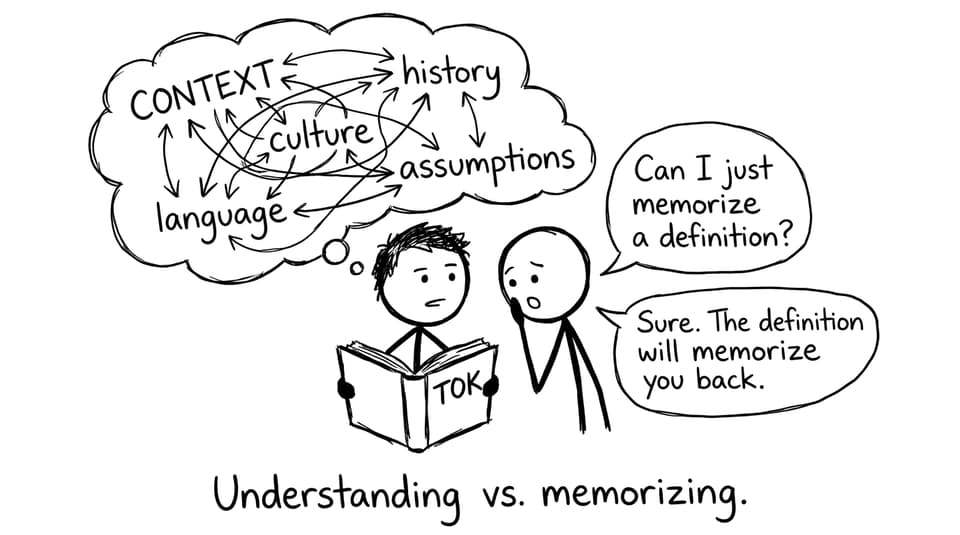
Define context (historical, cultural, linguistic, methodological, personal) and understand (explain, interpret, apply, justify).
-
Choose two AOKs that genuinely contrast (Arts + Human Sciences works well).
-
Build one clear claim and one fair counterclaim per AOK.
-
Use specific real-life examples (RLEs) you can explain in detail.
-
Evaluate: When does context matter most, and why?
If you are still deciding which prompt fits you best, start with How to Choose the Best TOK May 2026 Title for Your Essay and compare options using Comparing the May 2026 TOK Titles: Which Is Easiest?.
What “context” really means in TOK (and why it’s slippery)
In TOK, context can mean:
-
Historical context: what was happening at the time knowledge was produced.
-
Cultural context: shared values, norms, taboos, power structures.
-
Linguistic context: connotations, idioms, what words “carry.”
-
Methodological context: how knowledge was measured, sampled, framed.
-
Personal context: your experiences that shape what feels “obvious.”
The title’s trap is the word only. A high-scoring TOK response usually avoids extremes. You do not need to argue “context is everything” or “context is irrelevant.” You can argue something more realistic: context sets the ceiling for interpretation in some AOKs, but in other cases we can understand key aspects without much context.
To tighten your focus, convert the title into a knowledge question. RevisionDojo’s guide, TOK Essay Titles: What Are Knowledge Questions?, helps you turn the prompt into something you can actually evaluate.
TOK in the Arts: context as a key that unlocks meaning
In the Arts (and especially literature), context often operates like a key. The words are on the page, but what those words do depends on the world that produced them.
Claim: Without context, we risk misunderstanding what a work is saying
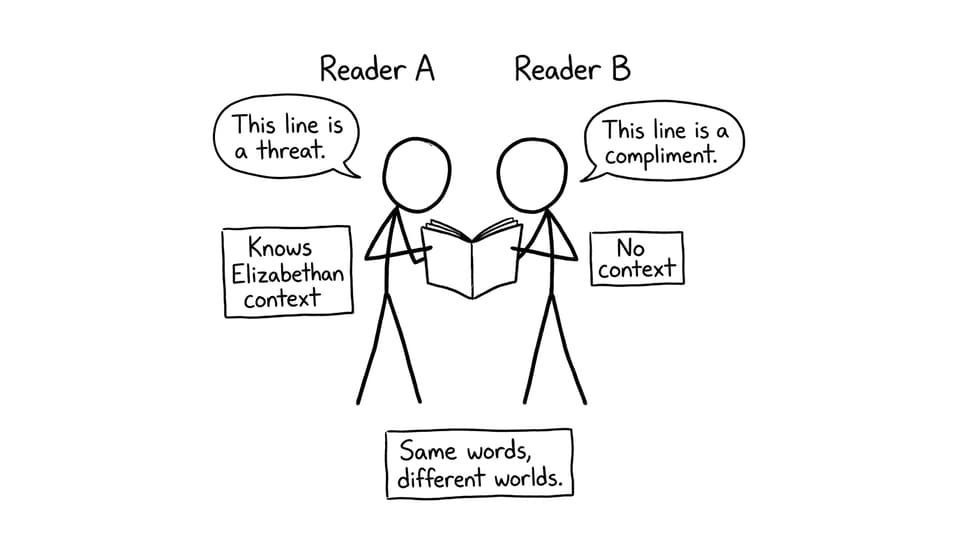
Take Shakespeare. You can follow the plot of Macbeth without knowing Elizabethan politics. But understanding ambition, legitimacy, gender expectations, religious fear, and the anxieties of monarchy gives you a deeper sense of why characters speak the way they do and why certain choices feel catastrophic. In TOK terms, context improves not just comprehension but interpretation.
A similar point appears in postcolonial writing. Achebe’s Things Fall Apart contains knowledge about colonial disruption and identity, but its moral force and its critique sharpen when you understand the historical and cultural pressures around language, tradition, and power.
If you want a practical model for writing context without dumping background, RevisionDojo’s English resources are surprisingly useful for TOK too: Understanding Context: Historical, Social, and Cultural Perspectives and Writing about Literary Contexts: Historical and Cultural Insights.
Counterclaim: Some understanding survives without context
Even with minimal context, readers can still grasp broad themes: love, betrayal, power, fear. That matters in TOK because it suggests understanding can be partial and still meaningful. Context may deepen interpretation, but it may not be required for the first layer of knowledge acquisition.
Evaluation: The Arts reward context, but punish irrelevant context
A smart TOK move is to admit the limitation: too much context becomes noise. If your “context” paragraph could be copied into any essay about any book, it is not functioning as context anymore. The best context is targeted: it explains a specific choice, symbol, or interpretation.
TOK in the Human Sciences: context as a warning label
If the Arts show context as a key, the Human Sciences show context as a warning label.
Claim: Human sciences can collapse without contextual sensitivity
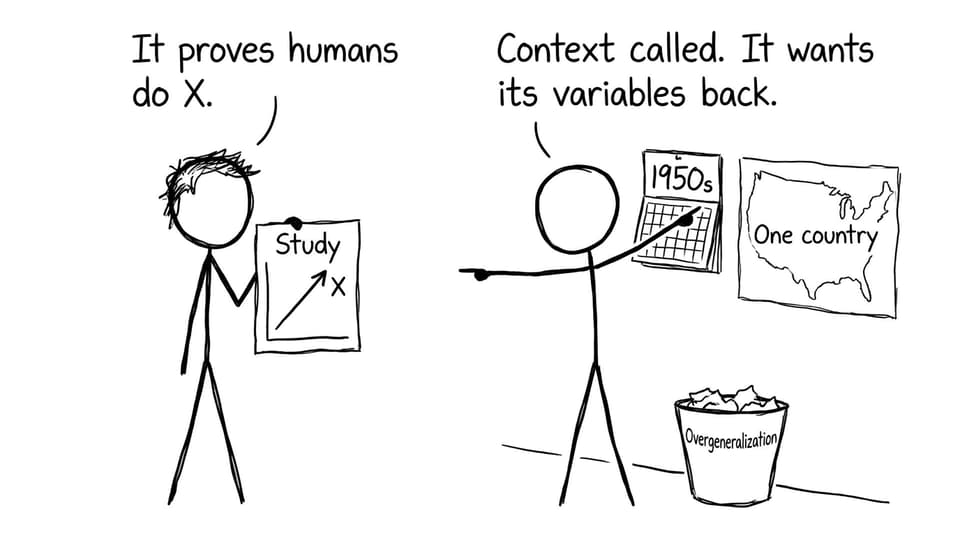
Psychology studies like Asch’s conformity experiments are often taught as if they reveal something stable about “human nature.” But the 1950s United States had particular norms: post-war social pressure, specific classroom expectations, and cultural ideas about fitting in. When you move to different cultures or modern environments, the meaning and magnitude of conformity can change.
Economics shows the same pattern. Models about rational choice or risk aversion may describe behavior in one environment, but shift when institutions, trust levels, and social safety nets change. In TOK, that is the difference between a finding being “true” and being transferable.
Counterclaim: Some human patterns appear across contexts
The counterweight is that some findings replicate across cultures: basic emotions, certain cognitive biases, and general tendencies like social influence. Even if context changes the details, it may not erase the underlying pattern. So in TOK terms, context may shape degree and expression rather than existence.
Evaluation: In Human Sciences, context often determines validity conditions
A strong TOK evaluation sentence sounds like: “This claim is persuasive under these conditions, but weaker under those.” That is exactly what examiners reward.
Ways of Knowing: how TOK connects context to thinking
To keep your TOK essay from becoming two subject essays stitched together, link context to Ways of Knowing:
-
Language: words carry histories; translation and connotation shift meaning.
-
Reason: helps separate correlation from causation, and tests whether context is relevant.
-
Emotion: can amplify what feels significant inside a culture, shaping interpretation.
-
Sense perception: gives data, but context tells us what the data counts as.
If you need structure support, use Structuring for Success in IB TOK Essays alongside RevisionDojo’s May 2026 overview: TOK May 2026 Essay Prescribed Titles: Complete Guide.
A simple essay plan for TOK Title 4
-
Introduction: define context + understanding; preview your stance (usually “to a large extent, but not only”).
-
AOK 1 (Arts): claim + RLE + counterclaim + evaluation.
-
AOK 2 (Human Sciences): claim + RLE + counterclaim + evaluation.
-
Comparison paragraph: why context functions differently across AOKs.
-
Conclusion: answer the title with conditions and limits.
For stronger counterclaims, practice with TOK Counterclaims for May 2026 Titles (Best Picks).
Closing: context doesn’t replace understanding -- it shapes its boundaries
A good TOK essay for Title 4 does not worship context, and it does not dismiss it. It treats context as the set of conditions that decide what a claim can reasonably mean, where it applies, and how far it can travel. That is a mature kind of honesty: the willingness to say, “I understand this, but only within these limits.”
When you are ready to turn that honesty into marks, use RevisionDojo as your home base: explore the RevisionDojo Ultimate TOK May 2026 Essay Guide, polish structure with targeted checklists, and tighten your final draft with Last-Minute Tips for the TOK May 2026 Essay. Then practice like it is an exam: draft, get feedback, revise, repeat. That loop is where TOK understanding becomes real.