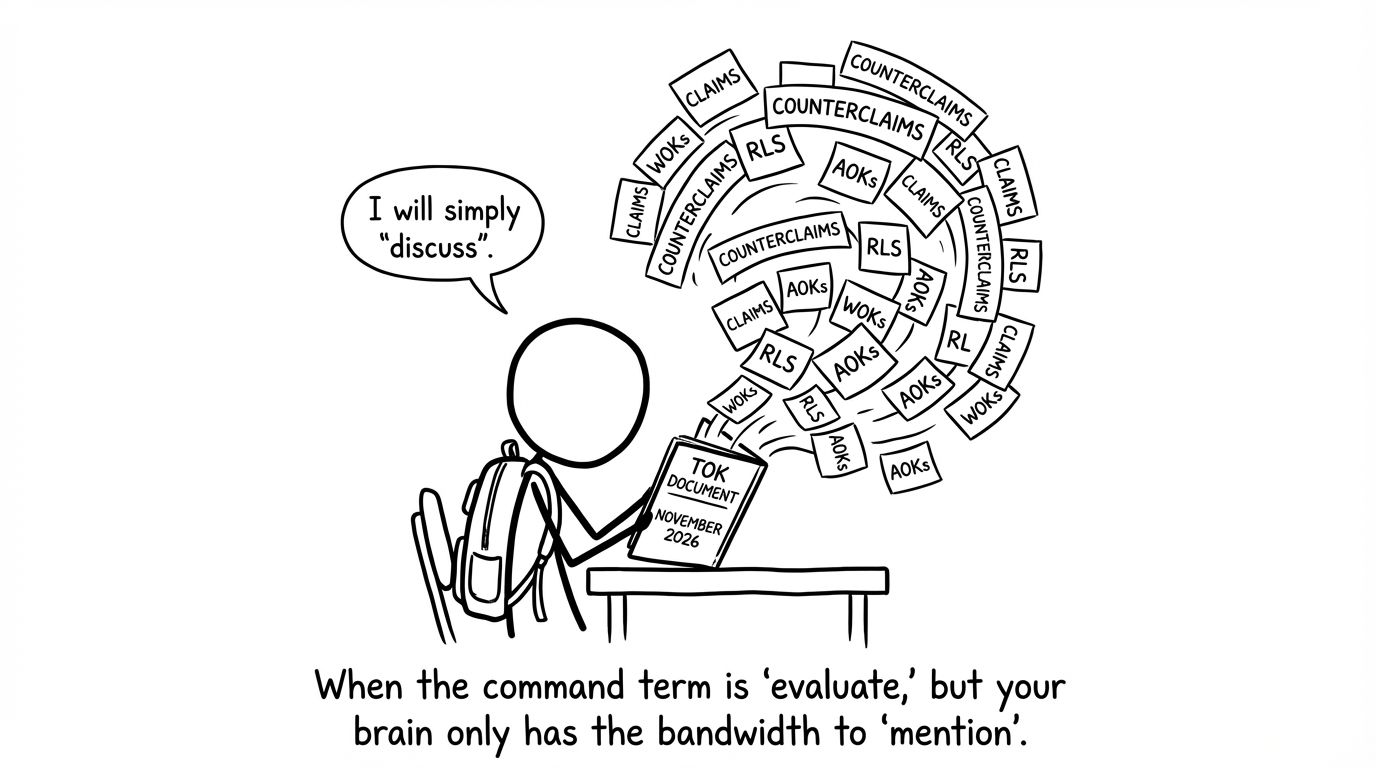

A friend once told me TOK feels like being handed a perfectly normal sentence and then being asked to distrust every word in it. Title 6 for May 2026 does exactly that: “To what extent is interpretation a reliable tool in the production of knowledge?” In TOK, the pressure isn’t to pick a side. It’s to show that you can weigh reliability under different conditions, in different Areas of Knowledge (AOKs), with different Ways of Knowing (WOKs).
If you treat interpretation as “good” or “bad,” your essay will read like a verdict. Examiners want a diagnosis: when does interpretation earn trust, and when does it quietly smuggle in error?
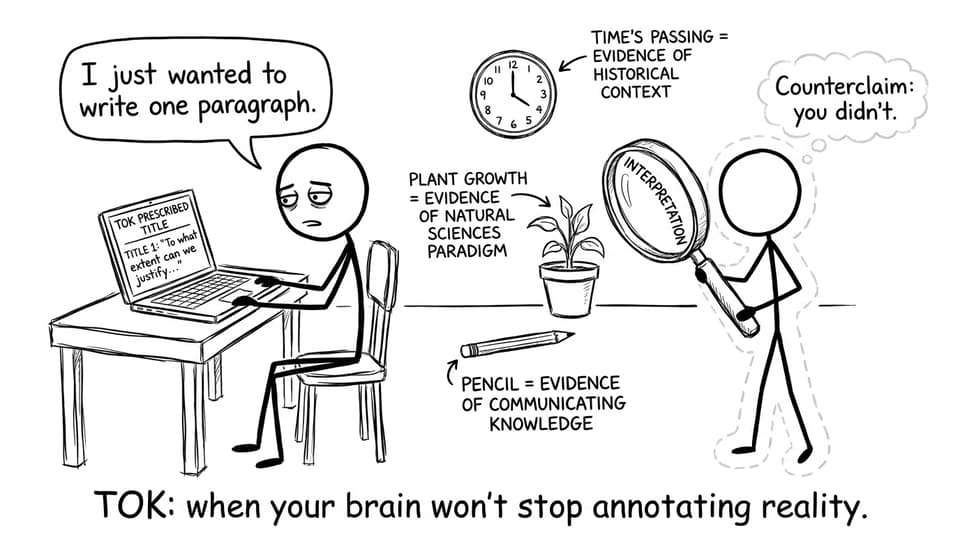
TOK Title 6 in one sentence (your thesis anchor)
Interpretation is a necessary tool for turning evidence into meaning, but its reliability depends on constraints such as methods, standards of proof, and community checks.
If you want a bigger map of how all the May 2026 prompts work, start with RevisionDojo’s May 2026 TOK essay guide.
A quick TOK checklist for planning Title 6
-
Define interpretation (assigning meaning; selecting what matters; explaining what evidence implies).
-
Define reliable (consistent, justifiable, checkable, not easily distorted by bias).
-
Choose two AOKs where interpretation works differently (History + Natural Sciences is a strong pair).
-
For each AOK: build claim + example + evaluation + counterclaim + evaluation.
-
Add WOKs only when they change the analysis (language, emotion, reason, imagination).
-
Loop back to “to what extent” in every paragraph conclusion.
To keep structure tight under exam conditions, borrow the blueprint from Comprehensive Guide to IB TOK Essay Structure.
TOK and interpretation in History: reliable, but rarely neutral
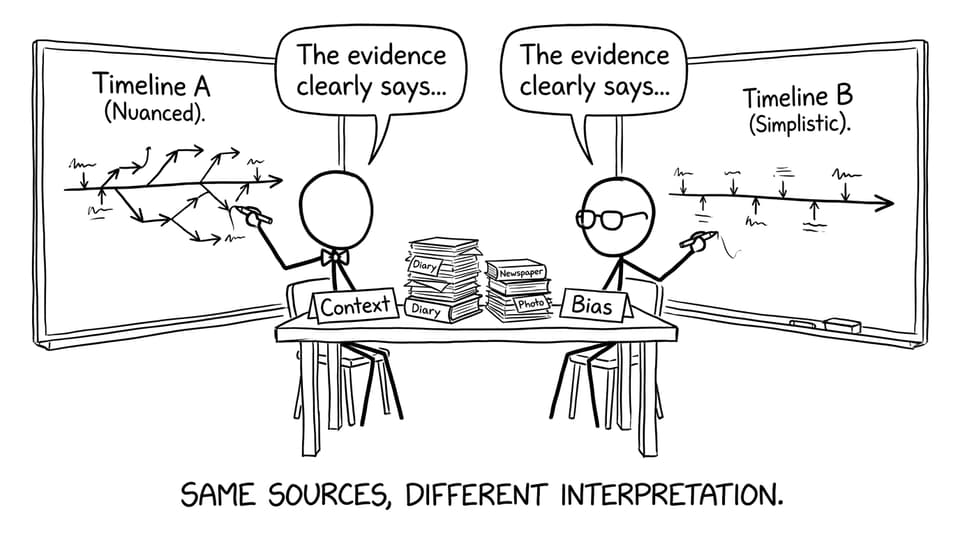
In History, interpretation isn’t a decoration added after the facts. It is the bridge between fragments of evidence and a coherent account of what happened.
Claim: Interpretation can be reliable in History because it allows historians to contextualize sources, compare perspectives, and build explanations that fit the available evidence.
Example you can adapt: Cold War events were interpreted differently by Western and Soviet historians. The sources existed, but what they “meant” depended on ideology, national memory, and access to archives.
Evaluation (what makes it more reliable): Reliability increases when historians triangulate sources, justify inferences, and make methods explicit. You can strengthen this by linking it to the TOK idea that knowers are shaped by their position and incentives.
Counterclaim: Interpretation becomes less reliable when it is driven by confirmation bias, selective quotation, or presentism (judging the past by today’s values).
Mini-conclusion: In History, interpretation is reliable to the extent that it is disciplined by evidence standards and openness to competing readings.
For more exam-ready guidance on building AOK comparisons, see Connecting TOK Essay Ideas to Areas of Knowledge.
TOK and interpretation in the Natural Sciences: constrained, but unavoidable
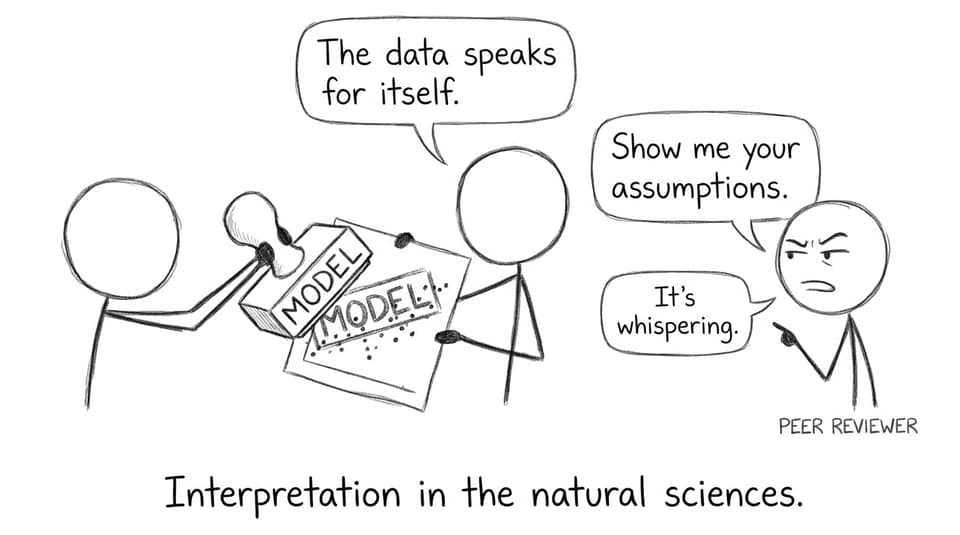
Students often assume the Natural Sciences escape interpretation. But data doesn’t arrive with a label saying “this is the conclusion.” Humans choose models, decide what counts as noise, and translate measurements into explanations.
Claim: Interpretation is relatively reliable in the Natural Sciences because it is constrained by reproducibility, measurement, peer review, and mathematical modeling.
Example you can adapt: Medical imaging requires interpretation. A radiologist reads patterns and probabilities in scans, and misinterpretation can lead to misdiagnosis. The key TOK point is that technology extends observation, but still relies on human judgment.
Evaluation (why it’s more reliable than History): Scientific interpretation is audited by method. If assumptions are weak, other scientists can challenge them, rerun analyses, or attempt replication.
Counterclaim: Interpretation becomes less reliable when models hide assumptions, when statistics are misunderstood, or when incentives (publishing pressure, funding) bias conclusions.
Mini-conclusion: In the Natural Sciences, interpretation is reliable to a high extent when paired with methodological rigor, but it is never fully removed from human decision-making.
If you want sharper language for science reliability, use What Makes Natural Sciences Unique in TOK? alongside How Science Builds Trustworthy Knowledge Notes.
Ways of Knowing that strengthen your TOK evaluation
In TOK, WOKs are not garnish. Use them to explain why interpretations differ.
-
Language: Words like “revolution,” “terrorist,” or “freedom fighter” steer interpretation before evidence is even discussed.
-
Reason: Strengthens reliability by forcing interpretations to be consistent, explicit, and responsive to counterclaims.
-
Emotion: Can enrich understanding (moral urgency, empathy) but can also distort reliability (outrage-first narratives).
-
Imagination: Helps build plausible historical reconstructions and scientific hypotheses, but needs constraints to avoid fantasy.
For a planning approach that turns titles into clear knowledge questions, see TOK Essay Titles: What Are Knowledge Questions? and Using Knowledge Questions in Your TOK May 2026 Essay.
Common TOK mistakes on Title 6 (and quick fixes)
-
Mistake: Treating interpretation as purely subjective.
Fix: Show constraints: methods, standards, peer review, source criticism. -
Mistake: Only describing examples.
Fix: Add evaluation: what makes this interpretation trustworthy or risky? -
Mistake: Forgetting “to what extent.”
Fix: End paragraphs with a graded judgement: “reliable to a moderate extent because…”
For writing clarity under time pressure, use Tips for Writing a Clear and Coherent TOK Essay.
Conclusion: make TOK Title 6 feel answerable
Interpretation is the tool we reach for when reality arrives incomplete: a messy archive, a noisy dataset, a sentence that can be read two ways. In TOK, Title 6 rewards you for noticing that interpretation becomes reliable when it is constrained--by evidence standards in History, and by method and community checks in the Natural Sciences. Your job is to show the conditions under which interpretation earns trust, and the conditions under which it quietly fails.
When you’re ready to turn this into a full draft, RevisionDojo can carry the workload: practice with the TOK Questionbank, build examples from IB Theory of Knowledge (TOK) resources, refine arguments with AI Chat, drill key terms with Flashcards, and pressure-test your essay with the Grading tools and annotated exemplars in the Coursework Library. TOK gets easier when your thinking has a system--and RevisionDojo is built to be that system.