
For IB students sitting exams in May 2028 (started DP1 in August 2026).
To learn how to get a 7 in IB ESS 2028, build accurate knowledge, practise applying it to unfamiliar evidence, and make every conclusion answer the question directly. A 7-level response does not simply contain more environmental facts; it selects relevant evidence, explains interacting systems, evaluates competing perspectives and reaches a justified judgment.
ESS can look deceptively familiar. Climate change, pollution and conservation appear in everyday news, so it is easy to mistake recognition for mastery. The examination rewards something more disciplined: turning environmental understanding into analysis under time pressure.
This guide applies to the ESS course first assessed in May 2026 and offered at both SL and HL. The IB’s currently published curriculum information confirms two external papers and an individual investigation of up to 3,000 words. However, May 2028 grade boundaries, examination questions, markschemes and exact ESS examination dates are not yet published. Do not plan around a guessed percentage for a 7.
The 7-level checklist
A student aiming for the IB ESS top grade should be able to:
- define syllabus terminology precisely rather than approximately
- interpret graphs, maps, tables and written evidence before recalling examples
- explain environmental systems through relationships, feedback and change
- connect ecological processes with social, economic and political factors
- follow command terms such as evaluate, discuss and to what extent
- use specific examples only when they advance the argument
- write balanced essays with a defensible final judgment
- produce a focused, replicable and critically evaluated IA
- correct recurring weaknesses through timed retrieval and question practice
Begin with the IB Environmental Systems and Societies new syllabus hub. It brings the relevant Study Notes, Flashcards and Questionbank practice into one course structure, reducing the risk of revising material from the former syllabus.
Confirm the assessment model for your level
The following structure is based on the IB course first assessed in 2026. Your teacher should confirm any later guide updates through the official IB Programme Resource Centre.
| Component | SL | HL |
|---|---|---|
| Paper 1 | 1 hour, 35 marks, 25% | 2 hours, 70 marks, 30% |
| Paper 2 | 2 hours, 60 marks, 50% | 2 hours 30 minutes, 80 marks, 50% |
| Individual investigation | Up to 3,000 words, 30 marks, 25% | Up to 3,000 words, 30 marks, 20% |
Paper 1 uses a resource booklet containing an unseen case study and evidence in different forms. Paper 2 combines short-answer and data-based questions with structured essays. At SL, students answer one structured essay from a choice of two; at HL, they answer two from a choice of three.
HL is not merely SL with a few extra definitions. It requires additional content and application of the HL lenses of environmental law, environmental and ecological economics, and environmental ethics. The guide to the biggest difference between SL and HL ESS explains how that changes revision and written evaluation.
What 7-level Paper 1 performance looks like
Paper 1 rewards a useful habit: evidence first, memory second. Read the title, axes, units, legend, location and time period before deciding what the data show. Then connect the pattern to a defensible ESS mechanism.
Imagine a graph showing nitrate concentration increasing downstream of intensive agriculture while aquatic invertebrate diversity falls.
Weak response: “Fertilizer causes water pollution and reduces biodiversity.”
Stronger annotated response: “Downstream nitrate concentration rises while invertebrate diversity declines [identifies the paired pattern]. Runoff from fertilized land may increase nutrient availability and primary productivity [proposes a relevant mechanism]. Subsequent decomposition can raise biological oxygen demand and reduce dissolved oxygen [explains a system pathway], making conditions less suitable for oxygen-sensitive taxa [links the mechanism to the observed outcome]. The graph alone does not establish fertilizer runoff as the sole cause because flow rate, temperature and other pollutants are not controlled [evaluates the evidence].”
The improvement is not length. It is structure. Observation becomes mechanism, mechanism becomes consequence, and consequence is qualified by the evidence available.
When a question asks for a calculation, show substitution and units. For percentage change, for example:
If an answer produces a negative value, explain what that sign means in context. Numerical work earns its place when it supports environmental interpretation.
A useful practice routine is to separate observation from inference on scrap paper. In one column, record only what the resource actually shows, including supporting values where available. In the other, write possible explanations and the evidence needed to test them. This prevents a familiar topic from pulling you away from an unfamiliar dataset. Before submitting an answer, check whether your wording distinguishes a measured relationship from a proposed cause, especially when several variables could explain the pattern.
Use the overview of ESS assessment under the new syllabus to separate the demands of each component before beginning timed practice.
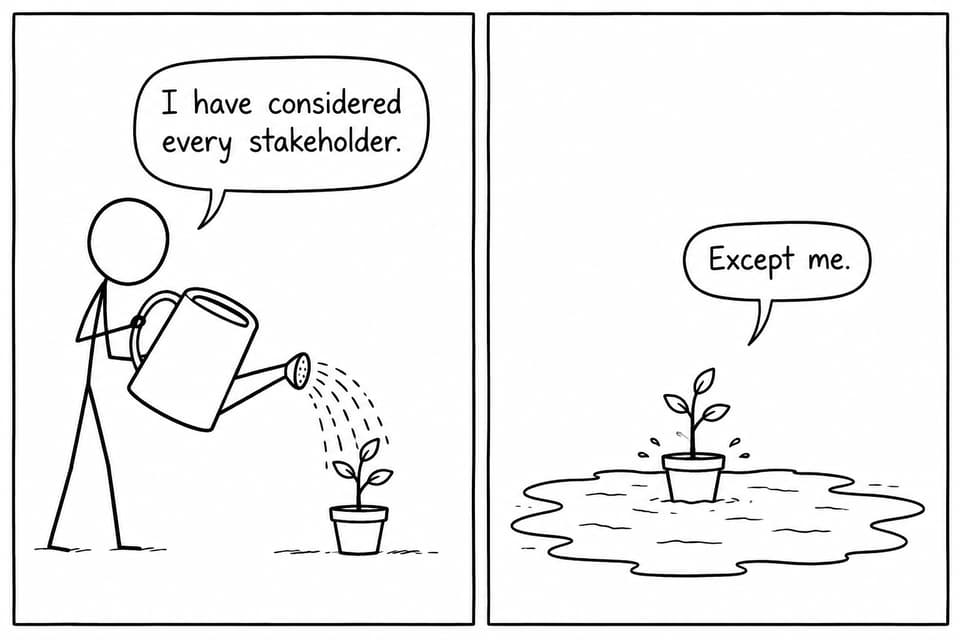
Environmental evaluation becomes harder when the stakeholder unable to speak is the ecosystem itself.
What 7-level Paper 2 performance looks like
Paper 2 requires both breadth and control. Short responses should match the command term and mark allocation. An essay needs a line of reasoning, not a catalogue of everything remembered about the topic.
Suppose the prompt asks: “Evaluate the effectiveness of protected areas in conserving biodiversity.”
A strong plan might contain:
- a clear claim that effectiveness depends on design, enforcement and surrounding land use
- ecological benefits, including habitat protection and reduced direct exploitation
- limitations such as isolation, edge effects, displacement of extraction and climate-driven range shifts
- contrasting stakeholder perspectives
- one or two accurately understood examples
- criteria for judgment, such as species recovery, habitat connectivity, equity and long-term resilience
- a conclusion explaining when protected areas are effective and what complementary measures are needed
An effective paragraph could read:
“Protected areas can reduce habitat conversion when boundaries are ecologically meaningful and regulations are enforced [qualified claim]. Their effectiveness may be limited when populations require migration corridors beyond those boundaries [counterargument]. Local restrictions can also create conflict if communities carry livelihood costs without participating in governance [stakeholder dimension]. Therefore, designation alone is a weak measure of success; ecological monitoring, connectivity and legitimate local participation provide stronger criteria [reasoned judgment].”
At HL, bring in the lenses where relevant, rather than attaching them mechanically. Environmental law might illuminate enforcement and compliance. Economics might expose externalities or incentives. Ethics might compare anthropocentric, ecocentric and technocentric reasoning. These lenses should sharpen the judgment, not become decorative labels.
Balance does not require giving every position equal weight. If one argument has stronger evidence, explain why it deserves greater influence on your conclusion. Likewise, distinguish short-term benefits from long-term consequences and local gains from costs transferred elsewhere. These comparisons make evaluation specific. During planning, finish the sentence “This strategy is most effective when...” before writing the essay. If you cannot complete it convincingly, your criteria for judging effectiveness probably need more thought.
Build an IA that earns marks rather than admiration
A sophisticated topic is not automatically a strong investigation. A manageable research question with appropriate data usually offers more scoring opportunities than an ambitious question that cannot be investigated reliably.
Under the current course, the IA is an individual investigation with a maximum overall word count of 3,000 words and six assessment criteria. Read the RevisionDojo ESS IA marking overview and the detailed ESS IA guide before collecting data.
A focused question might examine how distance from a road relates to particulate deposition on leaves at specified sites. Its strength would depend on controlled sampling, sufficient repeats, transparent processing and honest treatment of uncertainty, not on the topic alone.
A 7-level investigation typically shows a coherent chain:
environmental issue → focused research question → justified strategy → reproducible method → appropriate data processing → evidence-based conclusion → specific evaluation
Evaluation should name the limitation, explain its likely effect and propose a feasible improvement. “Human error may have occurred” does none of those things. A better comment would identify inconsistent leaf surface area, explain how it could distort comparisons, and recommend standardized image analysis or sampling leaves within a defined size range.
Use the guide to choosing a strong ESS IA topic early. Later, RevisionDojo’s Coursework Library can help you study structure, while its ESS Grading tools can highlight rubric gaps. Treat AI feedback as a prompt for revision, never as a replacement for your teacher’s guidance or your own authorship.
A two-year plan for May 2028
August-December 2026
Build accurate foundations. After each lesson, compress the topic into a system map showing stores, flows, feedback and stakeholder effects. Use Study Notes to repair gaps and Flashcards for terminology, but finish each week with several Questionbank items so recall becomes application.
Start a case-study bank with four fields: environmental setting, process, stakeholder conflict and evaluative lesson. One well-understood example is more adaptable than several memorized names.
January-June 2027
Begin mixed-topic practice. Once every two weeks, answer an unfamiliar data question without notes and annotate where marks were lost. Start IA planning early enough to test whether your method produces useful data. If it does not, a pilot study has succeeded by warning you.
August-December 2027
Complete the main IA work according to your school’s internal deadlines. Practise Paper 1 interpretation and Paper 2 essays separately, then combine them in timed sessions. HL students should deliberately revisit each major issue through law, economics and ethics.
RevisionDojo’s AI Chat can clarify why an answer is incomplete, while Tutors can help diagnose persistent reasoning problems. Predicted Papers and Mock Exams are most useful after broad coverage, when they test integration rather than introduce content.
January-May 2028
Move from learning to performance. Each week should contain retrieval, timed questions, marking, error classification and reattempts. Keep an error log divided into knowledge, command term, evidence, calculation, evaluation and timing.
Make each entry actionable rather than merely recording a score. Instead of “poor biodiversity answer,” write “named habitat fragmentation but did not explain reduced gene flow.” Then close the markscheme and rewrite the missing explanation from memory. Revisit a similar question later to check whether the correction transfers. If the same weakness returns, change the practice task rather than simply increasing its volume. Progress means needing fewer prompts to produce the reasoning independently.
Do not use an unofficial predicted boundary as your target. May 2028 boundaries will only be determined after that examination session, so build a margin by pursuing consistently strong rubric performance across both papers and the IA.
The quiet advantage of deliberate correction
Getting a 7 in IB ESS is less about studying endlessly than noticing exactly why an answer failed. A vague definition needs retrieval. A descriptive essay needs argument. An unsupported conclusion needs criteria and evidence. A rushed paper needs timed decisions.
RevisionDojo becomes most useful when its Questionbank, Study Notes, Flashcards, AI Chat, Grading tools, Predicted Papers, Mock Exams, Coursework Library and Tutors form one feedback system. Each tool should lead to a more precise next attempt.
Your specific next step is simple: open the IB ESS new syllabus Questionbank and resource hub, complete ten questions from your current topic without notes, and record one correction beside every mark you lose.