


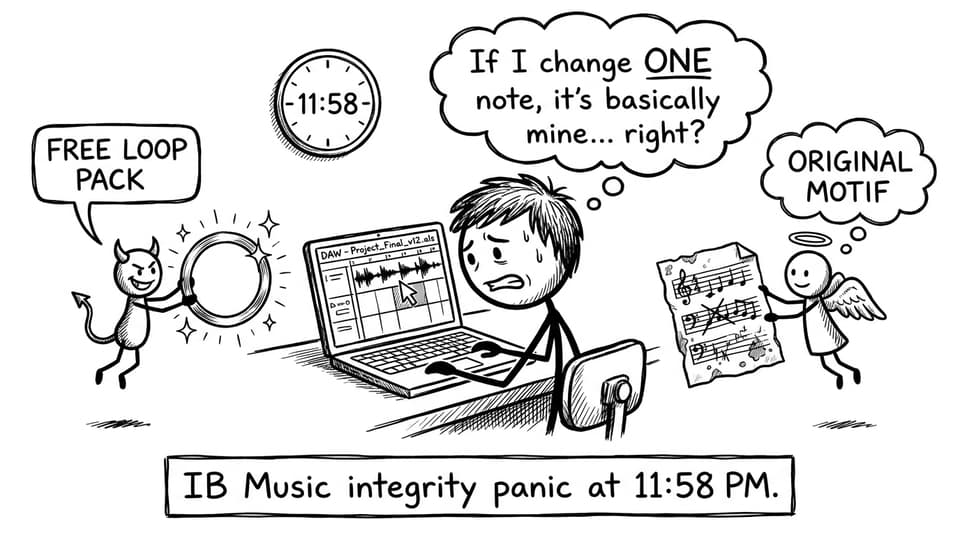
In the last ten minutes before a deadline, your brain becomes an excellent lawyer.
It can argue that a loop is “just a texture,” that a borrowed melody is “an homage,” or that a performance fix is “just cleaning the audio.” In IB Music, those small self-justifications add up fast. Not because the IB is trying to catch you out, but because the course is built on a simple idea: your portfolio should be believable as yours.
Integrity in IB Music is the quiet force behind every confident submission. It protects your marks, yes. But more importantly, it protects your identity as a musician: someone who can create, perform, and explain musical choices with honesty.
Integrity in IB Music: a quick checklist you can actually use
If you want a fast “am I safe?” scan for IB Music, use this before you export anything:
-
Your creating work is driven by original musical decisions (motif, harmony, structure, texture).
-
Any samples, loops, or borrowed materials are allowed, limited, and credited.
-
Your performance recording is honest (no timing/pitch correction, no disguised edits).
-
Your exploration and reflections use your own words and cite what you learned from.
-
You can explain, out loud, how you made every key choice.
If one item feels shaky, fix it now. Integrity problems usually grow in silence.
What integrity means in IB Music (and why examiners care)
In IB Music, integrity is not just “don’t plagiarize.” It’s closer to musical accountability: you show what you did, why you did it, and where your ideas came from.
That matters because IB assessment rewards process, intention, and understanding. When your work is authentic, your reflection becomes easier to write, your analysis becomes more specific, and your portfolio becomes coherent. When your work is half-borrowed, your commentary starts to sound vague because it has to.
If you need a clean overview of what the course is actually asking for, start with IB Music: A Complete Beginner's Guide and keep it open while you plan.
Authentic composition in IB Music: how to sound like you (not your playlist)
Most students don’t plagiarize on purpose. They drift into it through convenience: default DAW patterns, a chord loop they’ve heard 200 times, a melody that “accidentally” lands on something famous.
Authentic composition in IB Music looks like this:
Build from an original motif, not a downloaded identity
A motif is small enough to be yours. Four notes. A rhythm cell. A contour. Something you can transform.
Try this practical method:
-
Write a 1-bar motif (melody or rhythm).
-
Create three variations (retrograde, augmentation, displacement, reharmonization).
-
Use those variations to build sections (A, B, transition, return).
Now your piece has fingerprints.
If you want composition-specific study structure, the guide Best Resources for IB Music Composition (Study Smart) pairs planning with the criteria so your creativity stays mark-aware.
Keep proof of process (it saves you twice)
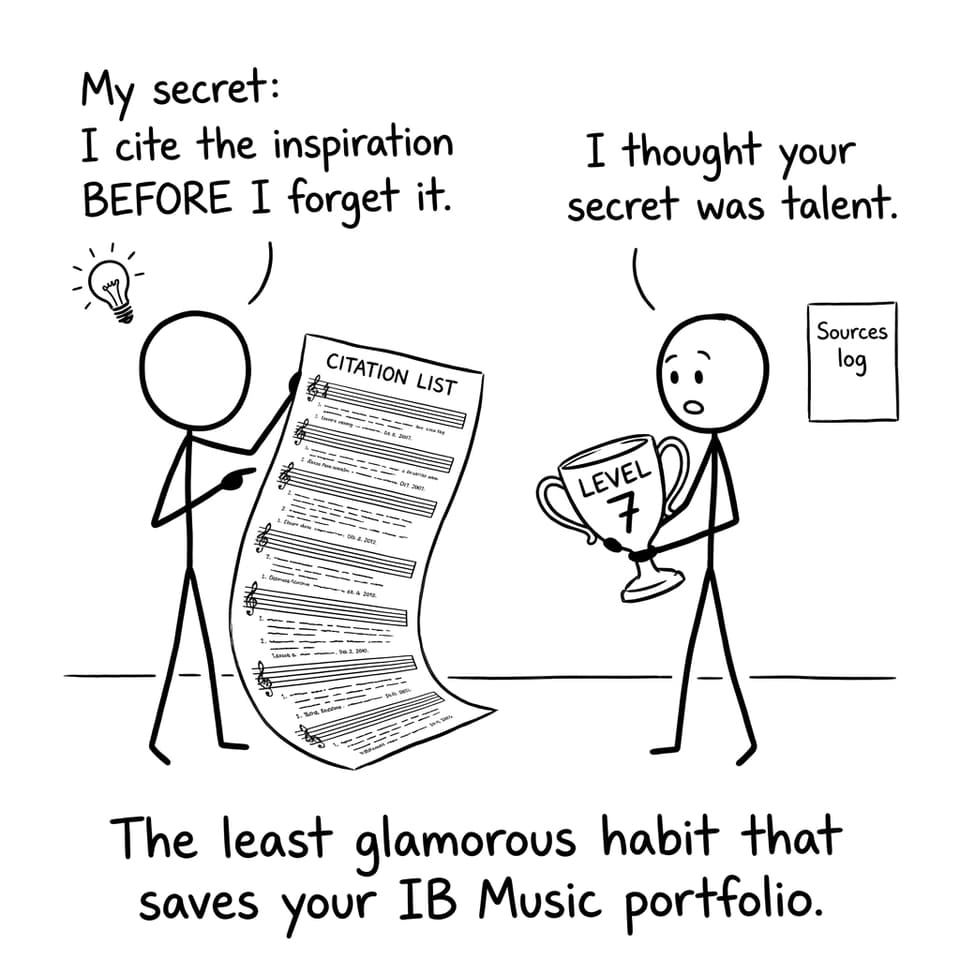
Save versions. Keep screenshots. Export drafts. Not because you expect accusations, but because process evidence makes your reflection honest and detailed.
A simple folder system:
-
V1_motif_sketch -
V2_harmony_tests -
V3_structure -
V4_orchestration -
Final_export
When you write your commentary, you’re no longer guessing what happened. You’re documenting it.
Ethical use of technology: samples, loops, and AI in IB Music
Technology is not the enemy of integrity. Vagueness is.
In IB Music, the safest rule is: if a sound meaningfully shapes the piece and you didn’t make it, you either (1) avoid it, or (2) credit it clearly and keep it proportionate.
Loops and sample packs: the “small spice, not the meal” rule
A loop can be a texture layer. It should not be the core musical idea that carries your marks.
If your piece would collapse without a loop, it’s probably doing too much of the composing for you.
AI tools: use them like a tutor, not a ghostwriter
If an AI tool generates music, it can replace the very evidence the course needs: your musical thinking.
If you use tools at all, keep them in the realm of:
-
helping you understand terminology,
-
brainstorming possible development techniques,
-
quizzing you on musical features.
A helpful broader integrity mindset is explained in How RevisionDojo Helps You Maintain Academic Integrity While Studying.
Ethical performance in IB Music: honesty is a sound
A performance portfolio is not a studio project. It’s evidence of musicianship under real conditions.
Ethical performance in IB Music means the recording represents what you can actually do. That includes your strengths and the small imperfections that prove it was real.
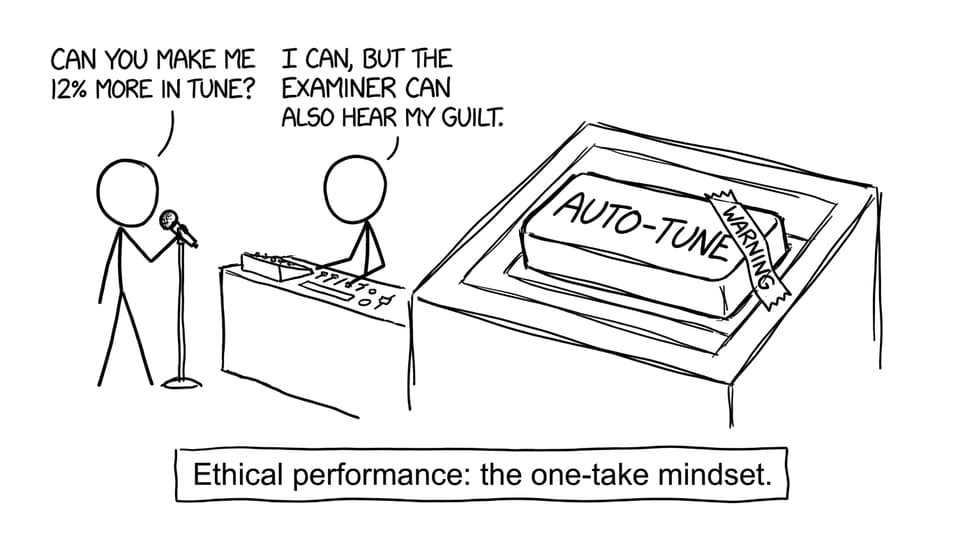
The “one-take mindset” (even when you do multiple takes)
Even if you’re allowed more than one attempt, train as if each take is final.
That changes your practice:
-
you rehearse full run-throughs,
-
you recover from mistakes without stopping,
-
you build endurance and focus.
For a performance-focused checklist of what goes wrong (and how to fix it), use IB Music Performance Mistakes (and How to Fix Them) and then compare it with What Examiners Look for in IB Music Performances.
Editing: clarity is fine, correction is not
A good rule: you can make the recording easier to hear, but you shouldn’t make the playing “better than you.”
If a tool changes pitch, timing, or performance accuracy, it stops being documentation and starts becoming fabrication.
Honest analysis and reflection: cite the thinking you borrowed
In IB Music, analysis is where students accidentally copy. Program notes, study guides, and online breakdowns are seductive because they sound polished.
But your marks live in your listening.
A safer workflow for exploring and writing
-
Listen first, write rough notes in your own words.
-
Then read sources and add citations where they influenced you.
-
Return to the music and verify every claim with evidence (time stamps, features, techniques).
If you’re choosing an exploration angle and want themes that naturally produce depth (without forcing it), see Best IB Music Exploration Themes for Depth and Variety and strengthen comparisons using Best Strategies for IB Music Comparative Analysis.
Cultural respect: integrity is also how you represent music that isn’t “yours”
IB Music rewards intercultural understanding, but integrity requires something more careful than “I used a pentatonic scale.”
Cultural respect looks like:
-
learning function and context (why the music exists, who it serves),
-
naming the tradition accurately,
-
avoiding costume-style imitation that strips meaning,
-
crediting teachers, communities, and recordings you learned from.
This is where honest reflection becomes powerful: you can acknowledge limits, describe what you researched, and explain what you chose not to do.
How RevisionDojo supports integrity in IB Music (without killing creativity)
Integrity is easiest when your workflow is structured. RevisionDojo is built for that structure.
A realistic IB Music loop inside RevisionDojo looks like this:
-
Use Study Notes to clarify terminology and criteria-focused expectations.
-
Drill listening and music-theory application with the Questionbank.
-
Lock in definitions, devices, and context facts with Flashcards.
-
Use AI Chat to unblock confusion (then immediately test yourself so the thinking stays yours).
-
Practise under pressure with Predicted Papers and Mock Exams so panic doesn’t push you into shortcuts.
-
Use Grading tools for rubric-aware feedback on written components.
-
Learn what strong work looks like through the Coursework Library.
-
When you need human calibration, book Tutors for ethical, skills-based guidance.
You can also browse the wider set of course strategies in All IB Music Posts.
FAQ: Integrity in IB Music
What counts as plagiarism in IB Music?
Plagiarism in IB Music is broader than copying text. It can include submitting a melody, harmonic progression, arrangement concept, or audio material that is substantially someone else’s work without clear acknowledgement. It also includes copying analyses, program notes, or commentary phrasing and presenting it as your own reflection. The tricky part is that music has shared patterns, so the issue is rarely “you used a I-V-vi-IV progression.” The issue is when the distinctive musical identity is borrowed: a recognizable hook, a signature bassline, or an arrangement that mirrors a specific recording. A good self-test is this: if a listener could reasonably say “this is basically that song,” you need to change it significantly and document the transformation, or choose a different starting point. When in doubt, cite the influence and make your own compositional work clearly visible.
Can I use loops, samples, or digital instruments ethically?
Yes, and many IB Music students do, but you need to treat them like ingredients with labels. First, make sure the material is permitted by your school and aligns with copyright expectations, then keep it proportionate to your own composing. Second, document exactly what you used: the sample pack name, the instrument library, or the source of a sound, plus how it functions in your piece. Third, ensure your core musical ideas are still original: motif development, structure, harmonic plan, and expressive intent. If the loop is doing the main musical storytelling, it becomes risky because your assessed evidence gets thinner. Finally, keep a process log so an examiner can see your decision-making rather than a finished audio file with mysterious origins.
What editing is acceptable for IB Music performance submissions?
Acceptable editing is usually about making the recording audible and presentable, not improving your execution. That means basic levels, reducing distracting background noise when possible, and ensuring the file is clear enough for assessment. What crosses the line is performance correction: pitch correction, timing quantization, comping together the “best” micro-moments into an unreal take, or overdubbing to hide errors. In IB Music, the recording is meant to be evidence, so it should sound like a real musician in a real room, doing real work. If you feel tempted to fix everything in software, treat that as a practice signal: the piece may be too hard, or your preparation routine needs more full run-throughs. The goal is not perfection; it’s credible, controlled musicianship.
Conclusion: In IB Music, integrity is what makes your voice believable
The most convincing IB Music portfolios don’t feel flawless. They feel owned.
You can hear the student behind the choices: the deliberate motif, the researched stylistic decisions, the honest performance, the reflection that tells the truth about the process. That’s what integrity gives you: not smaller ambition, but stronger credibility.
If you want a system that makes ethical work easier under deadline pressure, build your routine inside RevisionDojo using Study Notes, Flashcards, the Questionbank, AI Chat, Grading tools, Predicted Papers, Mock Exams, the Coursework Library, and Tutors. In IB Music, the goal is simple: create work you can stand behind and explain with calm confidence.