
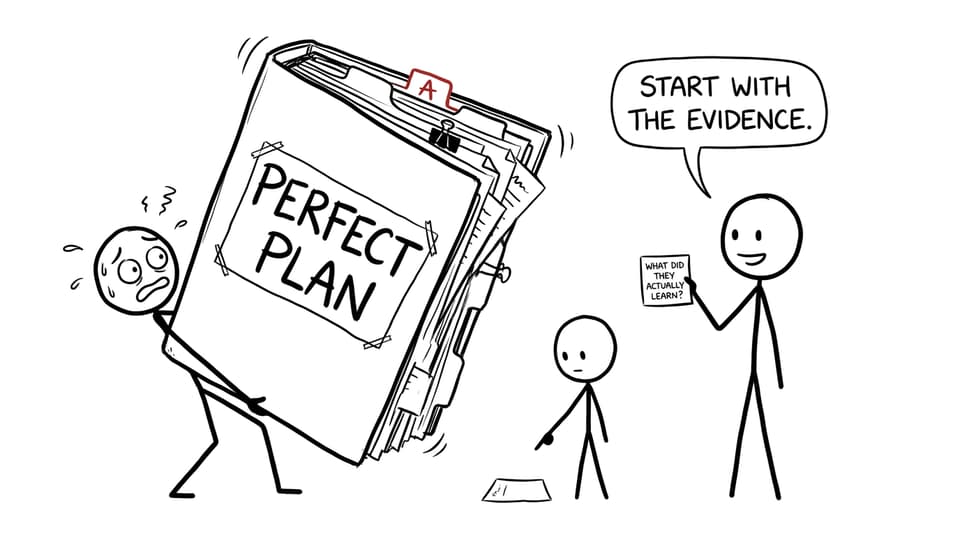
If I could sit beside my first-year Diploma Programme self, I would not begin with a better unit plan. I would begin with permission: permission to teach less, notice more, and stop treating uncertainty as evidence of incompetence.
The clearest lesson from my IB teacher reflections is that effective DP teaching is not about covering every page with equal intensity. It is about knowing what students must understand, what they must do, and what evidence will reveal the difference.
I would still learn the current subject guide carefully and respect deadlines, assessment criteria, and academic integrity requirements. But I would add something I did not yet understand: the guide is a foundation, not a daily script. Professional judgment turns it into learning.
The advice I would keep beside my desk
My first-year checklist would be short enough to use:
- Plan backwards from concepts, skills, and assessment evidence.
- Check understanding before assuming teaching produced learning.
- Make criteria visible before students submit work.
- Give feedback that leads to a specific next action.
- Coordinate major deadlines with the wider DP team.
- Teach students how to practise independently.
- Protect time for reflection, moderation, and recovery.
- Use technology to remove repetition, not professional judgment.
Everything else is important detail, but still detail.
I would teach the course, not worship the calendar
In the first year, a calendar can feel like a contract. If Tuesday says Topic C, then Topic C must begin on Tuesday, even when Monday revealed that half the class misunderstood Topic B.
I would now treat the calendar as a forecast. It identifies pressure points, but it cannot predict exactly what students will need. DP teaching is informed by assessment, so evidence should sometimes change the plan.
That does not mean drifting through the syllabus. I would map non-negotiable content, major assessments, school deadlines, revision periods, and contingency time before teaching begins. Then I would leave selected spaces flexible. A plan without slack assumes that no student will struggle, no school event will intervene, and no lesson will deserve another day.
I would design the assessment journey earlier
One of the most practical lessons learned teaching IB is that assessment cannot simply be attached to a unit at the end. Students need repeated encounters with the thinking behind the final task.
If they must evaluate, construct an argument, interpret unfamiliar data, or apply a method under pressure, those actions should appear throughout the course. I would introduce command terms in context, model strong responses, and let students compare work against criteria before major submissions.
The DP uses internally and externally assessed components, with requirements varying by subject. The current official subject guide, teacher support material, and school calendar therefore remain essential. No third-party resource should replace them.
For rehearsal, I would move from focused tasks to timed sections and then to full simulations used sparingly. RevisionDojo's guide to making IB mock exams more effective explains how results can guide reteaching instead of merely producing another grade.
I would ask for evidence sooner
Early-career teaching can confuse explanation with learning. A clear presentation feels productive. Students nod, notes appear, and the room seems settled. But recognition is not retrieval, and silence is not necessarily understanding.
I would build small checks into ordinary lessons: an unfamiliar application, a brief explanation without notes, a comparison between approaches, or an exit response naming the least secure idea. These checks do not need grades. Their purpose is to answer a better planning question: What should happen next?
When patterns matter across a class, teacher analytics and student insights can reveal shared weaknesses. Data still requires interpretation. A low score might indicate missing knowledge, weak command-term interpretation, poor timing, or an unsuitable assessment. The dashboard begins the conversation; it does not finish it.
I would make feedback smaller and more usable
My younger self would have tried to prove care through volume. Long comments can feel generous, but students cannot act on six priorities at once.
I would identify the most consequential gap, connect it to the criterion, and require a response. That might be a rewritten paragraph, corrected calculation, revised plan, or another question testing the same skill. Feedback becomes valuable when it changes the next attempt. Without that attempt, it is often only commentary.
RevisionDojo's IB Coursework Grader can provide initial criterion-level observations, while the Coursework Library helps students examine how quality is constructed. Both are supporting tools. Authentication, context, official criteria, and final academic judgment remain human responsibilities.
I would teach independence deliberately
DP students are often called independent learners before they have learned how independence works. I would teach them to divide large tasks into stages, retrieve knowledge instead of merely rereading, classify errors, and ask precise questions.
RevisionDojo's IB resources hub supports that progression. Study Notes can clarify a concept. Flashcards strengthen recall. The Questionbank tests application, while AI Chat helps students articulate specific misunderstandings. Predicted Papers and Mock Exams add timed rehearsal. Grading tools, the Coursework Library, and Tutors provide different forms of support.
I would not ask students to use everything. I would teach them to choose the next tool according to the problem they are solving.
I would protect collaboration and workload
Students experience six subjects and the core as one connected workload, not as separate teacher calendars. I would speak with colleagues earlier about major submissions, simulations, and revision demands. A shared calendar is both an instructional and wellbeing tool.
I would also stop recreating every resource from a blank page. The RevisionDojo platform for IB teachers and departments combines question selection, assignments, feedback, and analytics. Its teacher tools guide covers lesson preparation, testing, coursework review, and classroom workflows.
The principle is simple: automate repetition so teachers can spend more time interpreting student thinking and making professional decisions. In RevisionDojo's 2026 State of Learning Survey of 2,975 students and teachers, 60.2% of teachers reported lower average stress after using RevisionDojo, with a 31.8% relative reduction from 3.47 to 2.36 on a five-point scale. These self-reported, observational findings do not establish causation, but they suggest that connected workflows may reduce avoidable friction.
I would reflect on decisions
Reflection becomes useful when it produces a testable adjustment. Instead of writing that a lesson went well, I would ask what students demonstrated, where their reasoning diverged from mine, whether feedback changed the next attempt, and what should be retained, removed, or retaught.
I would keep a short weekly record rather than an elaborate journal abandoned by October. Over time, those notes would reveal patterns that memory smooths over.
This is what I would finally tell my first-year self: confidence will not arrive before the work. It grows from making careful decisions, examining their consequences, and adjusting without treating every imperfect lesson as a verdict on your ability.
RevisionDojo supports that growth by connecting planning, practice, feedback, coursework, timed preparation, and targeted support in one IB-focused environment. The tools matter, but the reflective teacher deciding how to use them matters more.