


A mock exam can feel like a verdict.
You walk out, you remember the question you froze on, and the grade starts whispering a story: maybe I’m not an IB person. But the best IB teachers know something students often forget in the moment: a mock exam isn’t a verdict. It’s a map.
Used well, IB mock exams do three jobs at once. They reveal what you know under time pressure, they teach you what the examiner actually rewards, and they turn anxiety into something measurable you can train. Used poorly, they become a one-off stress event that drains energy and teaches the wrong lessons.
This guide is for IB students preparing for exams, but it’s written with a teacher’s toolkit in mind. Because when teachers run mock exams more effectively, students get what they really need: a tight feedback loop, clear next steps, and a calmer path to better IB results.
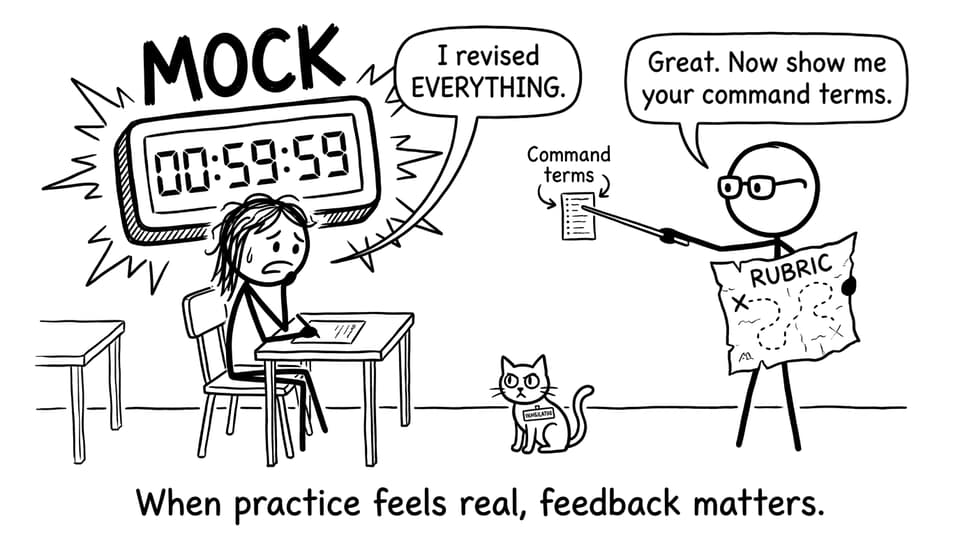
Quick checklist: what “effective” IB mock exams look like
If you want a fast way to judge whether your IB mock exams are helping, look for these signals:
-
The mock mirrors IB paper structure (timing, marks, question styles, instructions).
-
Students understand success criteria before they sit the mock (not after).
-
Marking is consistent across classes and teachers.
-
Feedback is fast enough to change next week’s behaviour.
-
Students complete a structured reflection and a retake plan.
-
Data is used to change teaching, not just report grades.
A good mock exam doesn’t just measure learning. It creates learning.
Why IB mock exams matter more than “practice”
In the IB, small technique errors cost big marks. A student can know the content and still lose points because they misread command terms, structure an answer poorly, or spend 18 minutes on a 6-mark question.
That’s why IB mock exams are more than practice. They’re a diagnostic tool for three different gaps:
-
Content gaps: you genuinely don’t know (or can’t recall) something.
-
Technique gaps: you know it, but you don’t express it in mark-awarding form.
-
Time gaps: you could do it, but not at exam speed.
If you’ve ever felt like you “revised a lot” but your IB grade didn’t move, it’s usually because mocks were treated as a score, not a system.
To build a system, many teachers pair mock results with targeted practice using RevisionDojo’s all-in-one ecosystem: Questionbank, Study Notes, Flashcards, AI Chat, Grading tools, Predicted Papers, Mock Exams, Coursework Library, and Tutors. It’s not more work for you. It’s less guessing.
Design IB mock exams for authenticity (without overdoing it)
The first rule is simple: the mock should resemble the real IB exam closely enough that the skills transfer.
That means:
-
Matching the IB paper format and mark distribution.
-
Enforcing timing properly (including “you must move on” moments).
-
Using the same materials students will have on exam day (where relevant).
But there’s a second rule teachers sometimes miss: authenticity doesn’t require maximum length every time.
A smart approach is a ladder:
-
Mini-mocks (20-40 min) to isolate one skill (data response, essay plan, method questions).
-
Section mocks (45-75 min) to train pacing and stamina.
-
Full mocks sparingly, to rehearse the whole performance.
Students can also build this ladder at home using resources like Custom IB Mock Exams: Build Practice Tests by Topic and IB Test Templates: Pre-Made Exams for Quick Practice.
Teach the rubric before the mock, not after
Most students meet the rubric the way people meet a fire alarm: loudly, late, and with confusion.
Effective IB teachers flip the sequence:
-
Show what top-band answers look like.
-
Translate criteria into a short student checklist.
-
Model how marks are earned (and how they’re lost).
This matters because IB mock exams aren’t just testing content. They’re testing communication under constraints. When students know what the criteria demand, they stop writing “interesting” answers and start writing mark-friendly ones.
If you want a platform-supported way to keep rubrics, exemplars, and feedback consistent across a cohort, RevisionDojo for Schools is built for exactly this standardisation.
Make feedback the main event (and the grade a footnote)
Here’s the quiet truth: the grade from an IB mock exam is often the least useful part.
The useful part is the pattern behind the grade.
Great teachers run a post-mock routine that forces patterns to appear:
-
Same-day review while the mistakes are still vivid.
-
A requirement to categorise every lost mark (content/technique/time).
-
One rewritten answer to top-band quality.
-
A short retake scheduled within 7 days.
This is also where fast feedback tools make a real difference. RevisionDojo’s Grading tools and AI Chat can help students understand why they lost marks in language that matches IB expectations, then move straight into targeted repair.
For students, it helps to connect mock review to a simple ongoing routine like the one in How 45-Point IB Students Prepare for Exams.
Use peer marking to teach examiner thinking
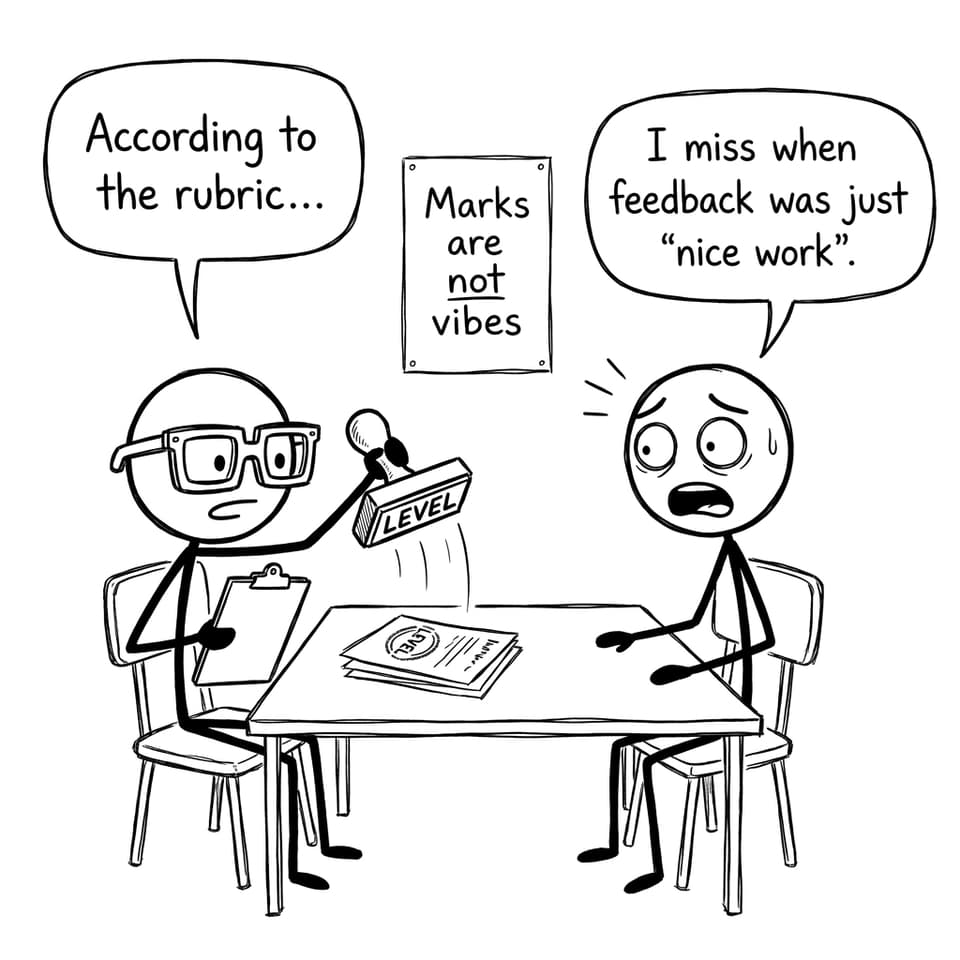
Peer marking sounds risky until it’s structured. Done right, it’s one of the fastest ways to teach students how IB marking actually works.
A strong peer-marking setup looks like this:
-
Use anonymised responses (or teacher-provided samples).
-
Mark with the official criteria and a clear markscheme.
-
Require students to justify every mark with a quoted phrase from the rubric.
-
End with a calibration discussion: “What did we disagree on, and why?”
This builds a rare skill: students start predicting what the IB will reward before they write. That’s when their practice becomes intentional.
To keep practice flowing after peer marking, students can drill the exact weak skill using the Questionbank feature and strategy guides like IB Question Bank: Thousands of Practice Questions.
Track IB mock exam results over time (so progress becomes visible)
One mock can be noise. Two mocks can be a mood. But three or four mocks create data.
Teachers who use IB mock exams more effectively track trends like:
-
pacing (marks per minute)
-
command term accuracy
-
topic-level weaknesses
-
recurring method errors
Students benefit from trend tracking because it changes the emotional meaning of a mock. It stops being “I’m bad at IB Biology” and becomes “I lose marks on data-based explanations, especially when I don’t link evidence to conclusion.”
That’s a fixable statement.
Platforms like RevisionDojo make this easier by connecting mock practice to the tools that repair it: Study Notes for quick clarity, Flashcards for retention, Questionbank for repetition with feedback, then Mock Exams and Predicted Papers for full rehearsal. Students who need extra structure can also use RevisionDojo App: The Smarter Way to Prep for IB Exams as a simple system.
Turn mocks into a repeatable loop, not a one-off event
The highest-performing IB students don’t do more. They repeat better.
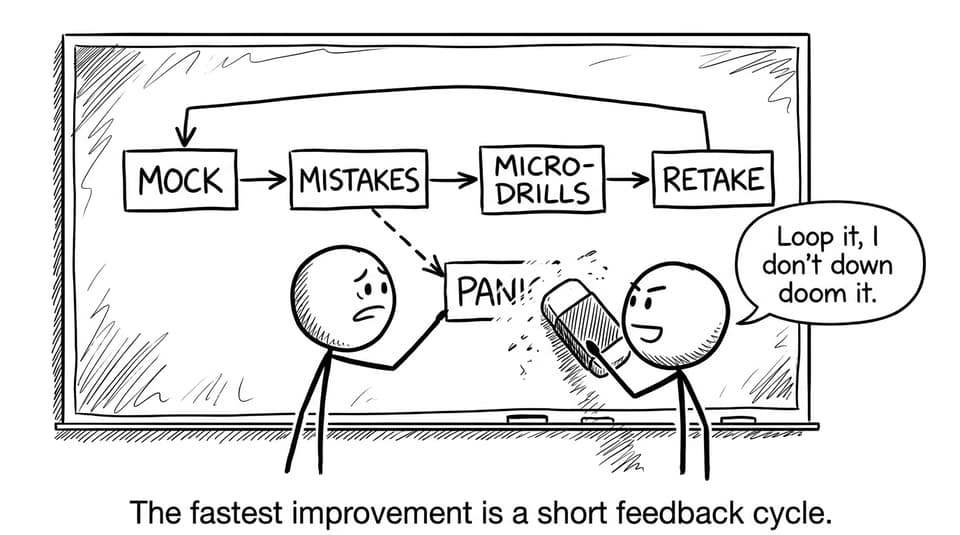
A mock exam works best when it’s part of a short cycle:
-
Mock (under real conditions)
-
Mistakes (pattern finding)
-
Micro-drills (targeted practice)
-
Retake (prove the fix)
Students can build this cycle at home too, especially with guides like Online IB Mock Exams: Practice Anywhere, Anytime and resilience-focused support like Failed Mock Exams? You Can Still Pass IB.
Common mistakes teachers (and students) make with IB mock exams
A few pitfalls show up again and again in IB schools:
-
Too many full mocks, too few retakes: stamina improves, but marks don’t.
-
Feedback arrives too late: the class has already moved on.
-
No explicit rubric teaching: students practise writing, not scoring.
-
Mock conditions are “kind”: pauses, hints, loose timing. Comfort doesn’t transfer.
-
Students revise broadly instead of surgically: they feel busy, not better.
Fixing these doesn’t require more intensity. It requires better sequencing.
FAQ
How often should IB students do mock exams?
For most IB students, one substantial timed mock-style session per week is enough to build exam stamina without burning out. That session can be a mini-mock, a section, or occasionally a full paper, depending on the calendar. The key is that each IB mock exam attempt should generate a clear list of fixable patterns. If you’re doing mocks but not changing your approach afterward, frequency won’t help. Students usually improve faster when they retake a repaired skill within a week rather than sitting endless fresh mocks. A balanced plan is: one timed attempt, one deep review, then targeted drills and a retake.
Should IB mock exams be full-syllabus or topic-based?
Both have a place, and the best IB preparation uses them in stages. Early on, topic-based mocks are more efficient because they isolate specific weaknesses like data analysis, algebraic manipulation, or essay structure. Closer to the real IB exams, full-syllabus mocks matter because integration and stamina become the challenge. The mistake is doing full papers too early and too often, when the student lacks the building blocks to benefit from them. A good teacher uses topic-based IB mock exams to build competence, then uses full papers to rehearse performance. Students can mirror that approach by combining targeted practice with full simulations using RevisionDojo’s Questionbank, Mock Exams, and Predicted Papers.
What should I do the day after an IB mock exam?
The day after an IB mock exam should be more about analysis than emotion. Start by identifying lost marks and sorting them into content, technique, or time, because each category needs a different fix. Then rewrite one answer fully to top-band quality, using the rubric language, not just your own phrasing. After that, do a short set of targeted questions on the same weakness to make the correction stick. If you can, schedule a mini-retake of the same skill within 3-7 days to prove the improvement under time. Tools like RevisionDojo’s AI Chat and Grading tools can accelerate this process by explaining what the markscheme expects and helping you practise the corrected approach immediately.
How can teachers help students take IB mock exams seriously without increasing anxiety?
Students take IB mock exams seriously when the purpose is clear and the next step is guaranteed. Teachers can reduce anxiety by framing mocks as diagnostics, not identity statements, and by showing students exactly how the data will be used. The most calming promise a teacher can make is: “You will get fast, specific feedback, and you will get a chance to retake a repaired skill.” It also helps to standardise conditions so the mock feels fair across the cohort, not like a surprise. When students see mock results translated into targeted practice, they stop fearing the score and start trusting the process. Platforms like RevisionDojo for Schools support this by centralising feedback, practice, and progress tracking so the system feels coherent.
Conclusion: make the IB mock exam a turning point
A good IB mock exam doesn’t just tell you where you are. It tells you what to do next.
For teachers, the opportunity is bigger than running a realistic paper. It’s designing a cycle where practice becomes performance: authentic timing, criteria-first teaching, fast feedback, targeted drills, and retakes that prove growth.
For students, the message is simple: you don’t need more panic revision. You need a cleaner loop.
If you want that loop to feel easier to run, build it in RevisionDojo: use Study Notes to patch confusion quickly, Flashcards to keep recall alive, the Questionbank to train exam behaviour, AI Chat and Grading tools for fast feedback, then Mock Exams and Predicted Papers to make the real IB exam feel familiar. When mocks are used effectively, IB becomes less mysterious and much more manageable.