

The question behind every IB timetable
The night it finally feels real, it usually looks like this: you open your calendar, count the weeks to exams, and do the same math every IB student does. If I study X hours a day, will I be okay?
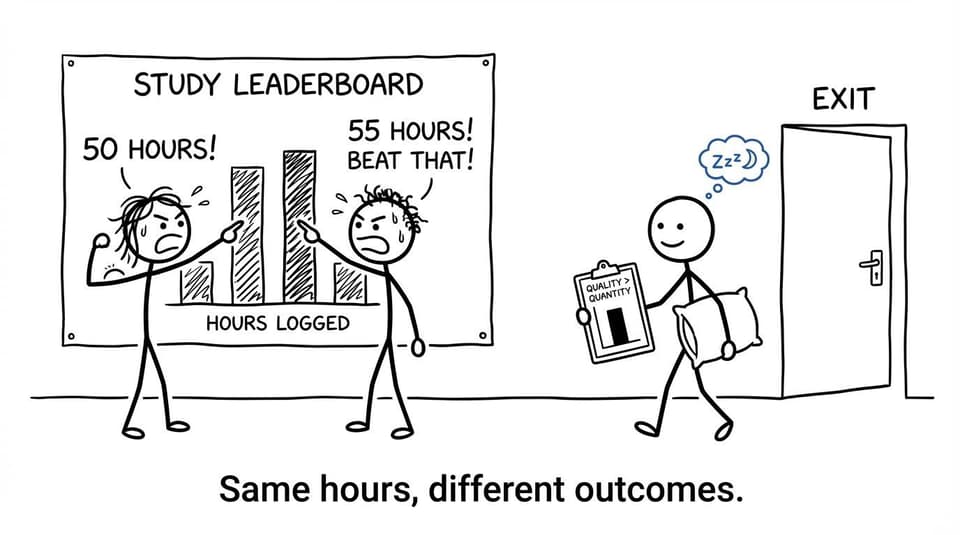
The honest answer is uncomfortable and relieving at the same time: IB success is not decided by a single heroic number. It is decided by whether your hours create repeatable proof, better recall, cleaner method, faster writing, fewer silly mistakes. Two students can study the same hours and end up with different grades because one spent those hours rereading, and the other spent them retrieving, practicing, and fixing.
So yes, we will talk about hours. But we will treat them the way IB examiners treat "word count", a constraint that matters, not the thing that earns marks.

Quick checklist: your IB study hours in one glance
Use this checklist to sanity-check your IB plan before you commit to a routine you cannot sustain.
- Baseline weekly targets (most weeks):
- HL: 6-8 hours per subject per week
- SL: 4-6 hours per subject per week
- Exam-season ramp (final 6-8 weeks): increase gradually by 30-60%, not overnight.
- Daily minimum for momentum: 60-120 minutes on school days (more on weekends).
- Non-negotiables: sleep, movement, and one weekly "reset" block to prevent burnout.
- Quality rule: every study block should include active recall or exam-style practice.
These hour ranges align with the realistic weekly framework described in How Long Should I Revise for Each IB Subject?.
Why "How many hours?" is the wrong first question (but still useful)
IB is unusual because it punishes vague effort. You can spend hours "doing IB" while avoiding the parts that move your grade: timed writing, multi-step method questions, command terms, and markscheme logic.
Hours are still helpful because they force trade-offs. They help you decide whether you can do everything (you cannot), whether your week has enough room for HL depth, and whether you are accidentally leaving your weakest subject to the last month.
Think of IB study hours as the budget. The spending choices decide whether you get rich.
A good way to protect your budget is to build your week around tools that compress time:
- Use a Questionbank to get fast repetitions of what the IB actually asks.
- Use Study Notes to rebuild weak concepts quickly instead of re-reading textbooks.
- Use Flashcards for spaced recall so your memory doesn't leak.
- Use AI Chat to clarify misconceptions immediately, while the confusion is still fresh.
If you want a clear overview of what that system looks like, start with the RevisionDojo for IB hub.
A realistic IB hour framework (that doesn't break you)
Most IB students need a plan that survives normal life: school days, activities, CAS, coursework deadlines, and the occasional bad week. The mistake is aiming for an "ideal" schedule you will abandon by Thursday.
Year 1 vs Year 2: different jobs, different hours
IB Year 1 is about building foundations and keeping friction low.
- Aim for 1-2 hours/day on weekdays.
- Add 3-5 hours/day split across the weekend.
- Total target: roughly 12-18 hours/week outside class.
IB Year 2 (especially January onward) becomes about performance.
- Aim for 2-3 hours/day on weekdays.
- Add 4-6 hours/day across the weekend.
- Total target: roughly 18-28 hours/week outside class.
These numbers fluctuate by subject mix and how early you started. But they are realistic for most IB students who also want to sleep.
HL vs SL: why HL needs more than "a little extra"
HL is not just more content. It is more decision-making under pressure: longer mark allocations, more steps, more places to lose marks.
A steady rule of thumb is:
- HL: 6-8 hours/week per subject
- SL: 4-6 hours/week per subject
If you take three HLs, that alone can be 18-24 hours/week. That is why your system matters: you cannot afford waste.
For a sustainable structure, borrow the routine ideas from How to Create a Balanced IB Study Schedule.
The 3 phases of IB studying (and how hours shift)
IB revision changes meaning as exams approach. Same student, same brain, different task.
Foundation phase (months out): learn cleanly
This is when your hours should look boring.
- 40%: concept rebuilding (notes + mini-lessons)
- 40%: targeted practice questions
- 20%: flashcards and quick recall
If your foundation is shaky, add hours here rather than later. It is cheaper to fix misunderstandings early than to patch them during timed practice.
Use digital notes to cut the time cost of "getting oriented" on a topic. A good starting point is Digital IB Study Notes: Access Anywhere, Anytime.
Performance phase (6-10 weeks out): convert knowledge into marks
This is the phase where extra hours can actually pay off, if they are structured.
- 20%: concept review
- 60%: exam-style practice (timed blocks)
- 20%: review mistakes and reattempt
This is where an IB student's study hours should increase gradually. Not because "more is better," but because performance practice takes repetitions.
If you want targeted repetition without random wandering, use a question bank workflow like the one described in Comprehensive IB Question Bank: Thousands of Practice Questions.
Refinement phase (final 2-3 weeks): protect confidence, reduce chaos
This phase is about being calm and accurate.
- Shorter, sharper blocks
- Light content review
- Timed sections, not all-day marathons
- Sleep becomes part of your strategy
A surprisingly high-scoring move is stopping earlier the night before an exam. For that, see What to Do the Night Before a Big Exam.
The truth about "studying more": why IB hours hit diminishing returns
There is a moment when more IB study hours stop helping and start harming.
It usually shows up as:
- you reread the same paragraph three times
- you keep "collecting resources" instead of practicing
- you start making unforced errors
- you feel busy but cannot explain what improved
This is not laziness. It is fatigue plus unclear feedback.
The fix is to make your hours measurable. Do work that gives you a score, a mark breakdown, or a list of recurring mistakes.
That is why timed simulations matter. If you want a structured way to do them, How to Plan Final IB Revision Using the Official Timetable helps you plan backward from the real pressure.
A simple model: build your IB study hours around loops
Here is the loop that quietly separates the students who feel "prepared" from the students who actually are.
The 60-90 minute "IB loop"
- 10 min: Study Notes skim for the exact subtopic
- 25-35 min: Questionbank practice (focused set)
- 10-15 min: review mistakes, write a one-sentence "error rule"
- 10 min: Flashcards (spaced repetition)
- Optional 5 min: AI Chat to clarify one misconception
Do two loops on a weekday, three loops on a weekend day, and your hours add up without your brain melting.
To see what's included in the core toolkit, visit Notes + Flashcards + Question Bank (Free).
Why this loop works for IB
- It forces retrieval (what exams reward).
- It turns mistakes into reusable rules.
- It keeps memory alive with flashcards.
- It makes your hours portable and repeatable.
And because it is modular, you can scale it up in exam season without changing your identity as a student.
How to adjust IB study hours by subject type
Not all subjects consume hours the same way. Your plan should respect that.
Content-heavy subjects (Biology, History, Psychology, etc.)
These subjects punish forgetting.
- Give them frequent shorter sessions.
- Use Flashcards daily.
- Use Study Notes for quick refresh before questions.
Skill-heavy subjects (Math, Physics, Chemistry, language papers)
These subjects punish sloppy method.
- Fewer sessions, but more practice density.
- More timed sections.
- More review of working, not just answers.
Writing-heavy subjects (English, History essays, Economics evaluation)
These subjects punish vague structure.
- Practice outlines under time.
- Rewrite introductions.
- Use Grading tools to get feedback faster than waiting a week.
If you are trying to keep your practice aligned to the current course requirements, see Updated IB Question Bank: Latest Curriculum Alignment.
The "exam season" ramp: how to increase hours without panic
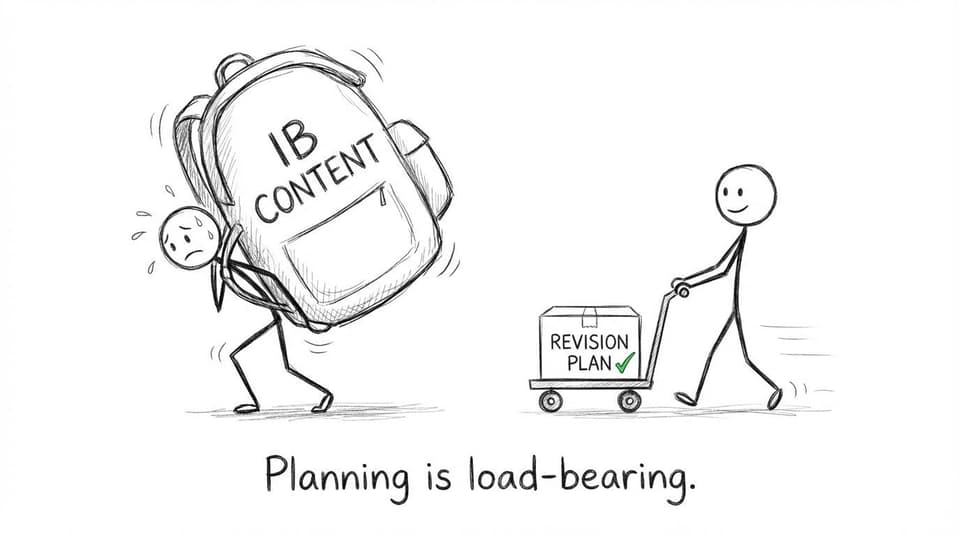
Most students don't fail because they studied too little. They fail because they ramped too late, then tried to brute-force.
Use a simple ramp:
- 8 weeks out: baseline + 20% (add one extra loop on 3 days)
- 6 weeks out: baseline + 35% (add a timed section each weekend)
- 4 weeks out: baseline + 50% (swap some content review for timed practice)
- 2 weeks out: hold steady, prioritize sleep, focus on weak areas and timing
If you like seeing all of this translated into a schedule, Personalized IB Study Plans: AI Creates Your Schedule explains how Jojo AI can structure your week around your weak topics.
Closing: choose IB hours you can repeat
The best IB schedule is not the one that looks impressive on a Sunday night. It is the one you can repeat on a Wednesday when you are tired, behind, and tempted to pretend that reorganizing your folder counts as revision.
Start with realistic IB study hours: enough to build momentum, not so much that you break. Then upgrade the quality of those hours with a tight loop: Study Notes for clarity, Questionbank practice for application, Flashcards for memory, AI Chat for fast explanations, Grading tools for feedback, and timed Mock Exams plus Predicted Papers for confidence under pressure.
If you want all of that in one place, begin at RevisionDojo for IB and build a week that makes your next hour obvious.