
Phones don't ruin your productivity in one dramatic moment.
They ruin it in tiny, reasonable decisions.
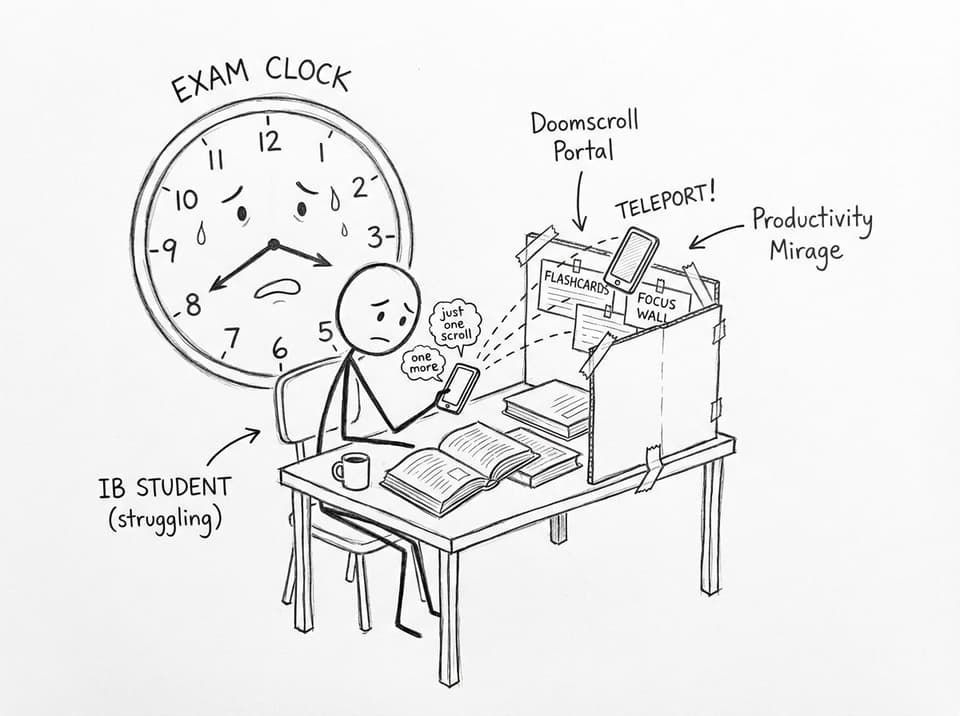
You sit down to do IB revision. You open your laptop. You even know exactly what you want to do: one topic, a short set of questions, maybe a timed section. Then your phone lights up. You don't even feel tempted. You feel responsible. Just checking. Just replying. Just clearing the little red dot.
Ten minutes later, you're not behind because you're lazy. You're behind because your attention has been quietly chopped into pieces.
For IB students, that matters more than you think. The IB doesn't reward "time spent." It rewards sustained thinking; the kind you can't do when your brain is half in a group chat.
This guide is about why your phone is killing your productivity, yes. But it's also about the calmer part: how to make your phone stop deciding your IB day.
The IB phone problem (quick checklist)
If you want the short version before the deeper story, here's a simple IB checklist to reclaim productivity from your phone:
- Put your phone out of reach during IB study blocks (not just face-down).
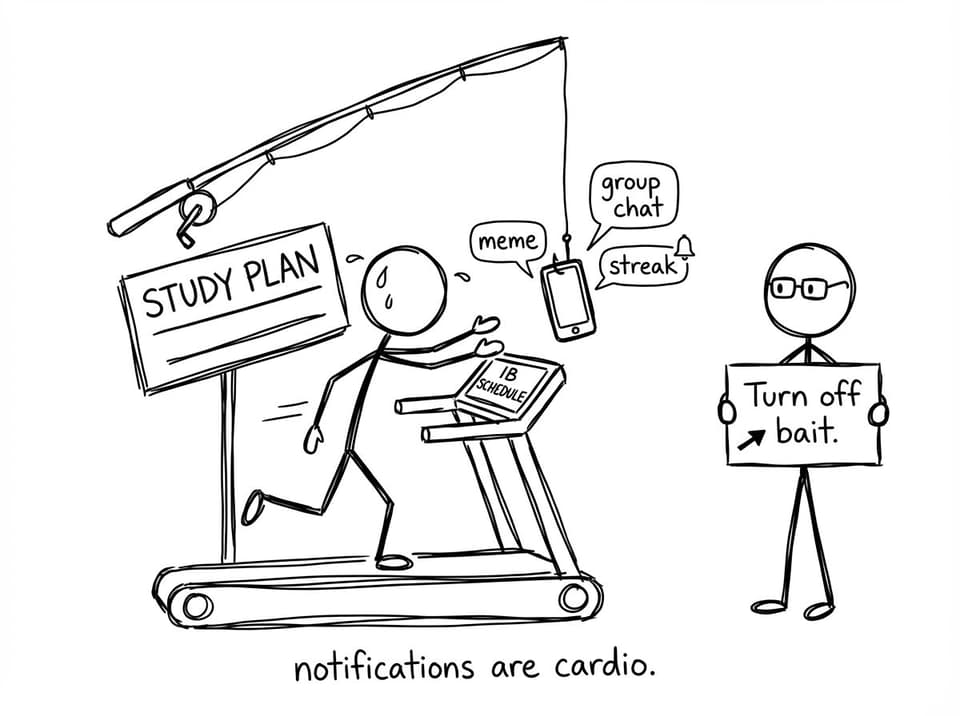
- Turn on Do Not Disturb and disable banner notifications.
- Study in short sprints (25-45 minutes), then take intentional breaks.
- Replace "scroll breaks" with physical breaks (water, stretch, sunlight).
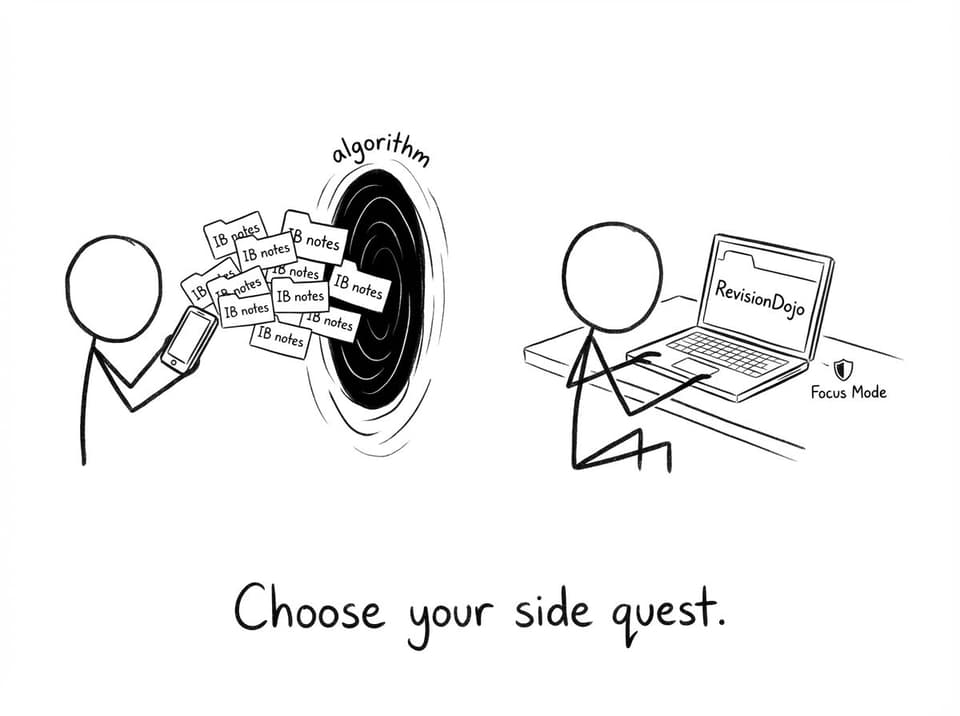
- Use one focused platform for IB revision to reduce tab-hopping.
- Build a loop: Notes → Questions → Review mistakes → Flashcards.
That last bullet sounds boring. It's also how people quietly get 6s and 7s.
Why your phone kills productivity (and why IB makes it worse)
Your phone isn't just "distracting." It trains you to expect novelty every few seconds. That expectation changes how studying feels.
IB studying often starts slow. The first five minutes can feel like pushing a heavy door. You're loading context: definitions, steps, essay structure, command terms. If your phone has taught your brain that comfort is one swipe away, you start negotiating with the discomfort.
In IB, the cost of that negotiation is high because:
- IB questions are long. Many require multiple steps, not quick recall.
- IB marking is picky. One missed justification or command-term mismatch loses marks.
- IB is cumulative. Losing today's focus doesn't just waste today. It creates future panic.
This is why your phone is killing your productivity: it doesn't steal your whole evening. It steals the start of your deep work, over and over, until you stop trusting your own focus.
If you want a clean starting point for rebuilding that trust, keep this open as your backbone: How to Study for IB Exams: Step-by-Step Guide.
The hidden math of distraction: context switching
Most IB students underestimate how expensive switching is.
When you jump from a Chemistry question to a notification to a meme, your brain doesn't come back to Chemistry instantly. It has to rebuild the mental model: where you were, what the question wanted, what rule applies, what you already tried.
That rebuild is the real time loss.
So the issue isn't "discipline." The issue is design. If your study setup allows switching, switching will happen.
A practical fix is to shorten the distance between intention and action. That's where an all-in-one IB workflow helps: fewer apps, fewer tabs, fewer reasons to "just check something." RevisionDojo is built around that loop:
- Study Notes to understand fast
- Questionbank to practise exam-style questions
- Flashcards to keep recall alive
- AI Chat to unblock confusion quickly
- Mock Exams and Predicted Papers to simulate pressure
- Grading tools for feedback on coursework writing
- Coursework Library to see strong examples
- Tutors when you need a human to simplify the knot
If you've been revising by collecting resources, read this as an antidote: 5 Proven IB Revision Hacks Backed by Science.
Your phone is also killing your sleep (and that kills IB productivity tomorrow)
A lot of IB productivity advice ignores the simplest truth: tomorrow's focus is built the night before.
Late-night scrolling doesn't just take time. It changes the quality of your rest. Even if you fall asleep "on time," your brain often feels fuzzier the next day. Then you compensate with more screen time because you feel tired. That becomes a loop.
If you want a healthier frame, don't ask "Can I afford to rest?" Ask "Can I afford exhausted studying?" This piece captures it well: Why Rest Is Productive in IB Exam Season.
The IB focus reset: build phone rules that don't require willpower
Most students set rules like: "I'll just use my phone less." That's not a rule. That's a wish.
Try rules that are physical and automatic:
Put your phone in a different room
Not on the desk. Not under the notebook. Not face-down.
Out of sight is not a cliché. It's an engineering choice. If your phone is within reach, your brain keeps a tiny background process running: "I could check." That background process is productivity leakage.
Use a timer, not a mood
For IB productivity, the timer is the agreement.
- 25-45 minutes focused
- 5-10 minutes break
- longer break after 3-4 rounds
If you want a structured version of this for long sessions, use: How to Stay Focused During Long Study Sessions.
Make breaks phone-optional, not phone-default
Some breaks should be screen-free. Not because screens are evil, but because your brain needs a different kind of rest.
Try: water, stretching, a short walk, or even just standing in silence for two minutes. The goal is to come back with attention intact.
Turn your phone from a productivity killer into an IB tool
A phone becomes dangerous when it's unstructured. But it can be useful when it's locked into one job.
Here's a simple swap: instead of using your phone as the break room, use it as the practice station.
That means:
- Do a short Flashcards session on your phone (7-12 minutes).
- Answer a small set of Questionbank questions while commuting.
- Use AI Chat to solve one confusion, then immediately practise.
The keyword is "immediately." If you use your phone to learn but don't use it to apply, your phone becomes another content stream.
For a practical approach to studying on small pockets of time, see: Mobile IB Question Access: Study Questions on Any Device.
And for a bigger system that reduces app-switching entirely, keep this bookmarked: RevisionDojo App: The Smarter Way to Prep for IB Exams.
The "one-tab" system for IB productivity
If your phone is killing your productivity, your browser probably is too.
A high-performing IB habit is embarrassingly simple: one tab per block.
- Block A: Study Notes for 10 minutes to get clarity
- Block A: immediately switch to Questionbank for 20-30 minutes
- Block A: finish with a 3-line mistake log
- End: 7 minutes Flashcards to keep recall warm
This structure isn't about motivation. It's about not giving your brain a buffet.
If you want a broader set of study techniques that fit IB demands, this is a strong companion: 10 Proven Study Techniques for IB Students.
A realistic weekly plan (built for IB students with phones)
You don't need a monk schedule. You need consistency.
- Daily (10-20 min): Flashcards (phone allowed, one app only)
- 4-6x per week (45-90 min): Topic blocks (phone in another room)
- 1-2x per week: Timed practice using Mock Exams or structured paper sets
- Weekly (15 min): Review your mistake log and pick 2 weak subtopics
If you're building your revision calendar, this article helps keep IB planning concrete: The Ultimate Guide to Revision for IB Students.
Closing: if you want IB productivity, protect your attention like a grade
The most frustrating part of IB isn't the workload.
It's the feeling that you tried all day and still didn't move.
If your phone is killing your productivity, you don't need a new personality. You need a better environment. Put the phone out of reach. Use timers. Build a single loop that turns effort into feedback.
And if you want that loop in one calm place, use RevisionDojo as your IB control panel: Questionbank, Study Notes, Flashcards, AI Chat, Grading tools, Predicted Papers, Mock Exams, Coursework Library, and Tutors.
Your phone will still exist.
But your IB productivity won't have to negotiate with it anymore.