


When you sit down for a long IB study session, the first 20 minutes can feel almost cinematic.
Your desk is clear. Your water bottle is full. Your intentions are noble.
Then, quietly, the friction starts.
A notification lights up. A hard question takes longer than expected. You reread the same paragraph three times and still can’t explain it back. By hour two, it’s not that you don’t care about the IB; it’s that your brain is negotiating for an exit.
Focus isn’t a personality trait. It’s a system.
And for IB students preparing for exams, a system matters more than motivation. The best students aren’t always the most intense. They’re the most repeatable.
Quick focus checklist for IB long sessions
Use this short checklist before any long IB study session, especially in exam season:
-
Choose one outcome you can finish today (not “revise everything”).
-
Decide your block length (25-45 minutes) and your break rules.
-
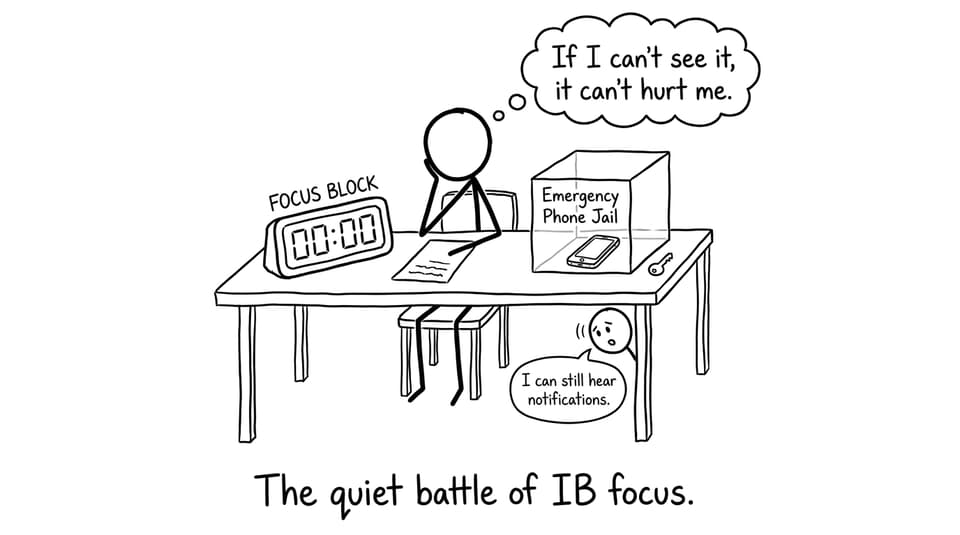
Remove the obvious distractions before you begin (phone, tabs, noise).
-
Start with active recall, not rereading.
-
Keep a tiny “mistake log” so your session has a trail.
When you do this consistently, you’re no longer hoping for focus. You’re building it.
Why IB focus disappears after a few hours
Most focus problems aren’t laziness. They’re overload.
In IB, the workload is wide (many subjects), deep (HL detail), and constant (IA, EE, TOK, tests). Long sessions fail when your brain is asked to do too many different things at once: understand content, memorize it, apply it, and stay calm about time.
That’s why focused students don’t “try harder.” They narrow the job.
A helpful rule: long sessions should feel like a sequence of short wins, not one endless grind.
If you want a broader structure for planning your week, pair this guide with How to Build a Study Routine That Actually Works.
Build your IB session around blocks, not hours
A long IB session should be measured in blocks, not time spent sitting.
Try one of these rhythms:
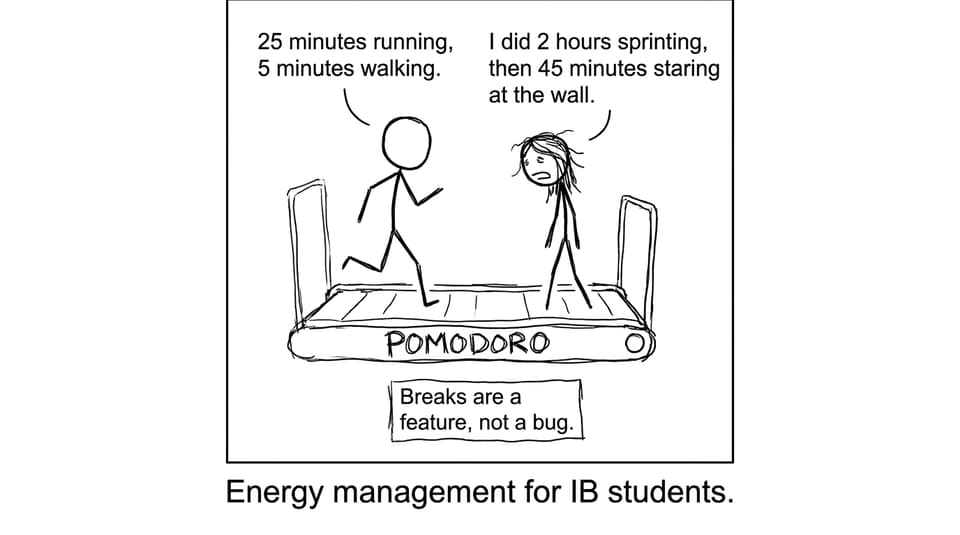
The 35/7 rhythm (my favorite for exam season)
-
35 minutes: focused work
-
7 minutes: break
-
After 3 rounds: 20 minutes longer break
Classic Pomodoro (great when you’re resisting starting)
-
25 minutes work
-
5 minutes break
-
After 4 rounds: 20 minutes longer break
Breaks keep your attention from decaying. They also create clean restart points, which is exactly what most IB students need when the session gets emotionally heavy.
For a deeper guide on using breaks strategically, see How to Use Breaks Effectively During Long Study Sessions.
Make focus easier by shrinking the task
The fastest way to lose focus in IB is to begin with something too vague.
“Study Biology” is vague.
“Answer 12 Topic X questions and write 3 error rules” is concrete.
Try this three-step intention before each block:
-
Target: the exact topic or skill (one chapter, one command term, one question type).
-
Rep: how many (questions, cards, paragraphs, outlines).
-
Proof: what you’ll produce (a score, a summary, a corrected solution).
If you’ve been stuck in cycles of starting strong then drifting, the mindset shift in Why You Can’t Focus Studying IB (And Fix It Fast) is a strong companion.
Use the “RevisionDojo loop” to stay engaged
Long IB sessions fail when they become passive. Reading feels safe, but it’s low friction; and low friction makes it easy to slide into zoning out.
Instead, run a loop that forces interaction:
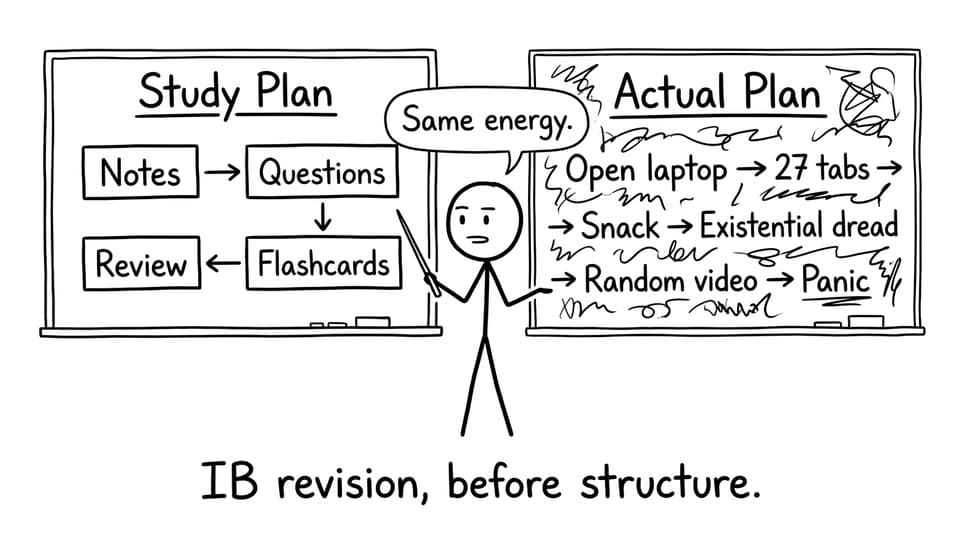
Notes -> Questions -> Review -> Flashcards
-
Start with Study Notes to get clarity fast: Study Notes
-
Move immediately into practice with the Questionbank: Questionbank
-
Review mistakes using mark-scheme language (what the examiner wanted, not what you “meant”).
-
Lock it in with Flashcards for spaced repetition: IB Flashcards with Spaced Repetition (SRS)
RevisionDojo is built to keep that loop tight. When your resources live in one ecosystem, you don’t waste your best energy on tab-hopping and reorganizing.
If you want the bigger picture of how students build this habit across weeks, read Why Some IB Students Stay Consistent.
Reduce distractions before they show up
In long IB sessions, the enemy is not one big distraction. It’s small interruptions that reset your attention.
Try a “pre-commitment” routine:
-
Put your phone out of reach (a different room if possible).
-
Close every tab you won’t use in the next block.
-
Use one soundtrack or silence; don’t keep searching for the perfect playlist.
-
Keep a scrap page called “Later” for intrusive thoughts (messages to send, chores, random ideas).
If your phone is the main issue, the strategies in IB Focus: Why Your Phone Is Killing Productivity are practical and realistic.
Stay focused by switching the type of effort, not the goal
A long IB session doesn’t need constant intensity. It needs intelligent alternation.
Think in two modes:
Heavy mode (high effort)
-
Timed questions
-
Essay planning
-
Hard problem sets
Light mode (lower effort but still useful)
-
Flashcard review
-
Error log clean-up
-
Short note refresh
When focus dips, don’t default to scrolling. Switch to light mode inside the same IB session. You stay in motion without demanding peak concentration every minute.
This is where AI Chat can help: use it to unblock a single confusion, then go straight back to practice. And when you want feedback on exam-style responses, RevisionDojo’s Grading tools keep your work honest.
Build stamina with realistic practice, not endless sitting
Focus also improves when your brain trusts the process.
In the IB, that trust comes from rehearsal: sitting questions under time pressure, reviewing, and seeing improvement.
Once or twice a week, add a stamina block:
-
Use Mock Exams to simulate timing and decision-making.
-
Use Predicted Papers to practice full-paper structure and topic coverage.
Start here: IB Predicted Papers.
That weekly rehearsal changes how long sessions feel. They stop being “hours of studying” and become “training for a specific performance.”
For a calmer mindset around rehearsal materials, read IB Predicted vs Specimen Papers: What They Mean.
Closing: focus is the quiet advantage in IB
A long IB study session is not a test of willpower. It’s a test of design.
When you plan blocks, protect breaks, and keep your learning active, focus becomes less dramatic. You stop chasing the perfect mood and start building a repeatable loop.
If you want one place to run that loop, RevisionDojo brings it together: Questionbank for targeted practice, Study Notes for fast clarity, Flashcards for retention, AI Chat for quick unblocking, plus Mock Exams, Predicted Papers, Grading tools, a Coursework Library, and Tutors when you want deeper support.
Open RevisionDojo, choose one topic, and run one clean block today. In IB, that’s how confidence is built, quietly, consistently, and on purpose.