
The moment grade boundaries stop feeling abstract
IB Language A revision gets weirdly emotional around this time of year. You can be doing the right work -- reading closely, annotating, practicing thesis statements -- and still feel uncertain because one question keeps hovering: “But what do I actually need for a 7?”
For IB Language A students in IB Japanese A: Literature HL, grade boundaries are the simplest way to turn that anxious question into a plan. Not because the numbers predict your result, but because they show you what “enough” has looked like before -- and where to build a buffer.
Quick checklist (use this before you revise)
-
Pick your weakest component first (Essay, IO, Paper 1, Paper 2).
-
Convert boundaries into targets (aim slightly above the 7 boundary, not right on it).
-
Practice under time pressure weekly.
-
Get feedback fast: rubric-based, specific, repeatable.
-
Use RevisionDojo tools to loop: Study Notes --> Flashcards --> Questionbank --> review.
Helpful hubs to keep open while you plan:
IB Japanese A: Literature HL 2025 grade boundaries (by component)
These boundaries help IB Language A students set realistic mark goals across each assessment component.
Essay (out of 20)
-
Grade 7: 18--20
-
Grade 6: 15--17
-
Grade 5: 13--14
-
Grade 4: 10--12
-
Grade 3: 7--9
-
Grade 2: 4--6
-
Grade 1: 0--3
Internal Assessment: Individual Oral (out of 40)
-
Grade 7: 34--40
-
Grade 6: 29--33
-
Grade 5: 24--28
-
Grade 4: 19--23
-
Grade 3: 13--18
-
Grade 2: 7--12
-
Grade 1: 0--6
Paper 1 (out of 40)
-
Grade 7: 24--40
-
Grade 6: 21--23
-
Grade 5: 18--20
-
Grade 4: 15--17
-
Grade 3: 12--14
-
Grade 2: 6--11
-
Grade 1: 0--5
Paper 2 (out of 30)
-
Grade 7: 24--30
-
Grade 6: 20--23
-
Grade 5: 16--19
-
Grade 4: 12--15
-
Grade 3: 9--11
-
Grade 2: 5--8
-
Grade 1: 0--4
Final overall (out of 100)
-
Grade 7: 74--100
-
Grade 6: 62--73
-
Grade 5: 52--61
-
Grade 4: 40--51
-
Grade 3: 29--39
-
Grade 2: 15--28
-
Grade 1: 0--14
If you want the full reference page for this subject, use: IB Japanese A: Literature HL 2025 Grade Boundaries Guide. For broader context on how boundaries work across sessions, read What Are the Grade Boundaries for IB Subjects?.
How to use grade boundaries to actually score higher
Build a “buffer plan” (the IB Language A way)
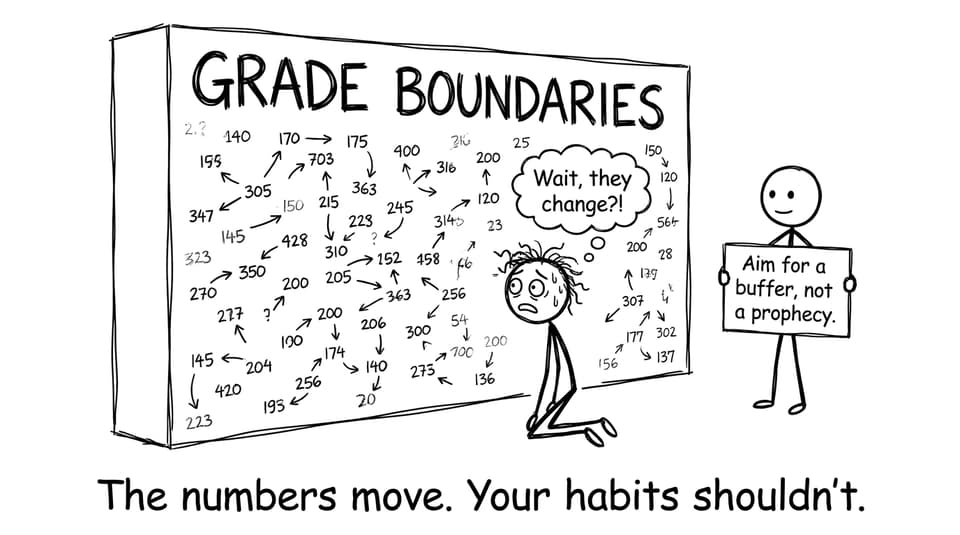
Boundaries shift. Your preparation shouldn’t. A calm approach is to set targets that sit above the boundary you want. If the 7 boundary for Paper 2 is 24/30, don’t train for 24. Train for 26--27 by tightening structure and quote integration.
Match your practice to the markscheme, not your mood
A lot of IB Language A work feels productive (highlighting, rereading, rewriting notes) without producing marks. RevisionDojo makes it easier to practice like the assessment: use Grading tools and AI Chat feedback loops, then reinforce weak spots with Flashcards and targeted Questionbank drills.
To set up that system in one place, start here: RevisionDojo App: The Smarter Way to Prep for IB Exams and Study Notes feature.
FAQ
Are these grade boundaries guaranteed for 2025?
No -- grade boundaries are session-specific and are set after marking, once the IB sees how difficult the assessments were and how students performed globally. That’s why IB Language A students should treat boundaries as guidance, not a promise. The practical value is in planning: you can convert boundaries into mark targets for each component and track progress over time. If boundaries move slightly, the student with a buffer is protected. If you want to understand why they change, Insights on IB Grade Boundaries and Result Trends explains the logic clearly. The best mindset is to prepare for the task, not to negotiate with the number.
What should I focus on first in IB Japanese A: Literature HL?
Start with the component where you can gain marks fastest with clear technique. For many IB Language A students, that’s Paper 1 structure (thesis, focused paragraphs, technique-to-effect links) or the Individual Oral (clear global issue and balanced analysis). Choose one skill, run a timed practice, then review your work against the rubric with brutal honesty. RevisionDojo helps because you can move from understanding to execution quickly: check Study Notes, drill recall with Flashcards, then practice with Questionbank where possible. If oral is your priority, use Language A Individual Oral: How to Score Higher with AI Help to rehearse with feedback rather than guesswork. Progress comes from tight loops, not giant study days.
How can RevisionDojo help me hit a 7 in IB Language A?
RevisionDojo is built to make IB Language A improvement measurable and repeatable. Instead of doing “more work,” you run a clearer system: learn concepts quickly with Study Notes, lock in terminology and quotes with Flashcards, and practice exam decision-making with the Questionbank. When you’re stuck, AI Chat helps you clarify interpretations and sharpen thesis lines without losing an hour. When you need realism, use Predicted Papers and Mock Exams to train timing and stamina, then review patterns in your mistakes. For orals and writing, Grading tools help you see what the rubric rewards, and the Coursework Library plus Tutors can support deeper feedback when you need it. In other words: RevisionDojo turns your effort into evidence.
A closing thought (and your next step)
Grade boundaries matter, but not in the way students fear. They don’t decide your outcome -- they simply reveal the shape of the hill you’re climbing in IB Language A.
If you want the simplest next step: open the IB Grade Calculator, set a realistic buffer above the 7 boundary, then build one weekly loop inside RevisionDojo using Study Notes, Flashcards, Questionbank, AI Chat, Grading tools, Predicted Papers, Mock Exams, the Coursework Library, and Tutors. Calm reps beat frantic rereads, every time.
