
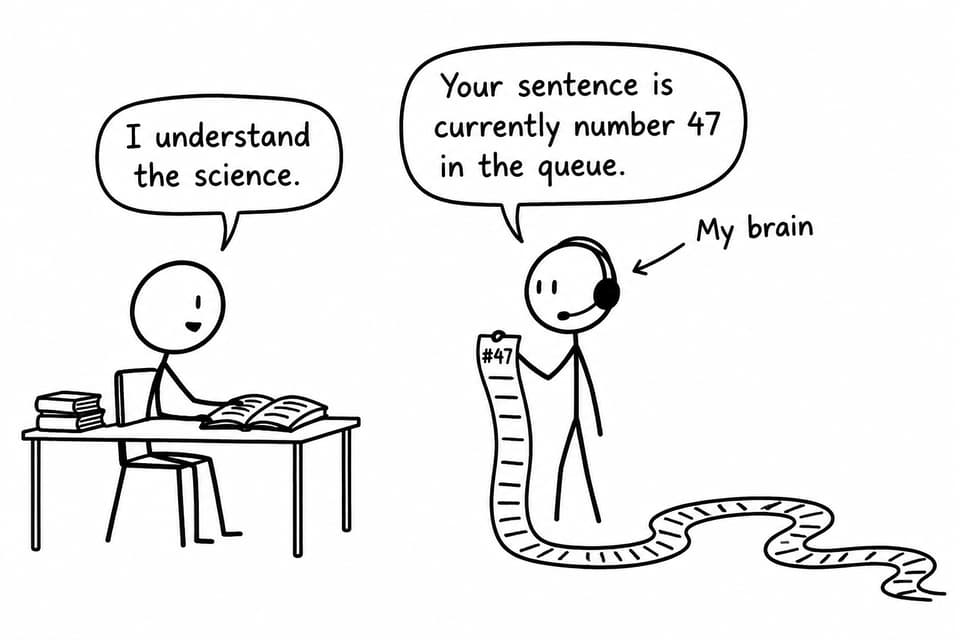
Studying the IB in a second language creates an unusual challenge. You may understand photosynthesis, market failure, or historical causation perfectly, yet need extra time to turn that understanding into the precise language an assessment demands.
The answer is not to relearn an entire language before you begin IB DP1. It is to build academic fluency alongside subject knowledge. Review the foundations you need, learn the language patterns used in each subject, and practise producing answers under realistic conditions.
This matters especially during the transition from MYP to DP. DP courses reward increasingly precise explanation, analysis, evidence, and evaluation. For multilingual students, the difficulty often comes from handling the concept and the language at the same time.
That can feel slow at first. Slow does not mean incapable. It usually means your brain is doing more work per sentence.
Your DP1 second-language checklist
Use this checklist during your first weeks:
- Identify missing knowledge from your previous curriculum.
- Create a vocabulary system for each subject.
- Learn what common command terms require.
- Read short sections actively rather than rereading whole chapters.
- Practise writing before you feel completely fluent.
- Review errors by category, not just by total score.
- Ask teachers which language mistakes affect meaning or assessment.
- Build speed gradually through short timed tasks.
Do not attempt to fix everything at once. Choose one subject, one topic, and one communication skill. Improvement becomes manageable when it has a name.
Understand what changes from MYP to DP
The MYP develops inquiry, conceptual understanding, communication, and reflection. Those habits remain valuable. The change is that DP subjects generally demand greater depth, more course-specific terminology, and sustained performance across a two-year programme.
Students coming directly from MYP should not assume they are starting again. Your experience interpreting criteria, completing independent work, and responding to command terms provides a foundation. The challenge is extending it. This comparison of MYP and DP explains the broader structural differences, while the guide to what surprises students moving from MYP to DP can help you anticipate changes in workload and depth.
If you did not study the MYP, you are not automatically behind. You simply need to make the hidden expectations visible. Ask for the subject guide, assessment criteria, current course outline, and examples supplied by your teacher. Then compare those expectations with what you previously studied.
A useful MYP to DP review has three layers:
| Review layer | What to check |
|---|---|
| Subject foundations | Definitions, formulas, processes, chronology, texts, and core concepts |
| Academic language | Command terms, technical vocabulary, linking phrases, and evidence language |
| Assessment habits | Planning, showing working, structuring extended responses, and checking answers |
This prevents a common mistake: spending weeks reviewing familiar content while ignoring the language needed to demonstrate it.
Review prior knowledge strategically
At the beginning of IB DP1, make a topic map for every subject. Place each topic into one of three categories: secure, partly familiar, or new. Be honest, but do not overdiagnose yourself. Forgetting the English word for a concept is different from not understanding the concept.
For each partly familiar topic, test four things:
- Can I define the central idea in simple language?
- Can I recognize and use the technical terms?
- Can I explain a relationship, process, or argument?
- Can I answer a short assessment-style question without translation software?
If the first answer is yes but the others are no, you probably have a language-production gap rather than a conceptual gap. Begin with RevisionDojo Study Notes and Flashcards to reconnect familiar ideas with DP terminology. Study Notes can clarify the topic structure, while Flashcards are useful for definitions, formulas, examples, and recurring phrases.
If the concept itself is weak, return to the prerequisite lesson before memorizing vocabulary. Language cannot stabilize an idea you do not yet understand.
Build vocabulary that helps you answer questions
Long vocabulary lists often create the feeling of studying without improving performance. Instead, build a working vocabulary bank for each subject.
Give every entry four parts:
- The technical term.
- A definition in clear English.
- The equivalent term in your strongest language, if useful.
- A complete sentence showing how the term functions in an answer.
For example, knowing that correlation means a relationship between variables is useful. Knowing how to write “The data indicate a negative correlation, but this does not establish causation” is more useful because the term is attached to reasoning.
Organize language by purpose as well as topic. Keep groups for introducing evidence, comparing interpretations, describing trends, acknowledging limitations, and reaching conclusions. This helps you retrieve a phrase because you know what job it must perform.
Translation can support early understanding, but make your final recall practice monolingual. In an assessment, you want the English term connected directly to the concept rather than routed through another language every time.
Treat command terms as instructions
A student can know the content and still lose marks by performing the wrong intellectual task. Identify, explain, compare, discuss, and evaluate are not decorative verbs. They indicate the kind of response required.
Start by reviewing IB and MYP command term meanings, then confirm how your DP subject uses them with your teacher and course materials. Expectations can vary by context, mark allocation, and subject.
Create a response pattern for recurring terms:
- Identify: provide the requested name, feature, or fact directly.
- Explain: state the point and show how or why it occurs.
- Compare: address relevant similarities and differences using both items.
- Discuss: consider a range of arguments, evidence, or perspectives.
- Evaluate: judge strengths, limitations, or significance using clear criteria.
Do not memorize these as rigid universal formulas. Use them as starting cues. Before answering, circle the command term, underline the topic, and note any limiting words such as one, two, economic, or short-term.
Practise output earlier than feels comfortable
Multilingual students sometimes postpone writing because they want their English to improve first. Unfortunately, academic writing improves through production and correction, not preparation alone.
Use a short practice cycle:
- Review one small topic for 15-20 minutes.
- Close your notes.
- Answer one relevant question.
- Compare the response with the guidance or marking criteria.
- Rewrite only the weakest section.
- Record one content error and one language improvement.
The RevisionDojo Questionbank guide shows how to filter practice by topic and use mistakes productively. Begin untimed. Once your structure becomes reliable, introduce a gentle time limit and reduce it gradually.
RevisionDojo’s AI Chat can help unpack an unfamiliar explanation, while Grading tools can highlight where an answer lacks precision or development. Use feedback as a second opinion, not as a substitute for your teacher or official course requirements. If a suggested correction changes the subject meaning, verify it before adopting it.
Separate language mistakes from knowledge mistakes
A low-scoring answer can hide several different problems. Treating all of them as “bad English” makes improvement harder.
After each task, label errors:
- Knowledge: the fact, method, or concept was incorrect.
- Interpretation: the question or command term was misunderstood.
- Structure: relevant knowledge was present but poorly organized.
- Vocabulary: the chosen word was inaccurate or too vague.
- Grammar: the sentence obscured the intended meaning.
- Timing: the response was incomplete because you ran out of time.
Then fix the most expensive pattern first. If your grammar is imperfect but your reasoning remains clear, vocabulary refinement may matter less than learning to evaluate evidence. If sentences repeatedly hide the logic, work on shorter sentence structures before attempting sophisticated phrasing.
RevisionDojo Tutors can offer human guidance when you cannot identify the pattern yourself. The Coursework Library can also help you observe how sustained academic work is organized, but examples should be studied for structure and decision-making, never copied.
Create a weekly DP1 routine
Consistency is more valuable than occasional heroic sessions. A practical weekly routine might include:
- Two short vocabulary reviews for each demanding subject.
- One focused Study Notes session.
- Two Questionbank responses on recently taught material.
- One rewritten answer based on feedback.
- One conversation with a teacher, classmate, Tutor, or AI Chat about a difficult concept.
- A 10-minute review of your error log.
Later in DP1, Predicted Papers and Mock Exams can help you combine topics and build endurance. Introduce them after you have enough syllabus coverage to make the attempt meaningful. Early on, targeted questions usually reveal more than a full assessment completed mostly through guessing.
Protect exposure outside formal study too. Read subject articles, listen to short explanations, and summarize lessons aloud. You do not need to sound elegant. You need to retrieve accurate ideas without relying constantly on translation.
Progress is clearer when you measure the right thing
Studying the IB in another language can make improvement difficult to notice. Your grade may remain stable while your reading becomes faster, your answers become more direct, or you need fewer translations. Those are meaningful changes.
Track small indicators each month: unfamiliar terms per page, planning time, questions completed, repeated error types, and how confidently you can explain a topic aloud. Grades matter, but they are delayed signals. Habits and error patterns show you what is changing now.
RevisionDojo brings Questionbank practice, Study Notes, Flashcards, AI Chat, Grading tools, Predicted Papers, Mock Exams, a Coursework Library, and Tutors into one learning system. That makes it easier to move from understanding a concept to expressing it under DP conditions.
A useful first step is small: choose the subject that currently feels hardest and try 10 free questions in the subject Questionbank. Do them without pressure. Your errors will show whether you need to review the idea, the academic language, or the way the question is asking you to think.